

Gene Expression: Definition, How It Works, Regulation, and Uses
Definition: Gene expression is the process by which a cell turns the information in a gene into a functional product, such as an RNA molecule or a protein.
In simple terms: gene expression is how a cell reads a gene and uses its instructions to make something that works inside the cell.
What Is Gene Expression?
A gene is a stretch of DNA that holds the instructions for making a particular product. On its own, that sequence does nothing; it is a set of instructions written in a chemical alphabet. Gene expression is the readout of those instructions. For most genes the product is a protein, and the process moves information from DNA to RNA to protein. This directional flow of genetic information is the central organizing principle of molecular biology, often called the central dogma.
The scale of the process is easy to underestimate. A human cell contains roughly 20,000 protein-coding genes, but no cell expresses all of them at once. A typical mammalian cell expresses thousands of genes at any given time, and the specific set differs sharply between cell types. A neuron and a skin cell carry an identical genome yet look and behave nothing alike, because each switches on a different combination of genes. Gene expression, not gene content, is what gives a cell its identity, and changes in expression underlie development, adaptation, and much of disease.
At a glance:
- Core idea: turning the instructions in a gene into a working molecule
- Main steps (protein-coding genes): transcription → RNA processing → translation → folding
- Key intermediate: messenger RNA carries the message from DNA to the ribosome
- Not always protein: tRNA, rRNA, and microRNA are functional RNA end products
- Tightly controlled: regulated at DNA, RNA, and protein levels
- Read out by: RNA sequencing, qPCR, single-cell methods, proteomics
It is also important that not every gene makes a protein. Genes for transfer RNA, ribosomal RNA, microRNA, and other non-coding RNAs are transcribed but never translated; for them the RNA molecule itself is the functional output. These genes are still expressed in the full sense of the word. Throughout this article, "expression" refers to the production of a gene's functional product, whether that product is a protein or an RNA.
Gene Expression, Transcription, Translation, and Regulation
These terms are closely related but not interchangeable. Gene expression is the broad process; transcription and translation are major steps within it, and gene regulation is the control system that determines when and how strongly expression occurs.
| Term | Meaning |
|---|---|
| Gene expression | Production of a functional RNA or protein from a gene |
| Transcription | Copying DNA information into RNA |
| Translation | Using messenger RNA to build a protein |
| Gene regulation | Control of when, where, and how strongly genes are expressed |
How Does Gene Expression Work?
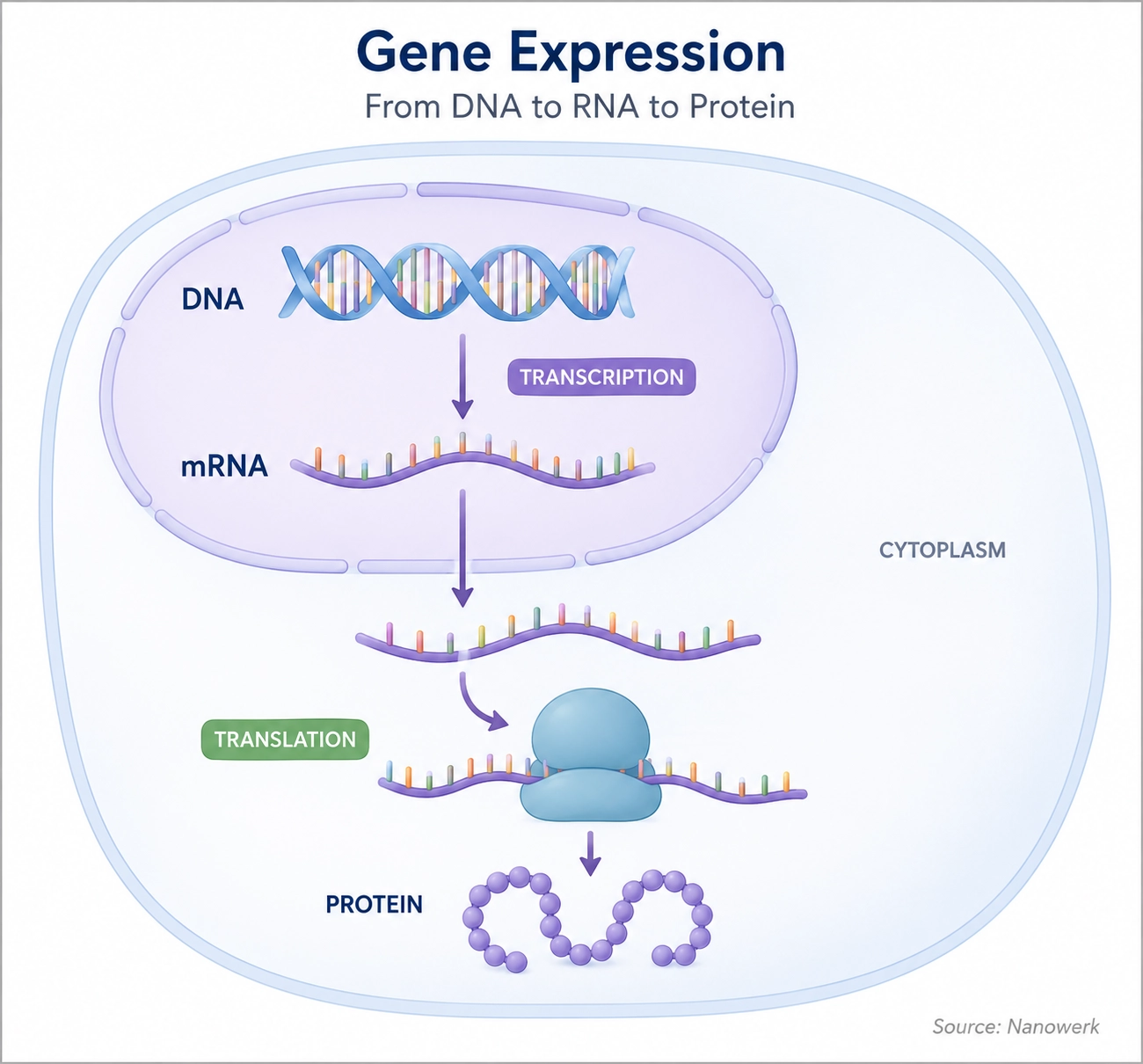
For a protein-coding gene, expression proceeds in two principal stages: transcription and translation. In transcription, the enzyme RNA polymerase binds near the start of a gene, unwinds the DNA double helix, and reads one strand as a template to build a complementary RNA copy. The result is an RNA copy corresponding to the gene sequence. Transcription is selective: only genes a cell currently needs are copied, and the rate at which a gene is transcribed largely sets how much of its product the cell makes.
In eukaryotic cells the new transcript is not yet usable. Before it leaves the nucleus it is processed: a protective cap is added to one end, a string of adenine nucleotides called a poly(A) tail is added to the other, and non-coding internal segments called introns are spliced out while the coding segments, the exons, are joined together. Through alternative splicing, cells can combine exons in different ways. As a result, a single gene can yield several distinct messenger RNA variants and therefore several related proteins. This processing step is itself a major point of control over what is ultimately expressed.
The mature messenger RNA is then exported to the cytoplasm and translated. A ribosome moves along the messenger RNA reading it three nucleotides at a time. Each triplet, called a codon, specifies one amino acid according to the nearly universal genetic code. Transfer RNA molecules deliver the matching amino acids, which the ribosome links into a growing chain. When the chain is complete it folds into a three-dimensional shape, and only the correctly folded protein is functional. This is protein synthesis, the endpoint of expression for most genes.
Bacteria run a streamlined version of the same logic. With no nucleus to separate the steps, transcription and translation occur together in the cytoplasm, and ribosomes can begin reading a messenger RNA while it is still being made. There is little or no splicing, and a single messenger RNA often carries several protein-coding sequences that are translated from the same transcript. These differences matter in practice: they are part of why bacteria such as E. coli are convenient hosts for producing proteins, while many human proteins require a eukaryotic host to be processed and folded correctly.
Regulation of Gene Expression
Expression is not a switch that is simply on or off. Cells continuously tune how much of each gene product they make, and this gene regulation is what allows one genome to build hundreds of cell types and respond to a changing environment. Control is exerted at every stage, but the most important and best-understood point is the initiation of transcription, which determines whether a gene is read at all.
Transcription is governed largely by regulatory proteins called transcription factors, which bind specific short DNA sequences and either recruit or block the transcription machinery. Some bind close to a gene's start site; others act from distant DNA elements called enhancers that loop into contact with their target genes and can raise expression dramatically. The combination of transcription factors present in a cell, rather than any single one, defines its expression program, which is why a small set of master factors can reprogram one cell type into another.
Access to the DNA is itself regulated. Genomic DNA is wound around proteins into chromatin, and a gene must be in an open, accessible state before it can be transcribed. Chemical marks placed on DNA and on the packaging proteins – the domain of epigenetics – tighten or loosen this packaging without changing the underlying sequence. DNA methylation of gene promoters, for instance, is typically associated with silencing. The full set of such marks across a genome is the epigenome, and it can carry expression states from one cell generation to the next.
Control continues after transcription. The stability of a messenger RNA, how efficiently it is translated, and how quickly the resulting protein is degraded all shape the final amount of product. Small regulatory RNAs add another layer: through RNA interference, microRNAs and related molecules bind target messenger RNAs and reduce their translation or trigger their destruction. Because of these post-transcriptional layers, the amount of messenger RNA for a gene does not always predict the amount of protein, a recurring theme in modern expression studies.
How Is Gene Expression Measured?
Because expression is dynamic and cell-specific, measuring it is central to biology and medicine. Most methods quantify messenger RNA as a proxy for how active a gene is. RNA sequencing reads and counts the RNA molecules in a sample, giving a genome-wide snapshot of which genes are on and how strongly; quantitative PCR measures a small number of chosen transcripts with high precision. The complete set of RNA transcripts in a sample is its transcriptome, and the study of these patterns at scale is transcriptomics.
Bulk methods average over many cells and can hide important differences between them. Single-cell sequencing measures expression in thousands of individual cells at once, revealing cell types and states that bulk averages obscure, and spatial genomics adds the location of each measurement within a tissue. These approaches have reshaped how researchers map development and disease, though they bring substantial computational demands for turning raw counts into reliable biological conclusions. The table below summarizes how the main approaches differ.
| Method | What it measures | Resolution | Typical use |
|---|---|---|---|
| Quantitative PCR (qPCR) | A few selected mRNAs | Bulk sample | Precise validation of specific genes |
| Bulk RNA sequencing | Genome-wide RNA abundance | Bulk sample | Genome-wide expression profiling |
| Single-cell RNA sequencing | Transcript abundance in individual cells | Individual cells | Cell-type discovery, heterogeneity |
| Spatial transcriptomics | Transcript abundance with tissue location | Cells in context | Mapping expression within tissues |
| Mass spectrometry proteomics | Protein abundance | Mostly bulk sample; increasingly single-cell | Measuring the final functional output |
The non-obvious point is that RNA is a proxy, not the endpoint. Because translation and protein turnover are independently regulated, transcript levels and protein levels can diverge, sometimes substantially. Protein-level techniques – mass spectrometry-based proteomics, and antibody-based assays for individual proteins – measure the molecules that actually do the work in the cell. A complete picture of expression often requires reading both the RNA and the protein layers and recognizing where they disagree. Reporter genes, in which an easily detected protein is placed under a gene's control elements, offer a complementary way to watch expression unfold in living cells.
Gene Expression in Disease
Many diseases are, at their core, disorders of gene expression rather than of gene content. The DNA sequence may be intact while the pattern of which genes are active is badly miscalibrated. Cancer is the clearest example: genes that drive cell division can become abnormally overexpressed, while genes that restrain growth can be silenced by mutation, deletion, or epigenetic changes such as aberrant DNA methylation. Mapping these altered expression programs has become a standard part of characterizing tumors and choosing treatments.
Misregulation also drives developmental, neurological, and immune disorders. Mutations in regulatory DNA or in transcription factors can switch genes on in the wrong place or at the wrong time, and defects in RNA processing – including abnormal splicing and altered messenger RNA stability – are linked to conditions ranging from muscular and neurological diseases to cancer. Because expression signatures differ between healthy and diseased states, they also serve as diagnostic and prognostic tools; a measured expression pattern can act as a biomarker that guides clinical decisions.
Gene Expression in Biotechnology
The ability to control expression deliberately underpins much of modern biotechnology. To manufacture a therapeutic protein such as insulin or a monoclonal antibody, the gene encoding it is placed in an expression system – an engineered bacterial, yeast, insect, or mammalian cell – together with regulatory sequences that drive high output. The host cell then expresses the gene as instructed, producing recombinant proteins at scale. Choosing the right host matters because, as noted earlier, bacterial and eukaryotic cells process and fold proteins differently.
Beyond protein production, controlling expression is itself a goal. Gene therapy works by adding genes, modifying genetic instructions, or changing gene expression in a patient's cells, and tools derived from CRISPR-Cas9 can be configured not only to edit DNA but to activate or silence specific genes without altering the sequence. Synthetic biology goes further, building artificial regulatory circuits that turn genes on and off in response to defined signals. Across these fields, gene expression is treated less as a fixed property and more as a programmable layer of the cell.
Frequently Asked Questions
What is the difference between gene expression and transcription? Transcription is one step within gene expression. Gene expression is the entire process by which the information in a gene is used to make a functional product, and for protein-coding genes this includes transcription, RNA processing, translation, and protein folding. Transcription specifically refers to copying a gene's DNA sequence into a complementary RNA molecule, which is the first step of that larger process.
Do all cells in the body express the same genes? No. Almost every cell in a multicellular organism carries the same genome, but each cell type expresses a distinct subset of genes. A neuron and a liver cell share the same DNA yet switch on different genes, and this selective expression is what gives each cell type its identity and specialized function.
Can a gene be expressed without making a protein? Yes. Many genes are transcribed into functional RNA molecules that are never translated into protein, including transfer RNA, ribosomal RNA, microRNA, and long non-coding RNA. For these genes, the RNA itself is the final product, so the gene is expressed even though no protein is made.
Is gene expression the same as protein synthesis? No. Protein synthesis is the translation and folding part of expression for protein-coding genes. Gene expression is broader: it includes transcription and RNA processing, and for some genes it ends with a functional RNA rather than a protein.
What does it mean when a gene is upregulated or downregulated? Upregulation means a cell increases the expression of a gene, producing more of its RNA or protein, while downregulation means expression is reduced. These terms describe quantitative changes in output rather than a simple on or off state, and they are how cells adjust their molecular makeup in response to signals, stress, or development.
Can gene expression change without changing the DNA sequence? Yes, and this is normal and constant. Cells continually adjust expression in response to signals, development, and environment without altering their DNA. Epigenetic mechanisms such as DNA methylation and chemical modification of chromatin packaging can switch genes on or off and can even pass an expression state to daughter cells, all while the underlying genetic sequence stays the same.
What causes gene expression to go wrong in disease? Gene expression can be disrupted by mutations in regulatory DNA, by changes in transcription factors or chromatin-modifying enzymes, and by epigenetic alterations such as abnormal DNA methylation. In cancer, for example, genes that drive cell growth can become abnormally active while genes that restrain it are silenced by mutation, deletion, or epigenetic change.
Further Reading
WIREs RNA, Post-Transcriptional Regulation of Gene Expression and the Intricate Life of Eukaryotic mRNAs
Nature Reviews Genetics, mRNAs, Proteins and the Emerging Principles of Gene Expression Control
Annual Review of Genomics and Human Genetics, Transcriptional Regulation by (Super)Enhancers: From Discovery to Mechanisms
Nature Reviews Genetics, Best Practices for Single-Cell Analysis Across Modalities
Nature Reviews Genetics, Regulation of Gene Expression by Alternative Polyadenylation in Health and Disease
