

Nanotechnology News – Latest Headlines
New imaging techniques reveal the workings of nature's supramolecular nanomachines
Researchers at the SPring-8 Photon Science Research Division are developing a range of imaging tools to reveal the remarkable mechanism of bacterial locomotion.
July 23, 2011 Read more
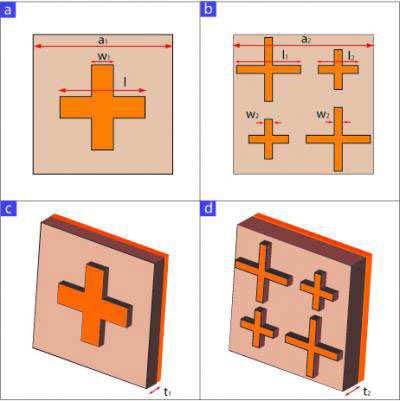
Shining a light on the elusive 'blackbody' of energy research
A designer metamaterial has shown it can engineer emitted "blackbody" radiation with an efficiency beyond the natural limits imposed by the material's temperature.
July 23, 2011 Read more
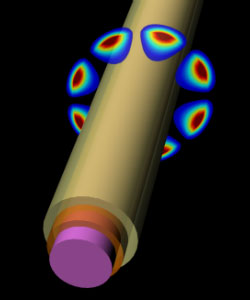
Nanoplasmonic 'whispering gallery' breaks emission time record in semiconductors
Renaissance architects demonstrated their understanding of geometry and physics when they built whispering galleries into their cathedrals. These circular chambers were designed to amplify and direct sound waves so that, when standing in the right spot, a whisper could be heard from across the room. Now, scientists at the University of Pennsylvania have applied the same principle on the nanoscale to drastically reduce emission lifetime, a key property of semiconductors, which can lead to the development of new ultrafast photonic devices.
July 22, 2011 Read more
Synthetic synapse mimics dynamic memory in human brain
Researchers from UCLA and Japan have designed a synthetic synapse for use in computing equipment that mimics the function of synapses in the human brain.
July 22, 2011 Read more
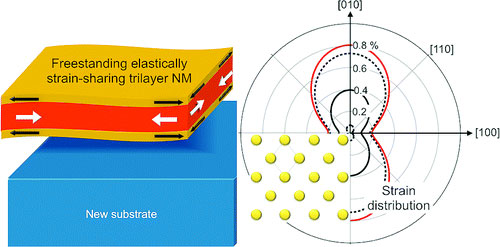
Nanomembranes promise new materials for advanced electronics
University of Wisconsin-Madison materials science and engineering researchers have introduced innovations that could make possible a wide range of new crystalline materials. They describe a new approach for using thin sheets of semiconductor known as nanomembranes.
July 22, 2011 Read more
Commercialization of Micro-Nano Systems Conference (COMS) August 28-31
The annual Commercialization of Micro-Nano Systems Conference (COMS 2011) being held Aug 28-31 in Greensboro, is again shaping up to be a who's who of the micro-nano technology (MNT) community, bringing together leaders in North Carolina with those from around the globe.
July 21, 2011 Read more
Food safety could benefit from modified metals that change color
Modified metals that change colour in the presence of particular gases could warn consumers if packaged food has been exposed to air or if there's a carbon monoxide leak at home. This finding could potentially influence the production of both industrial and commercial air quality sensors.
July 21, 2011 Read more
Chemists create molecular 'flasks'
Researchers design a self-assembling material that can house other molecules.
July 21, 2011 Read more
Nanotechnology for water filtration
Among many potential applications, carbon nanotubes are great candidate materials for cleaning polluted water. Many water pollutants have very high affinity for carbon nanotubes and pollutants could be removed from contaminated water by filters made of this nanomaterial, for example water soluble drugs which can hardly be separated from water by activated carbon.
July 21, 2011 Read more
National Nanotechnology Initiative releases 4 workshop reports from the nanoEHS Series
Reports detail information used to craft the updated EHS research strategy.
July 21, 2011 Read more
Advanced super-resolution microscope enables to see innermost workings of the cell
Stephanie Meyer, a physicist specializing in optics, is bringing new capabilities to the University of Colorado Denver Anschutz Medical Campus by building an advanced, super resolution microscope able to see some of the innermost workings of the cell.
July 21, 2011 Read more

New discovery paves the way for using super strong nanostructured metals in cars
Super strong nanometals are beginning to play an important role in making cars even lighter, enabling them to stand collisions without fatal consequences for the passengers. A PhD student at Riso DTU has discovered a new phenomenon that will make nanometals more useful in practice.
July 21, 2011 Read more
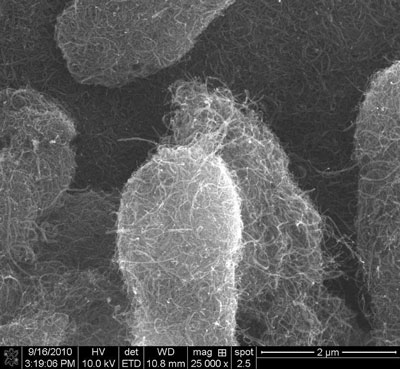
Wasserfilter mit Nanotechnologie
Neben vielen anderen Anwendungsmoeglichkeiten koennen Nanoroehren zur Reinigung von kontaminiertem Wasser eingesetzt werden. Viele wasserverunreinigende Stoffe haben eine hohe Affinitaet fuer Kohlenstoffnanoroehren. Deshalb koennen Schadstoffe aus kontaminiertem Wasser entfernt werden, indem sie durch dieses Material gefiltert werden.
July 21, 2011 Read more
Research outlines math framework that could help convert 'junk' energy into useful power
A University at Buffalo-led research team has developed a mathematical framework that could one day form the basis of technologies that turn road vibrations, airport runway noise and other "junk" energy into useful power. The concept all begins with a granular system comprising a chain of equal-sized particles -- spheres, for instance -- that touch one another.
July 20, 2011 Read more

Researchers create the first artificial neural network out of DNA (w/video)
Molecular soup exhibits brainlike behavior.
July 20, 2011 Read more
Scientists take the next major step toward quantum computing
Using high-magnetic fields, Susumu Takahashi, assistant professor at the University of Southern California, and his colleagues managed to suppress decoherence, one of the key stumbling blocks in quantum computing.
July 20, 2011 Read more
 Subscribe to our Nanotechnology News feed