

Nanotechnology News – Latest Headlines
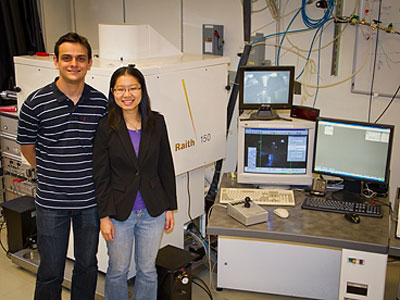
The future of chip manufacturing
MIT researchers show how to make e-beam lithography, commonly used to prototype computer chips, more practical as a mass-production technique.
June 30, 2011 Read more
COIN hosts Risk vs. Reward: Financing early-stage, emerging technologies
This Roundtable will address a significant hurdle to nanobiotechnology development and commercialization - early-stage funding.
June 30, 2011 Read more
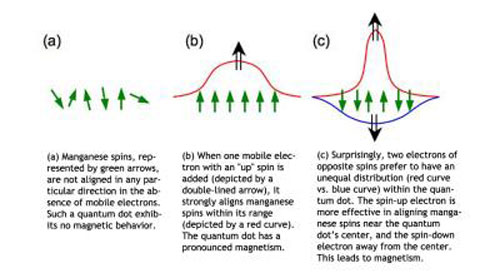
At the nanoscale, tug-of-war between electrons can lead to magnetism
Physicists have proposed that it would be possible to create a quantum dot that is magnetic under surprising circumstances.
June 29, 2011 Read more
Researchers solve problem filling space - without cubes
Whether packing oranges into a crate, fitting molecules into a human cell or getting data onto a compact disc, wasted space is usually not a good thing. Now, Princeton University chemist Salvatore Torquato and colleagues have solved a conundrum that has baffled mathematical minds since ancient times - how to fill three-dimensional space with multi-sided objects other than cubes without having any gaps.
June 29, 2011 Read more
Scientists shed light on the private lives of electrons
Lasers allow scientists to observe how electrons become entangled.
June 29, 2011 Read more
Nano-titanium-dioxide: challenges for human health risk assessment
Available evidence on exposure and hazard based on a open literature review.
June 29, 2011 Read more
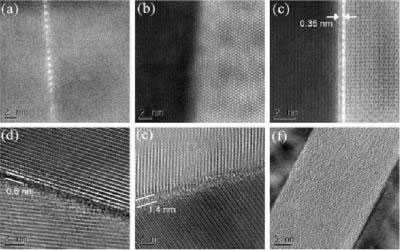
Lehigh University leads Department of Defense MURI grant for atomic-scale interphase research
For the next five years, Martin Harmer, director of Lehigh's Center for Advanced Materials and Nanotechnology, will lead a team of scientists from Lehigh, Carnegie-Mellon, Clemson, Illinois and Kutztown universities to determine how the atomic structure of grain-boundary interphases - interphase complexions - affect the mechanical, electrical and thermal properties of a wide range of strategic engineering materials.
June 29, 2011 Read more
ACS Podcast: Tiny generator powers wireless device
Imagine a new genre of tiny implantable sensors, airborne and stationary surveillance cameras and sensors and other devices that operate without batteries on energy collected from the motion of a heart beat and have wireless communications capability. And the power plant for those devices is a "nanogenerator" that could even produce energy to charge an iPod from the movements of a person walking down the street.
June 29, 2011 Read more
Moving microscopic vision into another new dimension
Scientists who pioneered a revolutionary 3-D microscope technique are now describing an extension of that technology into a new dimension that promises sweeping applications in medicine, biological research, and development of new electronic devices. Their reports on so-called 4-D scanning ultrafast electron microscopy, and a related technique, appear in two papers.
June 29, 2011 Read more
Gold microflowers to enhance signals from molecules
Researchers have to place objects under study on suitable substrates to obtain a strong enhancement of electromagnetic radiation emitted by single molecules. A simple and cheap method to fabricate substrates for SERS spectroscopy has been discovered at the Institute of Physical Chemistry of the Polish Academy of Sciences. A key role in substrate fabrication play spherical gold aggregates - flower-like micrometer-sized spheres.
June 29, 2011 Read more
Leading research organisations announce top-tier, open access journal for biomedical and life sciences
The Howard Hughes Medical Institute, the Max Planck Society and the Wellcome Trust announced today that they are to support a new, top-tier, open access journal for biomedical and life sciences research.
June 29, 2011 Read more

Schools play with nanotechnology
Pupils aged 12-14 years old from Kingham-Hill School, Marlborough School, The Oxford Academy, and Oxford High School, took part in the event where they got to learn about the basic science behind applications of nanotechnologies and investigate the properties of nanoscale materials.
June 29, 2011 Read more

Completely miscible nanocomposites - A breakthrough on its way to new types of functional materials
A research group at the University of Bayreuth has developed a process which opens an avenue for the production of new, completely miscible nanocomposites. These materials represent an extremely varied potential for technological innovations.
June 29, 2011 Read more
Metal nanoparticle generates new hope for hydrogen energy
Tiny metallic particles produced by University of Adelaide chemistry researchers are bringing new hope for the production of cheap, efficient and clean hydrogen energy. The researchers are exploring how the metal nanoparticles act as highly efficient catalysts in using solar radiation to split water into hydrogen and oxygen.
June 29, 2011 Read more
Beyond Darwin: Evolving new functions
A recent Kavli Futures Symposium focused on the progress, and promise, of evolving biological functions in the lab. Now, 3 Symposium participants discuss this remarkable research, and how it's drawing together diverse scientific fields.
June 28, 2011 Read more
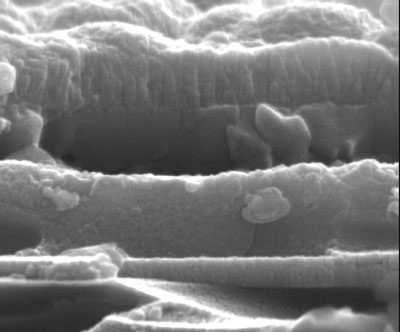
Inkjet printing could change the face of solar energy industry
Engineers at Oregon State University have discovered a way for the first time to create successful "CIGS" solar devices with inkjet printing, in work that reduces raw material waste by 90 percent and will significantly lower the cost of producing solar energy cells with some very promising compounds.
June 28, 2011 Read more
 Subscribe to our Nanotechnology News feed