

Nanotechnology News – Latest Headlines
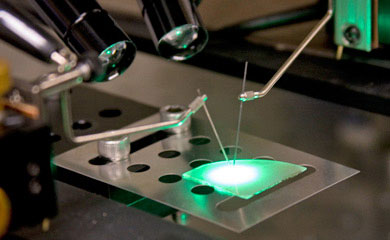
Zeroing in on the elusive green LED
Researchers at Rensselaer Polytechnic Institute have developed a new method for manufacturing green-colored LEDs with greatly enhanced light output.
April 25, 2011 Read more
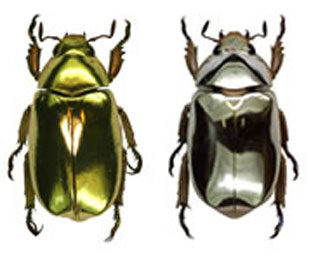
Beetle bling - researchers discover optical secrets of 'metallic' beetles
A team of researchers at the University of Costa Rica has found that some beetles' metallic appearance is created by the unique structural arrangements of many dozens of layers of exo-skeletal chitin in the elytron, a hardened forewing that protects the delicate hindwings that are folded underneath.
April 25, 2011 Read more
Electron ping pong in the nano-world
An international team of researchers succeeded at the Max Planck Institute of Quantum Optics to control and monitor strongly accelerated electrons from nano-spheres with extremely short and intense laser pulses.
April 25, 2011 Read more
Molecular movements of neural transporters unveiled
A team of scientists from Columbia University College of Physicians and Surgeons and Weill Cornell Medical College has shed light on the molecular workings of transporter proteins, molecular machines embedded in the cell membranes of neurons that modulate the transfer of signals between cells and recycle neurotransmitters.
April 25, 2011 Read more
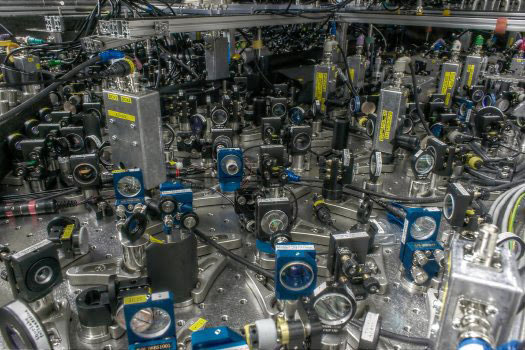
First-ever teleportation of a particular complex set of quantum information
Researchers have achieved a breakthrough in quantum communications and computing using a teleporter and a paradoxical cat. The breakthrough is the first-ever transfer, or teleportation, of a particular complex set of quantum information from one point to another, opening the way for high-speed, high-fidelity transmission of large volumes of information, such as quantum encryption keys, via quantum communications networks.
April 25, 2011 Read more

Quantum breakthrough - Scientists demonstrate for the first time that atoms can be guided in a laser beam
Scientists have demonstrated for the first time that atoms can be guided in a laser beam and possess the same properties as light guided in an optical communications fibre.
April 25, 2011 Read more

Solar power goes viral (literally!)
MIT researchers use genetically modified virus to produce structures that improve solar-cell efficiency by nearly one-third.
April 25, 2011 Read more
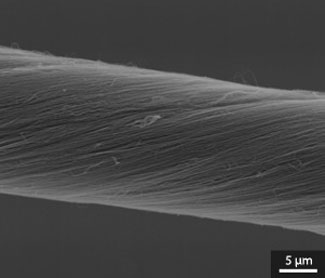
Carbon nanotube fibers containing photosensitive dyes could be applied as wearable solar cells
Bundles of carbon nanotubes have very high surface area, which makes them of potentially great benefit for use in solar cells. Researchers from Fudan University in China have now devised a method to fabricate flexible and weavable solar cells using long fibers spun from CNTs.
April 25, 2011 Read more

The ultimate camo: Team to mimic camouflage skill of marine animals in high-tech materials
Camouflage expert Roger Hanlon of the Marine Biological Laboratory (MBL) is co-recipient of a $6 million grant from the Office of Naval Research to study and ultimately emulate the exquisite ability of some marine animals to instantly change their skin color and pattern to blend into their environment.
April 22, 2011 Read more
Shedding light on mystery of Raman signal enhancement (w/video)
The mystery behind a detection method that can sense the presence of individual molecules - useful for researchers analyzing artwork and anthrax alike - has been unraveled by scientists with the Lawrence Berkeley National Laboratory.
April 22, 2011 Read more
Optical microscope without lenses produces high-resolution 3-D images on a chip
UCLA researchers have redefined the concept of a microscope by removing the lens to create a system that is small enough to fit in the palm of a hand but powerful enough to create three-dimensional tomographic images of miniscule samples.
April 22, 2011 Read more
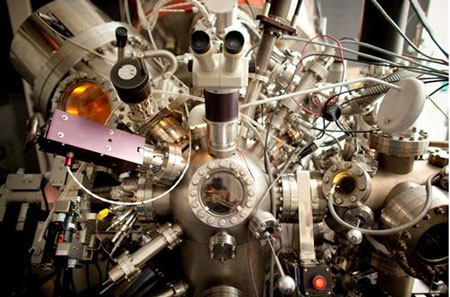
Playing pool with atoms
The scientist who developed the world's most sensitive spectrometer for identifying atoms on a material's surface came to Lehigh recently to give a talk at the only U.S. lab that is equipped with his cutting-edge instrument.
April 22, 2011 Read more
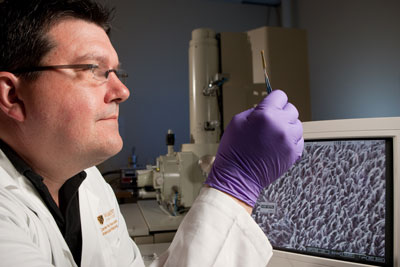
First polymer solar-thermal device heats home, saves money
A new polymer-based solar-thermal device is the first to generate power from both heat and visible sunlight - an advance that could shave the cost of heating a home by as much as 40 percent.
April 22, 2011 Read more
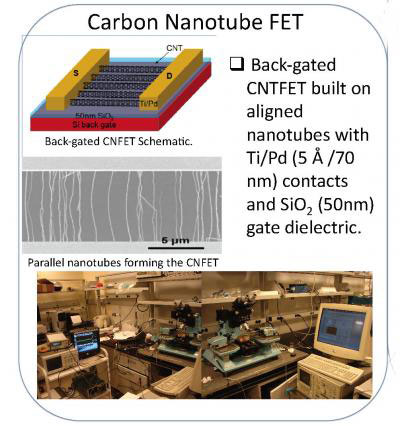
Researchers create functioning synapse using carbon nanotubes
Devices might be used in brain prostheses - or combined into massive network of synthetic neurons to create a synthetic brain
April 21, 2011 Read more
Say hello to cheaper hydrogen fuel cells
Los Alamos National Laboratory scientists have developed a way to avoid the use of expensive platinum in hydrogen fuel cells, the environmentally friendly devices that might replace current power sources in everything from personal data devices to automobiles.
April 21, 2011 Read more
Complex 3D-nano patterns with indentation lithography and piezo technology
A collaboration between the Whitesides Group at Harvard University and CSM Instruments has culminated in an important advance in lithography of different materials at the nanoscale. The motivation for this development was the ability to produce unique lithographical patterns of different shapes and sizes for use in research applications (e.g. lab-on-a-chip) where conventional techniques such as electron-beam lithography (EBL) and photolithography cannot be used.
April 21, 2011 Read more
 Subscribe to our Nanotechnology News feed