

Nanotechnology News – Latest Headlines
CNSE's Smart System Technology and Commercialization Center announces national nanosensing initiatives
STC selected by SPAWAR to build innovative sensor systems for U.S. military intelligence gathering, by EPRI to develop groundbreaking wireless sensor network to monitor efficiency of power generation.
February 23, 2011 Read more

Simpler way of making proteins could lead to new nanomedicine agents
Researchers have developed a simple method of making short protein chains with spiral structures that can also dissolve in water, two desirable traits not often found together. Such structures could have applications as building blocks for self-assembling nanostructures and as agents for drug and gene delivery.
February 23, 2011 Read more
Pittcon 2011 exposition includes exhibitors from 29 countries
The Pittcon 2011 Exposition, which takes place March 14 - 17, at the Georgia World Congress Center, Atlanta, Georgia, will include 978 exhibitors (count as of February 15) that provide products, services, and support for all facets of laboratory operations in the industrial, academic, and government sectors.
February 23, 2011 Read more

A sculpture you can't see: the chemistry behind the art
A University of Sydney professor is at the forefront of cutting edge work creating complex and beautiful molecular structures that, until recently, could only be made at a life-sized scale.
February 23, 2011 Read more
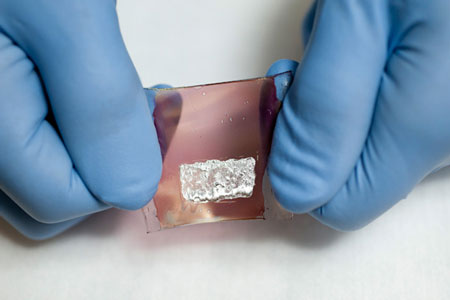
New stretchable solar cells will power artificial electronic 'super skin'
Ultrasensitive electronic skin developed by Stanford researcher Zhenan Bao is getting even better. Now she's demonstrated that it can detect chemicals and biological molecules, in addition to sensing an incredibly light touch. And it can now be powered by a new, stretchable solar cell she's developed in her lab, opening up more applications in clothing, robots, prosthetic limbs and more.
February 23, 2011 Read more
UK Nanotechnology SMEs take to Japan for business
The Institute of Nanotechnology (IoN) has just returned from a successful mission to Nanotech 2011 in Tokyo. Together with the Nanotechnology KTN, IoN took key UK SMEs to Japan last week as part of International NanoMicroClub (INMC) initiative.
February 23, 2011 Read more
Nanoparticles increase survival after blood loss
In an advance that could improve battlefield and trauma care, scientists at Albert Einstein College of Medicine of Yeshiva University have used tiny particles called nanoparticles to improve survival after life-threatening blood loss.
February 22, 2011 Read more
"Engineered" breast aims to improve nanoparticle testings
Researchers from Purdue University has reproduced portions of the female breast in a tiny slide-sized model dubbed "breast on-a-chip" that will be used to test nanoparticle-based approaches for the detection and treatment of breast cancer. The model mimics the branching mammary duct system, where most breast cancers begin, and will serve as an "engineered organ" to study the use of nanoparticles to detect and target tumor cells within the ducts.
February 22, 2011 Read more
Modified RNA creates stable therapeutic nanoparticles
By replacing a chemical group in the macromolecule, researchers have found a way to bypass RNase and create stable three-dimensional configurations of RNA, greatly expanding the possibilities for RNA in nanotechnology.
February 22, 2011 Read more
Early tests find nanoshell therapy effective against brain cancer
Rice University bioengineers and physician-scientists at Baylor College of Medicine and Texas Children's Hospital have successfully destroyed tumors of human brain cancer cells in the first animal tests of a minimally invasive treatment that zaps glioma tumors with heat. The tests involved nanoshells, light-activated nanoparticles that are designed to destroy tumors with heat and avoid the unwanted side effects of drug and radiation therapies.
February 22, 2011 Read more
Magnetic nanoparticles enable potential new approach for treating ovarian cancer
A paper published recently in the journal Nanomedicine could provide the foundation for a new ovarian cancer treatment option, one that would use an outside-the-body filtration device to remove a large portion of the free-floating cancer cells that often create secondary tumors.
February 22, 2011 Read more
Handheld nanoLAB suitable for in-home use detects disease proteins in minutes
Driven by scientific progress and economic stimulus, medical diagnostics will move to a stage in which straightforward medical diagnoses are independent of physician visits and large centralized laboratories. The future of basic diagnostic medicine will lie in the hands of private individuals. Researchers have taken significant strides towards achieving this goal by developing an autoassembly assay for disease biomarker detection which obviates the need for washing steps and is run on a handheld sensing platform.
February 22, 2011 Read more
Enabling nanoparticles to penetrate deeply in tumors
A large team of researchers from the Massachusetts Institute of Technology, Massachusetts General Hospital, and Harvard Medical School have developed multilayered, or multistage, nanoparticles that partially dissolve once they accumulate around tumors, leaving behind a payload of nanoparticles a mere one-tenth the size of the original delivery vehicle.
February 22, 2011 Read more
Reducing drug side effects with nanoparticles
Researchers at the Massachusetts Institute of Technology (MIT) and Brigham and Women's Hospital have shown that they can deliver the cancer drug cisplatin much more effectively and safely in a form that has been encapsulated in a nanoparticle targeted to prostate tumor cells.
February 22, 2011 Read more
A new way to design metal nanoparticle catalysts
Researchers at Northwestern University's Institute for Catalysis in Energy Processing have discovered a new strategy for fabricating metal nanoparticles in catalysts that promises to enhance the selectivity and yield for a wide range of structure-sensitive catalytic reactions.
February 22, 2011 Read more
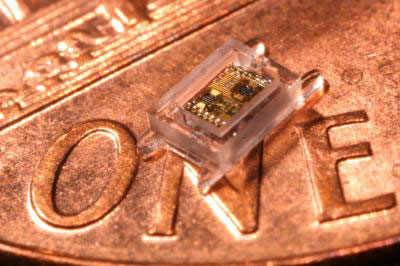
Toward computers that fit on a pen tip: New technologies usher in the millimeter-scale computing era
A prototype implantable eye pressure monitor for glaucoma patients is believed to contain the first complete millimeter-scale computing system. And a compact radio that needs no tuning to find the right frequency could be a key enabler to organizing millimeter-scale systems into wireless sensor networks. These networks could one day track pollution, monitor structural integrity, perform surveillance, or make virtually any object smart and trackable.
February 22, 2011 Read more
 Subscribe to our Nanotechnology News feed