

Nanotechnology News – Latest Headlines
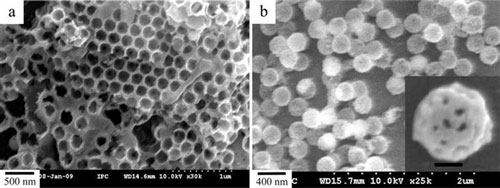
'Nano-raspberries' to fight foggy windows and eyeglasses
In an advance toward preventing car windshields and eyeglasses from fogging up, researchers in China are reporting development of a new way to make raspberry-shaped nanoparticles that can give glass a permanent antifogging coating.
May 20, 2009 Read more
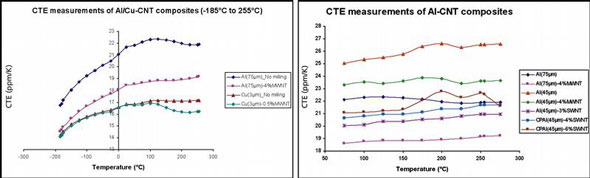
Carbon-Nanotubes senken den thermischen Ausdehnungskoeffizienten von Metallen
Die Senkung der thermischen Ausdehnungskoeffizienten von Metallen durch die Zugabe von Carbon-Nanotubes soll in Zukunft Abhilfe schaffen bei Ueberhitzungsschaeden.
May 20, 2009 Read more
A newly discovered nanocomposite as early warning system to monitor infrastructure
A newly discovered nanocomposite could vastly simplify and enhance the maintenance of large-scale infrastructure such as bridges and aircraft.
May 20, 2009 Read more
International research group seeking molecular key to halting HIV virus
Rice University's Andrew Barron and his group, working with labs in Italy, Germany and Greece, have identified specific molecules that could block the means by which the deadly virus spreads by taking away its ability to bind with other proteins.
May 20, 2009 Read more
Grant to develop a new class of solar-powered nanosensors for pollution monitoring
A $1.3 million State Government grant will help Queensland University of Technology create a new class of solar-powered nano-sensors capable of detecting pollution and monitoring the environment in remote areas.
May 20, 2009 Read more
DFG richtet neun weitere Sonderforschungsbereiche, auch zur Nanotechnologie, ein
Die Deutsche Forschungsgemeinschaft (DFG) richtet zum 1. Juli 2009 neun weitere Sonderforschungsbereiche (SFB) ein.
May 20, 2009 Read more
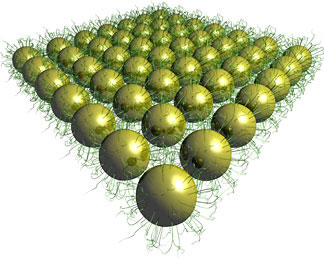
Metal sheets with DNA framework could enable future nanocircuits
Using DNA not as a genetic material but as a structural support, Cornell researchers have created thin sheets of gold nanoparticles held together by strands of DNA. The work could prove useful for making thin transistors or other electronic devices.
May 20, 2009 Read more
$1.5 million grant to explore how graphene can replace silicon in microchips
The U.S. Department of Defense announced May 8 that a Cornell team led by professor of electrical and computer engineering Michael Spencer will share a $1.5 million, five-year grant from the Air Force Office of Scientific Research to fabricate graphene, a one-atom thick layer of carbon, in large sheets suitable for use in microchips.
May 20, 2009 Read more
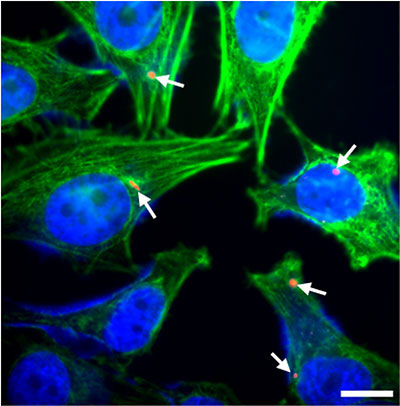
DNA molecules engineered to detect pathogens
Cornell researchers have created new DNA molecules that can detect pathogens and deliver drugs to cells when they form long chains called polymers.
May 20, 2009 Read more
'Electronic sonotweezers' could transform how small particles are moved
The way cells and biomolecules are moved from one position to another could be transformed thanks to a grant of 4 million pounds.
May 20, 2009 Read more
Researchers engineer nanoparticles for targeted delivery of chemotherapeutic drugs
An interdisciplinary team of researchers at Brigham and Women's Hospital and the Harvard-MIT Division of Health Sciences and Technology has demonstrated a better way to deliver cancer drugs directly to tumors by using specially engineered nanoparticles that can inhibit a signaling pathway and deliver a higher concentration of medication to the specific area.
May 20, 2009 Read more
Where to look for the nano-needle in the environmental haystack?
A seminar titled 'Nano and Environment: Where to look for the nano-needle in the environmental haystack?' today at the Institute for NanoBioTechnology at Johns Hopkins deals with the environmental impacts of nanomaterials.
May 20, 2009 Read more

New alloys offer alternative to chrome
Researchers have developed a new nickel-tungsten alloy that is not only safer than chrome but also more durable. The new coating, which is now being tested on the bumpers of a truck fleet, could also replace chrome in faucet fixtures and engine parts, among other applications.
May 19, 2009 Read more
Aerosol delivery of antibiotics via nanoparticles shows promise
Aerosol delivery of antibiotics via nanoparticles may provide a means to improve drug delivery and increase patient compliance, thus reducing the severity of individual illnesses, the spread of epidemics, and possibly even retarding antibiotic resistance.
May 19, 2009 Read more
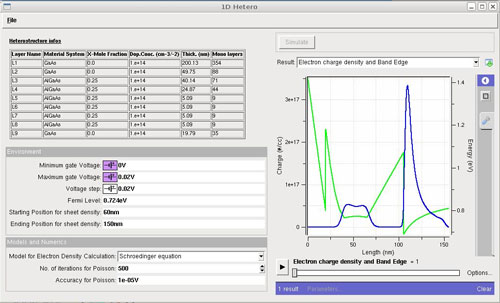
New tool for the simulation of heterostructures at the atomic scale
The 1D Heterostructure Tool is a program for the design and simulation of 1D heterostructures. It currently implements the effective mass bandstructure model and parameters for materials belonging to GaAs substrate such as GaP, InAs, AlGaAs etc.
May 19, 2009 Read more
GE Global Research to house a DOE EFRC Energy Frontier Research Center
The focus of GE's EFRC will be on advanced energy storage technologies and the pursuit of a zero carbon emissions solution for both transportation and stationary power applications.
May 19, 2009 Read more
 Subscribe to our Nanotechnology News feed