

Nanotechnology News – Latest Headlines
Getting wrapped up in solar textiles
MIT lecturer focuses on flexible photovoltaic materials.
June 9, 2008 Read more
Government of Canada highlights science and technology linkages with the Republic of Chile
Canada and Chile are exploring ways to extend science and technology cooperation.
June 9, 2008 Read more
Researchers use carbon nanotubes for molecular transport
Molecular transport across cellular membranes is essential to many of life's processes, for example electrical signaling in nerves, muscles and synapses. Researchers are now mimicking that process with manmade carbon nanotube membranes.
June 9, 2008 Read more
Nanotechnology worries push EU to seek full safety data for carbon
Companies selling carbon and graphite will be required to submit full health and safety data for the substances under the European Union's stringent new chemical safety laws, amid concerns that their nanotechnology forms may be dangerous to people, E.U. officials said Monday.
June 9, 2008 Read more

Health and the environment form focus of latest bio-nanotechnology seed grants
Risk assessment performed in tandem with research into beneficial applications will help researchers make better decisions about how nanotechnology is used in the future.
June 9, 2008 Read more
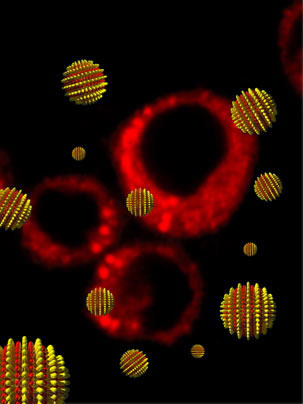
Stripes key to nanoparticle drug delivery
In work that could at the same time impact the delivery of drugs and explain a biological mystery, MIT engineers have created the first synthetic nanoparticles that can penetrate a cell without poking a hole in its protective membrane and killing it.
June 9, 2008 Read more
Surprising graphene - honing in on graphene electronics with infrared synchrotron radiation
Researchers at the Department of Energy's Advanced Light Source, from DOE's Lawrence Berkeley National Laboratory and the University of California at San Diego, have measured the extraordinary properties of graphene with an accuracy never before achieved.
June 8, 2008 Read more
Nanotechnology coating protects in case of dirty bomb attack
Pacific Northwest National Lab reports on the performance of Isotron Corporation's radionuclide fixative coating for its long-term effectiveness in preventing the spread of radiation as a result of a dirty bomb attack.
June 7, 2008 Read more
European innovation policies are expanding but governance structures show continuity
All over Europe, innovations are seen as key sources of competitiveness and social wellbeing. This has created the need to evaluate and develop the management of innovation policies, conclude new study commissioned by the VISION Era-Net consortium.
June 6, 2008 Read more
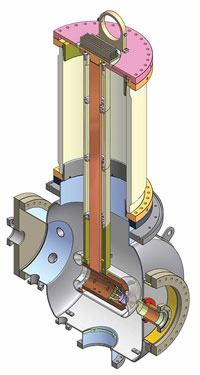
Brightest X-ray vision at the nanoscale
Technology-development studies at Cornell University and Jefferson Laboratory are showing how to use the brightest X-ray light ever generated for the scientific examination of everything from human proteins to forged art.
June 6, 2008 Read more
Multi-particle entanglement in solid is a first
An international team of physicists has entangled three diamond nuclei for the first time. The development promotes solid-state systems to a rank of quantum systems including ions and photons that have achieved entanglement for more than two particles.
June 6, 2008 Read more
Measuring light through small holes
For the first time, a team of Dutch, German and South Korean scientists have shown how light can squeeze through any hole regardless of its size using Terahertz (THz) radiation.
June 6, 2008 Read more
Microspheres to carry hydrogen, deliver drugs, filter gases and detect nuclear development
The June issue of The Bulletin, the monthly magazine of The American Ceramic Society, carries the first news of a never-before-seen class of materials and technology developed by scientists at the Savannah River National Laboratory.
June 6, 2008 Read more
ICAMS officially opened at Ruhr University: Materials research center starts work
ICAMS, the Interdisciplinary Centre for Advanced Materials Simulation, was officially opened today at the Ruhr University in Germany with an inauguration ceremony and podium discussion.
June 6, 2008 Read more

Stripes instead of layers: Miniaturizing magnetic sensors by means of ion technology
Magnetic sensors are made of thin layers with different magnetic properties. With the help of ion technology, scientists from Dresden were now able to shrink these multilayer systems down to one layer, retaining their magnetic properties.
June 6, 2008 Read more
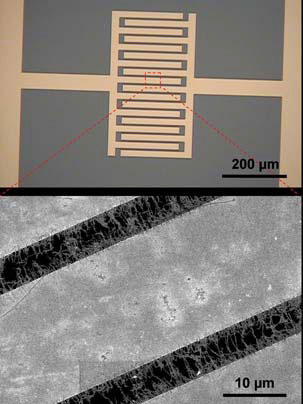
Detector uses nanotubes to sense deadly gases
Using carbon nanotubes, MIT chemical engineers have built the most sensitive electronic detector yet for sensing deadly gases such as the nerve agent sarin.
June 6, 2008 Read more
 Subscribe to our Nanotechnology News feed