| Jun 19, 2026 |
Study reveals the first galactic population of gamma-ray emitting protostars
Study identifies forming stars whose jets accelerate protons and emit gamma rays, revealing a new cosmic-ray source and deeper view of star formation.
|
|
(Nanowerk News) New stars are formed when part of a molecular cloud of gas and dust collapses under its own gravity. This star still under construction is called “protostar.” During this formation stage, the matter falling towards it interacts with intense magnetic fields that expel some of that material into space in the form of jets capable of traveling hundreds of kilometers per second.
|
|
For a long time, protostar systems had mostly been understood as thermal sources, with their emissions dominated by heat. However, there were hints that something more extreme might also be happening.
|
|
A study led by the Institute of Astrophysics of Andalusia (IAA-CSIC) in collaboration with DESY, published in Nature Astronomy ("Evidence for protostellar jets as a population of hadronic gamma-ray sources"), confirms these hints: it has revealed the existence of a new population of forming stars whose jets of matter are able to efficiently accelerate protons and produce gamma rays, the most energetic form of light in the universe. The population is called “Gamma-Loud Protostars.”
|
|
“Besides confirming the importance and impact that these jets of matter have on their environment, we have been able to relate the energy of the detected gamma rays to the power of their emitting source,” explains Javier Méndez Gallego, leader of the study and researcher at the IAA-CSIC.
|
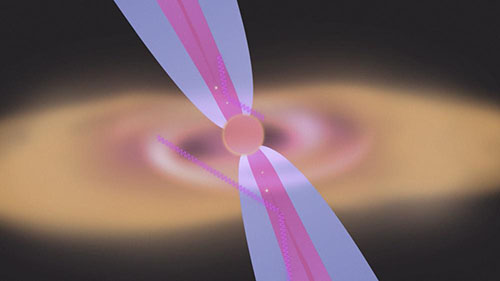 |
| Artist’s impression of a gamma-ray-bright protostar. (Image: IAA-CSIC/Scienseed)
|
|
This research closes an important gap in the understanding of star formation, adding non-thermal processes to the list of protostar attributes.
|
The traces of a cosmic accelerator in formation
|
|
To obtain these results, the research team compared the most comprehensive catalogue of unassociated gamma-ray sources obtained by the Fermi space telescope with the positions of young stellar objects from the Red MSX Source Survey. The analysis revealed 33 probable associations between the two types of objects, allowing the first ever identification of a population of gamma-ray emitting protostars.
|
|
Gamma rays are the most energetic form of electromagnetic radiation and are often associated with some of the most extreme phenomena in the universe, such as supernova explosions and active black holes. Their detection is especially important because they allow scientists to track particle acceleration processes that would otherwise be difficult to observe. They thus act as a fingerprint of the mechanisms responsible for the acceleration of cosmic rays.
|
|
“Gamma rays provide an observational window into the non-thermal universe, where extreme astronomical sources, such as black holes and pulsars, act as natural particle accelerators. These particles travel through space at speeds close to that of light and interact with their surroundings, producing significant energetic and chemical changes,” explains Emma de Oña Wilhelmi, a researcher at DESY and co-author of the study. The origin of these particles, mainly protons, remains one of the great mysteries of astrophysics.
|
|
The results also show a relationship between the energy of the detected gamma rays and the power of the jets emitted by the protostars. “This connection has allowed us to directly link gamma emission with jet activity and confirm that these objects act as efficient proton accelerators,” says Rubén López-Coto, a researcher at the IAA-CSIC and second author of the paper.
|
|
The study proposes that this acceleration occurs when jets ejected by protostars collide with the surrounding gas. These impacts act as natural accelerators, propelling protons to near-light speeds and resulting in the observed gamma-ray emission.
|
|
“Our results show that these protostars constitute a new natural laboratory for studying how cosmic rays are accelerated, so that future observations will allow us to better understand the physics behind this emission,” concludes Javier Méndez Gallego.
|