| Jul 08, 2026 |
A black hole theory comes to life in the lab
A new study shows that time-variations in tailored materials can reproduce the physics of ultrafast rotating bodies, enabling selective amplification of electromagnetic waves.
|
|
(Nanowerk News) More than half a century ago, Sir Roger Penrose envisioned a scenario in which energy could be extracted from a black hole spinning at extreme speeds. He proposed that a particle entering its ergosphere—a region of space dragged around by a rotating black hole— could split into two. One part could fall into the black hole while the other escaped carrying more energy than the original particle. Building on this theory, physicist Yakov Zel’dovich later predicted that a wave interacting with a sufficiently fast, rotating object could extract energy from it and become amplified.
|
|
Inspired by this theoretical construct, researchers at the Advanced Science Research Center at the CUNY Graduate Center (CUNY ASRC) have published a paper in Nature ("Observation of Floquet rotational super-radiance") demonstrating a new approach to wave amplification through interaction with rotating bodies. Rather than mechanically rotating matter, however, the team engineered a radio-frequency device with properties modulated in space and time to mimic spinning.
|
|
The device creates a synthetic form of ultrafast rotation that enables access to rotational speed far beyond what can be achieved mechanically, allowing researchers to overcome limitations that have long hindered experimental studies of ultrafast rotational dynamics.
|
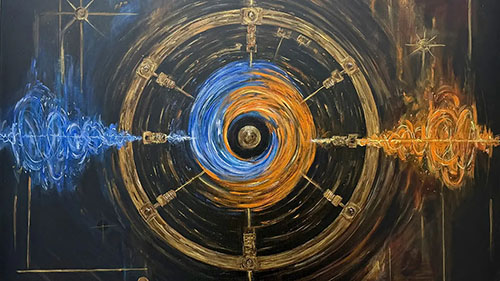 |
| Artistic rendering of Penrose super-radiance: electromagnetic waves with selected rotation patterns are amplified as they interact with a system that appears to rotate at superluminal speeds. (Image: Dalila Pasotti and Hadiseh Nasari)
|
|
“Our approach facilitates a new method of wave–matter interaction in which waves with selected rotational properties extract energy from synthetic time-engineered rotation, producing a form of broadband selective amplification,” said principal investigator Andrea Alù, Distinguished Professor and Einstein Professor of Physics at the CUNY Graduate Center and founding director of the CUNY ASRC’s Photonics Initiative.
|
|
“This successful experiment moves ideas about extreme rotational dynamics from theory to practice and creates a versatile experimental platform for exploring a broad range of phenomena at the intersection of astrophysics, wave physics, and quantum science,” said lead author Hadiseh Nasari, a post-doctoral researcher with the CUNY ASRC’s Photonics Initiative. “The work has implications for advances in fundamental science and in communications, optics and photonics.”
|
|
At the core of the team’s work was a fundamental question: Can electromagnetic waves sent to a device that remains still behave as though they were interacting with an object rotating at ultrafast speeds and extract energy from this form of synthetic motion?
|
|
To answer their question, the researchers built a ring-shaped network of electronic resonators whose properties were rapidly modulated in a carefully timed sequence, producing a traveling pattern around the ring. Although the device itself did not move, the traveling pattern made the electromagnetic waves perceived the system to be rotating at ultrafast speed.
|
|
“Waves with the appropriate rotational characteristics extracted energy from the system and became amplified, reproducing the essential physics of the Penrose–Zel’dovich process,” said co-lead author Hady Moussa, a former PhD student with the CUNY ASRC Photonics Initiative. “Our approach relies on engineered metamaterials that are designed to control how waves propagate.
|
|
Synthetic rotation’s ability to simulate movement past the speed of light gives researchers a powerful way to study extreme regimes in a controlled laboratory setting. The team’s achievement opens a new experimental playground for investigating physics that would otherwise remain inaccessible and provides remarkable opportunities for wireless communications and classical and quantum optics applications.
|
|
Looking ahead, the findings will need to be adapted in practical technologies, and the same concepts can be extended to photonic and quantum platforms, enabling new ways to manipulate light, process information and investigate wave phenomena inspired by some of the most extreme environments in the universe.
|