| Jul 06, 2026 |
Euclid discovers the oldest quasars in the universe
Euclid has uncovered 31 ancient quasars, including two record-breakers that push deeper into cosmic history and illuminate the early universe.
|
|
(Nanowerk News) Quasars represent a brief phase in the life of a galaxy during which large amounts of matter flow into the central supermassive black hole, releasing enormous amounts of energy in the process. As a result, the galactic nucleus shines brighter than anything else in the universe, exceeding the luminosity of its host galaxy by a factor of one hundred to one thousand.
|
|
For decades, researchers have been searching for the very first quasars in the universe. These objects provide important clues about what happened in the earliest stages of the cosmos - such as the formation of the first supermassive black holes and galaxies. Quasars from this era are difficult to detect, however: they are rare, since only a few galaxies had grown large enough by then, and their original light can easily be mistaken for the light of nearby stars.
|
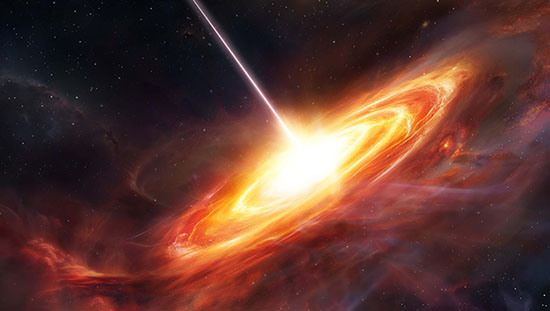 |
| Artist's rendering of a quasar: At the center is a brightly glowing disk of red-orange, incandescent matter spiraling into a supermassive black hole. A narrow jet of matter emerges from the center. Quasars are among the brightest objects in the universe and can outshine entire galaxies. (Image: ESA)
|
|
With the help of the Euclid space telescope, launched in 2023, researchers have now succeeded in delving deeper into this enigmatic phase of the early history of the cosmos, discovering 31 new quasars in the early universe.
|
|
“These early quasars date back to the Universe's infancy,” says Daming Yang of Leiden University in the Netherlands, lead author of the Euclid discovery paper (Astronomy & Astrophysics, "Euclid: Discovery of 31 new quasars at 6.6 < z < 7.8"). "By finding and studying them, we can better understand how these enormous systems formed and grew so quickly – one of the greatest mysteries in astrophysics.”
|
|
The oldest quasars known to date represented only the tip of the iceberg - rare, exceptionally bright objects that were the easiest to detect. For a systematic study of the population as a whole, there was long a lack of sufficient examples from the early universe.
|
|
With the launch of Euclid, the situation has changed fundamentally: the international research team can now survey large areas of the sky much more efficiently while detecting significantly fainter light. This makes Euclid a unique instrument for the search for quasars. It not only detects the brightest - and thus easiest to find - examples but also reveals a significantly larger portion of the early quasar population. While it previously took more than a decade to identify the first ten or so quasars from the early universe, Euclid has already discovered more in just a single year.
|
|
The discovery includes 14 new quasars from the first 770 million years of cosmic history. The two oldest objects set a new record: they formed within the first 670 million years after the Big Bang and are thus over 13 billion years old.
|
|
These ancient quasars are not only remarkable individual discoveries, but also windows into the past that allow us to explore the early universe. Studies of the second-oldest quasar, for example, show that it is embedded in a dust- and gas-rich galaxy where new stars are forming at a high rate. This provides important clues about the nature of the host galaxies of ancient supermassive black holes.
|
|
Key contributions to the study were made at the University of Hamburg Observatory. These include the photometric analysis for candidate selection, the identification of quasar candidates as part of one of three international teams, and follow-up observations.
|
|
“The success rate for spectroscopic confirmations currently stands at around 30 percent, which is significantly higher than with earlier methods. This is made possible by the combined use of three different selection methods, which identify particularly robust candidates. In Hamburg, we rely, among other things, on machine learning—with excellent results: All newly discovered quasars were also selected using our method. Even though the parallel use of multiple methods may seem redundant at first glance, it offers decisive advantages, as method-specific biases can be specifically compensated for,” says postdoctoral researcher Dr. Francesco Guarneri from the Hamburg Observatory.
|
|
“The new quasar discoveries emphasize the enormous potential of the Euclid mission to investigate the origins of supermassive black holes. At the same time, they demonstrate that it is not only the data itself that is crucial, but also the newly developed search algorithms, which enable particularly efficient follow-up observations. It is also noteworthy that not even a quarter of the data expected from the Euclid sky survey has been analyzed so far. Expectations are correspondingly high that further discoveries will follow in the coming years,” emphasizes Dr. Jan-Torge Schindler, a key researcher in the Quantum Universe Cluster of Excellence and Emmy Noether group leader at the Hamburg Observatory, where Euclid research is based in Hamburg.
|