| Jul 03, 2026 |
A nearby black hole as a window into the early Universe
A nearby galaxy's unusually bright radio signal reveals a black hole feeding more intensely, launching a particle jet like those seen in the early Universe.
|
|
(Nanowerk News) Short-lived sources of radio radiation in the sky, known as radio transients, can originate in the vicinity of supermassive black holes in the centres of galaxies. They are the result of processes that take place under extreme physical conditions. While most radio transients associated with galactic centres last only days or weeks, the galaxy SDSS J110546.07+145202.4 has been shining very brightly in radio light for several years—the first source of its kind.
|
|
An international team led by Stefanie Komossa from the Max Planck Institute for Radio Astronomy (MPIfR) studied this unique galaxy using new observations and archival data ranging from low-energy radio waves to high-energy X-rays. The results were published in The Astrophysical Journal ("SDSS J110546.07+145202.4: The First Long-duration Radio Changing-look NLS1 Galaxy").
|
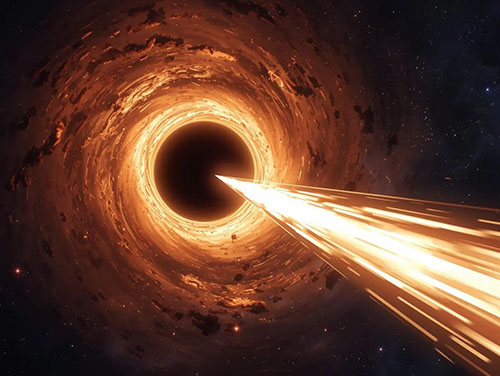 |
| Illustration of the black hole at the centre of the galaxy SDSS J110546.07+145202.4. The luminous disk of matter surrounds the event horizon, while a concentrated jet of particles and radiation is ejected into space. This newly launched jet is revealed by intense radio radiation that has been emanating from the centre of the galaxy for several years. (Image: Max Planck Institute for Radio Astronomy)
|
Loud and Long-Lasting
|
|
The spiral galaxy SDSS J110546.07+145202.4 is located about 1.8 billion light-years from Earth in the constellation Leo. The intensity of its radio emission has increased more than 20-fold in a short period of time and shows no signs of weakening. For over eight years now, the galaxy has been shining exceptionally brightly in the radio regime—about ten quadrillion (10¹⁶) times as intensely as our Sun.
|
|
“We are dealing with the prototype of a new class of galaxies that undergo rapid changes in radio emission”, comments co-author Phil Edwards from CSIRO, Australia’s national science agency.
|
|
The source of the radiation is located near the black hole at the galaxy’s centre. This black hole has a comparatively low mass, which is increasing exceptionally fast, however, through the accretion of matter.
|
|
“Luminous radio radiation from rapidly growing, lightweight black holes is rare to begin with. Their transition into a long-lasting, radio bright state has never been observed before,” reports lead author Stefanie Komossa. “Follow-up observations with numerous telescopes, including the 100-metre radio telescope in Effelsberg, CSIRO’s Australia Telescope Compact Array, and satellites in space, confirm the source’s unique properties”, adds co-author Alexander Kraus.
|
|
Based on the extensive dataset, the team suspects that more matter has been falling into the black hole for several years, which in turn has triggered a jet—a concentrated beam of particles traveling at nearly the speed of light that emits radiation. Why exactly more matter is falling into the black hole and why the outburst has lasted so long has not yet been conclusively determined.
|
A Local Laboratory for the Early Universe
|
|
A low mass and rapid growth are precisely the properties of central black holes that one does expect from galaxies in the early Universe. Compared to these distant sources, however, SDSS J110546.07+145202.4 is located in our cosmic neighbourhood. This allows for detailed observations and insights into the physical processes surrounding the evolution of black holes and the formation of jets.
|
|
“Such high-energy events can provide astronomers with a wealth of insights. By observing these jets and outbursts, we can study the physical processes in some of the most extreme environments in the Universe”, says co-author Kovi Rose from the University of Sydney’s Sydney Institute for Astronomy.
|
|
In the future, high-resolution instruments such as the Very Long Baseline Array (VLBA) will make it possible to map the structure of the jet and track the evolution of the radio emission over the coming years. “With sensitive facilities like the incoming SKA telescopes, we’ll be able to identify similar radio transients in future sky surveys. This is crucial for filling the gaps in our understanding of the early Universe”, explains Stefanie Komossa.
|