| Jun 16, 2026 |
Radionuclides trapped in a deep-sea sample point to an ancient cosmic event
Deep-sea crusts preserved plutonium traces from a rare ancient cosmic event, likely a neutron-star merger, dating back over 100 million years.
|
|
(Nanowerk News) An international team of researchers from Dresden as well as from Sydney and Canberra, Australia, has detected rare radioactive isotopes in a deep-sea manganese crust, providing new insights into the formation of the heaviest elements in the universe. Their results show that the last major astrophysical event in the vicinity of our solar system that could have generated such elements happened at least 100 million years ago.
|
|
Published in the journal Nature Astronomy ("The timing of the last r-process event near Earth from interstellar 60Fe, 244Pu and 247Cm deposition on Earth"), this international study was led by the Helmholtz-Zentrum Dresden-Rossendorf (HZDR).
|
|
Found at depths of hundreds to thousands of meters in the deep sea, ferromanganese crusts are mineral deposits that constitute unique geological archives. They grow millimeter by millimeter over millions of years, absorbing and storing material from their environment – including tiny amounts of radioactive isotopes that reached us from space long time ago. Researchers use these elements as markers for past cosmic events.
|
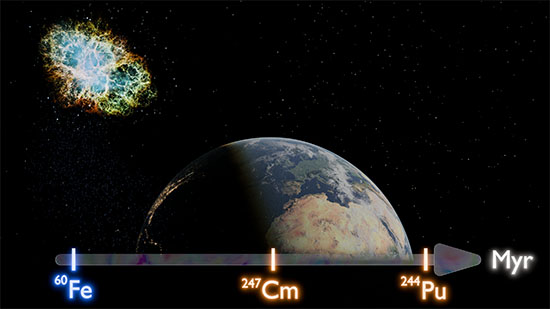 |
| Interstellar iron-60, plutonium-244 and curium-247 on Earth. The influx of the supernova tracer iron-60 does not correlate with the deposition of the r-process isotopes plutonium-244 and curium-247. The supernova-independent r-process event was dated to have occurred more than 100 Million years ago. (Image: B. Schröder/HZDR/ NASA, ESA, J. Hester, A. Loll (ASU))
|
Plutonium-244 from an ancient event
|
|
Scientists searched for a particularly rare example of these isotopes – plutonium-244 – in a crust from the depths of the Pacific Ocean. Plutonium-244 is formed by the so-called r-process (rapid neutron-capture process), a highly explosive process during which atomic nuclei capture successively a large number of neutrons within a very short time. Conditions like this are thought to prevail when two neutron stars merge, or in particularly high-energy supernovae – very rare events, some 1,000 to 10,000 times less frequent than normal supernovae.
|
|
The research team analyzed traces of the radioactive isotopes iron-60, plutonium-244 and curium-247 in the crust. “Iron-60 is a clear fingerprint of conventional supernovae, so we searched for both iron-60 and plutonium-244 and compared the traces,” explains Dr. Dominik Koll of HZDR’s Institute of Ion Beam Physics and Materials Research. The comparison showed that, unlike iron, plutonium cannot stem from stellar explosions that have taken place in the last few million years. It must originate from a rare cosmic event more than 100 million years ago.
|
Near-Earth supernovae not the source
|
|
While the iron-60 profile shows the distinct signatures of two near-Earth supernova explosions that occurred several million years ago, plutonium-244 does not follow the same pattern. It reached the Earth continuously over millions of years. This is evidence of an older process because the isotope would have had enough time to spread evenly like a veil through the interstellar medium.
|
|
Further strong evidence for such an interpretation came from another heavy interstellar radionuclide, curium-247, which, like plutonium-244, is produced in the r-process. With a half-life of approximately 15.6 million years rather than 80 million, it decays much faster: its isotope ratio is therefore a powerful dating tool.
|
|
Despite employing the highest measurement sensitivity, the astrophysicists could not find any traces of cosmic curium in the deep-sea crust. They were therefore able to infer a natural “expiry date” for the most recent r-process event in our cosmic neighborhood: it must have occurred more than 100 million years ago.
|
Detecting individual atoms
|
|
Crucially, the researchers were able to map out the plutonium traces for the first time with higher time resolution. To do so, they had to divide the sample into individual layers which each contained just a few atoms of plutonium. A plutonium atom hides in about ten sextillion other atoms. Detecting such minute concentrations has only recently become possible. For cosmic curium-247, this even represents the first significant measurement ever.”
|
|
“We only need 100 plutonium atoms in the final sample to capture one of them in the detector. This level of sensitivity is unique worldwide” says Michael Hotchkis, leading scientist at the VEGA facility at ANSTO in Sydney. VEGA is currently the only facility that is sufficiently sensitive to detect such cosmic traces. In the future, the HAMSTER facility at HZDR in Dresden is expected to achieve similar results. The team also conducted the iron-60 measurements at the Heavy Ion Accelerator Facility (HIAF) at the Australian National University in Canberra.
|
Understanding and precisely dating the sample
|
|
In parallel, the team analyzed the sample for beryllium-10 at the DREAMS facility at HZDR in Dresden and established a detailed age model. This allowed them to place the detected atoms on a cosmic timescale. Although the selected sample originates from one of the best-studied deep-sea ferromanganese crusts for radionuclide research, the team could further refine its growth history for precise dating. X-ray scans, 3D imaging, and reference measurements on smaller drill cores helped the researchers to better constrain how the crust grew over more than 10 million years.
|
|
“Our results suggest that the plutonium originated from very rare cosmic explosions, such as those that would occur during the merger of two neutron stars or in extremely energetic supernovae. Since then, it has dispersed throughout the interstellar medium,” says Prof. Anton Wallner, head of the Accelerator Mass Spectrometry and Isotope Research Department at HZDR. Two such neutron-star merger events have been independently observed in recent years through gravitational-wave detections; however, both occurred far outside our galaxy. The team was also able to rule out alternative explanations, including the recently proposed collision of the Solar System with a dense interstellar cloud.
|
|
The next measurements are already underway: Lunar samples from NASA should help to study the last r-process in greater detail. In the future, at the new HAMSTER facility in Dresden, they aim to detect not only plutonium and curium, but also other rare radionuclides that could open the door to new insights into the formation of elements in the universe and nearby cosmic explosions.
|