| Jul 01, 2026 |
XMM-Newton helps revise distance to outer spiral arms
X-ray echoes from distant blasts reveal the Milky Way's outer spiral arms are up to 10% farther away than previous maps suggested.
|
|
(Nanowerk News) The European Space Agency’s XMM-Newton and NASA’s Chandra X-ray space telescopes have spotted the aftermath of three bright explosions echoing through the outer spiral arms of our galaxy, the Milky Way. By measuring the distance to these echoes, they find the outer arms to be up to 10% further away than we thought (Astronomy & Astrophysics, "Accurate distances of the Galactic spiral arms from dust-scattered X-ray emission of gamma-ray bursts").
|
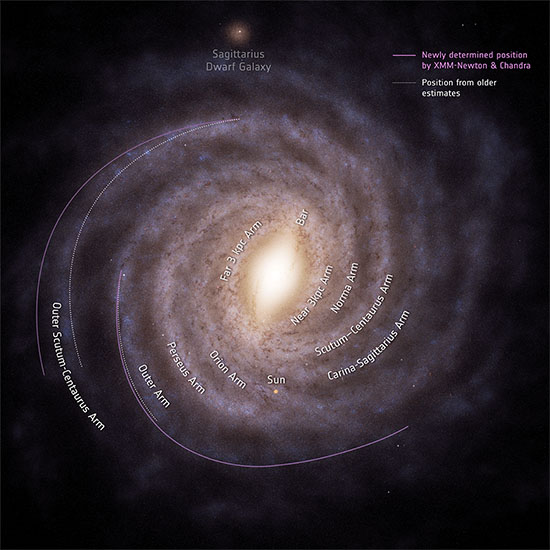 |
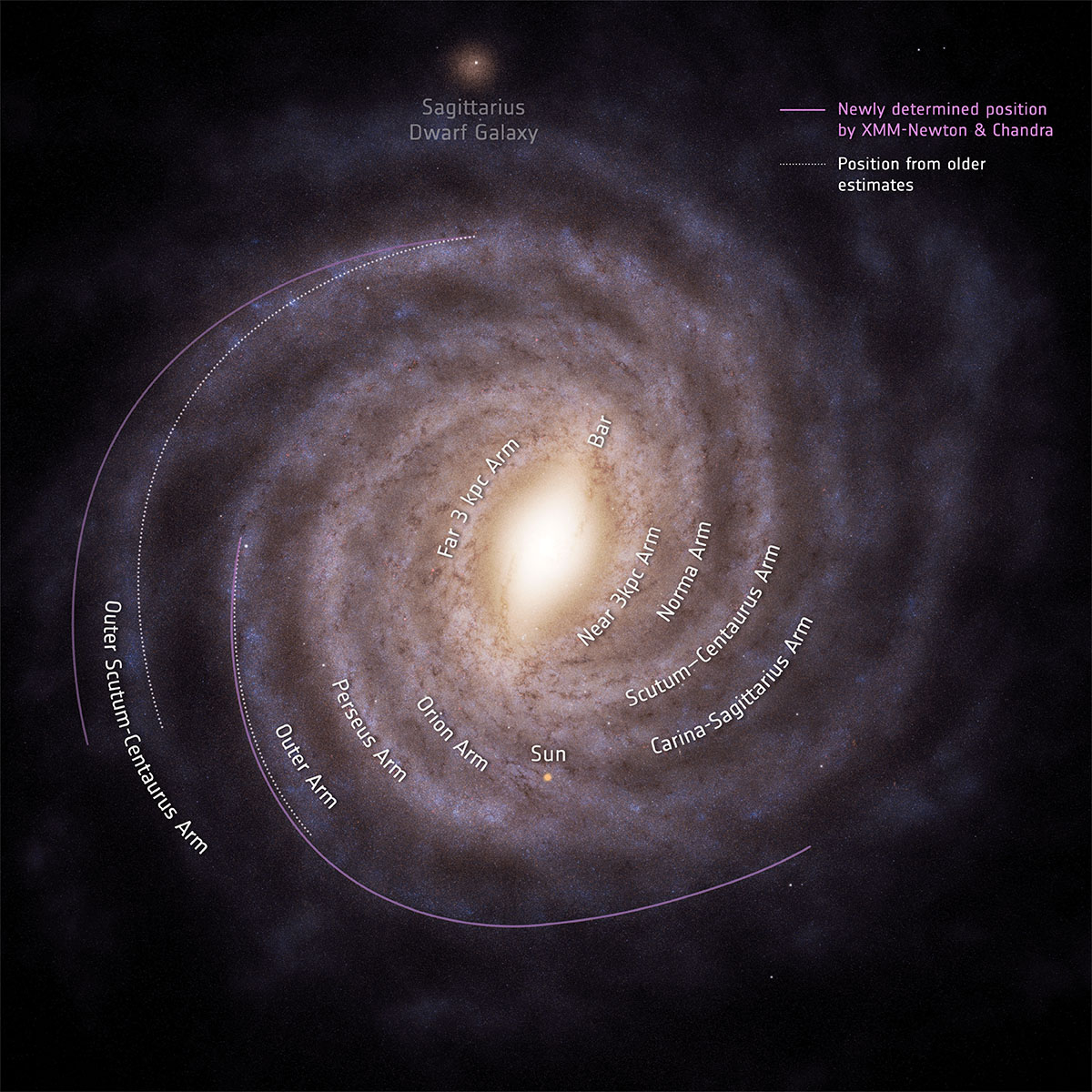
| An artist’s impression of what our home galaxy, the Milky Way, might look like face-on, as viewed from above the disc of the galaxy, with its spiral arms and bulge in full view. In the centre of the galaxy, the bulge shines as a hazy oval, emitting a faint golden gleam. Starting at the central bulge, several glistening spiral arms coil outwards, creating a circle-shaped spiral. The position of the Sun is indicated as a small yellow dot within the spiral. Two sets of two lines roughly trace the extremities of the outer arms labelled ‘Outer Arm’ and ‘Outer Scutum-Centaurus Arm’, drawing four arcs. In each set, a magenta line traces the newly determined position of the outer arm by XMM-Newton and Chandra; on the inside of the magenta arc, a white dashed arc traces the position of that arm derived from older estimates. (Image: ESA/Gaia/DPAC, Stefan Payne-Wardenaar, ESA/XMM-Newton and NASA/Chandra) (click on image to enlarge)
|
Mapping the Milky Way galaxy
|
|
Perhaps surprisingly, we don’t know much about the structure of our galaxy’s outer regions. It’s difficult to observe our galaxy from the inside; the Solar System is well embedded in its disc, preventing a bird’s eye view, and many regions are obscured by thick clouds of cosmic dust.
|
|
But this is changing: we’ve learnt a huge amount since the launch of ESA’s star-surveying Gaia space telescope. Using data collected by Gaia, scientists are currently mapping the Milky Way galaxy in more detail than ever before by measuring precise distances to its stars. Before Gaia, we weren’t even sure if our galaxy had two or four spiral arms (we now know the answer to be four).
|
|
Now, another of ESA's missions has found a new way to map the extremities of our galaxy. “We usually model the Milky Way's outer arms indirectly based on what we know of how our galaxy rotates, but doing it this way leaves room for error," says Beatrice Vaia of Istituto Nazionale di Astrofisica (INAF), Italy, who led the research as part of her PhD.
|
|
“Instead, we did something new: we looked at the aftermath of three cosmic explosions that took place in far more distant galaxies. These explosions flung out X-rays that echoed through several of the Milky Way’s outer arms – and we measured the distances to these echoes directly.”
|
|
X-ray light was thrown out by three bright explosions known as gamma-ray bursts (GRBs). The X-rays bounced around and were scattered by dust grains within the Milky Way galaxy’s spiral arms, forming bright rings that were then picked up by XMM-Newton and Chandra.
|
|
By studying how these ring-shaped echoes slowly expanded over time, Beatrice and colleagues were able to pinpoint the distance of the scattering dust grains. As these lie in clouds within the arms of our galaxy, the team could directly measure the distance of the arms. Besides confirming the known distance to the Perseus arm, the scientists found that two of the Milky Way galaxy’s arms – Outer Scutum-Centaurus Arm and Outer Arm – lie up to 10% further away than we thought.
|
A joint effort
|
|
While ESA’s Gaia has revolutionised our understanding of the Milky Way galaxy, the distance measurements available so far from the telescope are less precise for the outer arms. Using X-rays to probe the distances to dust clouds, as XMM-Newton and Chandra did here, is highly accurate out to longer distances, allowing the research team to revise the map of the outer Milky Way galaxy.
|
|
“This finding is a great example of how ESA’s longer-standing missions – such as XMM-Newton, which launched in 1999 – still have a hugely important role to play in exploring the Universe,” says Erik Kuulkers, ESA XMM-Newton project scientist.
|
|
“Now in its third decade, XMM-Newton continues to return a steady stream of groundbreaking science on everything from the brightest-ever GRBs, to stars being shredded by black holes, to X-ray snapshots of Mars. It’s even more exciting when missions team up, as they did here. Together, they can reveal huge amounts about the skies around us.”
|
|
What we know of our home galaxy will continue to grow in coming years. Alongside ever more detailed data from Gaia’s fourth and fifth data releases (planned for December 2026 and after the end of 2030, respectively), ESA’s next generation X-ray observatory NewAthena is poised to transform X-ray astronomy, and enable scientists to explore far fainter X-ray echoes in the outskirts of our galaxy.
|