| Jun 19, 2026 |
Collision in space is not evidence of dark matter after all?
New data suggest the Bullet Cluster's lensing may be explained with fewer or no dark matter assumptions, reviving an alternative gravity model.
|
|
(Nanowerk News) The Bullet Cluster has so far been considered evidence of the existence of dark matter. An international team of researchers has now analyzed new data and current images from the James Webb Space Telescope (JWST). According to this team, the observations are also consistent with an alternative explanation that does not involve dark matter. If the latter is, in fact, present, it is likely to be in smaller quantities than postulated so far.
|
|
The results are being published in the journal Physical Review D ("Baryonic mass budgets in the central regions of the Bullet Cluster and their consistency with strong lensing in MOND").
|
|
Around 4 billion years ago, there was a huge collision in space: Two galaxy clusters – clusters of hundreds of galaxies – crashed into each other at speeds of over 2,500 kilometers per second. Galaxy clusters contain many billions of stars. The majority of their visible matter, however, consists of interstellar gas. While the two gas clouds were passing through each other, they were significantly slowed down by frictional forces and also heated up considerably. Using X-ray telescopes, the hot clouds can be seen from the Earth as two diffuse patches that lie relatively close to one another.
|
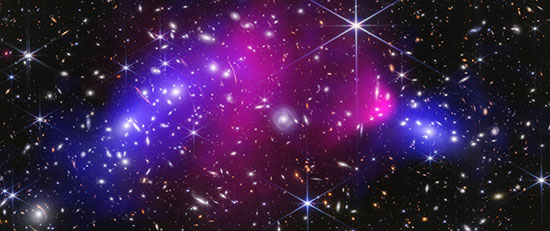 |
| Image from James Webb Space Telescope of the Bullet Cluster inner region: Pink shows the hot gas, the distribution of dark matter is shown in blue. According to the new study, neutron stars and black holes would explain the gravitational lensing effect. (Image: NASA, ESA, CSA, STScI, CXC; James Jee (Yonsei University, UC Davis), Sangjun Cha (Yonsei Univ.), Kyle Finner (Caltech/IPAC))
|
Fame in space
|
|
The galaxies in the two clusters, however, were able to pass through each other unhindered: The distance between the individual stars is so great that they simply fly past each other. The two galaxy clusters were thus separated from the interstellar gas that they carried with them. Cluster 1 is now to the left of the left gas cloud, cluster 2 is to the right of the right one. Together, these four structures form what is known as the Bullet Cluster. It has earned a degree of fame among astrophysicists, as it is considered compelling evidence for the existence of dark matter.
|
|
If you look closely at images of the formation, you can see that galaxies behind the Bullet Cluster appear distorted into crescent shapes. The reason for this is the gravitational lensing effect. This refers to the phenomenon predicted by Albert Einstein, according to which large masses deflect light.
|
|
Incredibly, however, this deflection is not particularly large in the region of the two luminous clouds of matter – i.e., where the greatest mass should be concentrated. Instead, the galaxy clusters to their right and left exert a much stronger lensing effect, despite their low mass. It thus appears that further matter is hidden here that we are unable to see.
|
|
“This observation has so far been considered evidence of the existence of dark matter,” explains Prof. Dr. Pavel Kroupa from the Helmholtz Institute of Radiation and Nuclear Physics at the University of Bonn, a member of the Transdisciplinary Research Areas “Modelling” and “Matter.”
|
|
This is because, according to current theory, dark matter exerts gravitational forces but does not otherwise interact with normal matter. As a result, unlike the gas clouds, it is not slowed down by friction and is also not separated from the visible matter in the galaxy clusters.
|
Alternative theory can also explain the observations
|
|
However, we still do not have any direct evidence that dark matter exists. The Israeli physicist Prof. Dr. Mordehai Milgrom already suggested an alternative hypothesis four decades ago that does not involve dark matter – “modified Newtonian dynamics” (MOND). Nevertheless, it is still considered a fringe theory – largely because it has previously been assumed that it cannot explain the observations in the Bullet Cluster.
|
|
“However, we show in our study that, on the contrary, the Bullet Cluster is actually particularly consistent with the MOND scenario,” says Kroupa’s colleague Dong Zhang, who carried out a large proportion of the calculations. New data from the James Webb Space Telescope allows a better, more precise calculation of the number of stars in both clusters. It is also known today that the Bullet Cluster contains a large number of heavy elements such as iron and oxygen. These are produced in fusion processes within stars, but only if the stars are very massive.
|
|
“If massive stars eventually burn up, they become neutron stars or black holes,” explains Zhang. “Like dark matter, both are invisible and can only be detected by the huge gravitational forces that they exert.”
|
Only half as much dark matter – or none at all?
|
|
Co-author Dr. Indranil Banik (University of Portsmouth) was able to show that the observed gravitational lensing effect can be explained by the newly calculated number of visible stars, neutron stars, and black holes. “The remnants of massive stars take on the role of dark matter to a certain extent in the MOND scenario,” says Kroupa. “Even in the standard model, which assumes the existence of dark matter, its postulated quantity would have to be significantly reduced – by around half.”
|
|
The physics professor from Bonn is convinced that the current study makes the MOND scenario much more plausible.
|