

Nanotechnology News – Latest Headlines
Two chip consortia aim to accelerate green manufacturing progress for semiconductor industry
Semiconductor Research Corporation (SRC), the world's leading university-research consortium for semiconductors and related technologies, and IMEC, Europe's leading independent nanoelectronics research center, intend to set up an international collaboration aimed at creation of novel processes and materials for advanced semiconductor manufacturing.
February 16, 2009 Read more
Nanoparticles double their chances of getting into sticky situations
Chemistry researchers at the University of Warwick have found that tiny nanoparticles could be twice as likely to stick to the interface of two non mixing liquids than previously believed.
February 16, 2009 Read more
Nanorobot can manipulate molecules within a DNA device
Chemists at New York University and China's Nanjing University have developed a two-armed nanorobotic device that can manipulate molecules within a device built from DNA.
February 15, 2009 Read more
Graphene's edge structure affects electronic properties
Graphene, a single-atom-thick sheet of carbon, holds remarkable promise for future nanoelectronics applications. Whether graphene actually cuts it in industry, however, depends upon how graphene is cut, say researchers at the University of Illinois.
February 15, 2009 Read more
Nanolasers set the world record in wavelength tunability
A single semiconductor laser chip with world-record wavelength tuning range of 200 nanometers - from 500 to 700 nanometers - has been demonstrated by a research team at Arizona State University.
February 15, 2009 Read more

Can food nanotechnology make junk food healthy?
The promise of nanotechnology, a Dutch scientist says, is it could allow re-engineering ingredients to bring healthy nutrients more efficiently to the body while allowing less-desirable components to pass on through.
February 14, 2009 Read more
Molecules self-assemble to provide new therapeutic treatments
Researchers in the laboratory of Samuel I. Stupp at Northwestern University have an interesting approach for tackling some major health problems: gather raw materials and then let them self-assemble into structures that can address a multitude of medical needs.
February 14, 2009 Read more
Nanotoxicology: Big and small nanoparticles affect most genes similarly
The smallest nano-sized silica particles used in biomedicine and engineering likely won't cause unexpected biological responses due to their size, according to work presented today.
February 14, 2009 Read more

DARPA project in search for a better artificial nose
A few years ago, with funding from the Office of Naval Research, Eric Paterson, a senior research associate at Penn State?s Applied Research Lab and an associate professor of mechanical engineering, decided to go back to the source, studying the fundamental fluid mechanics and odorant transport of canine olfaction with the object of coming up with a better mechanical equivalent.
February 13, 2009 Read more
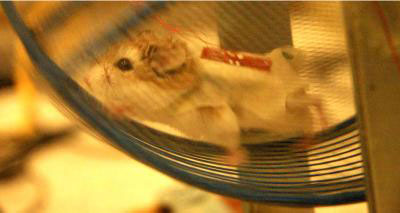
Nanotechnology hamster power
Could hamsters help solve the world's energy crisis? Probably not, but a hamster wearing a power-generating jacket is doing its own small part to provide a new and renewable source of electricity.
February 13, 2009 Read more
New nanoscale spectroscopy technique may help detect cancer early
A team of researchers in Chicago has developed a way to examine cell biopsies and detect never-before-seen signs of early-stage pancreatic cancer.
February 13, 2009 Read more
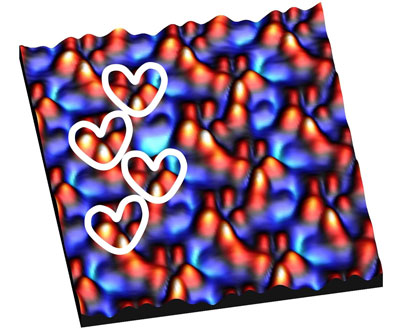
500 Milliarden Nano-Herzen zum Valentinstag
Wissenschaftler in der Schweiz haben eeinen neuartigen Atomwuerfel entdeckt. Dieser besteht aus fuenf Silizium-Atomen, die zusammen ein Herz bilden.
February 13, 2009 Read more
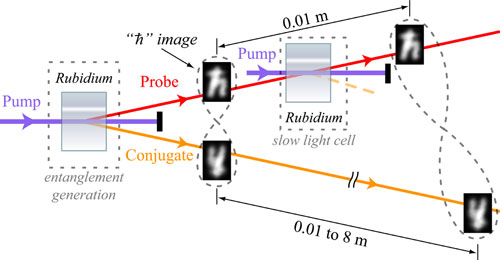
Researchers demonstrate a 'quantum data buffer'
Pushing the envelope of Albert Einstein's 'spooky action at a distance', known as entanglement, researchers at the Joint Quantum Institute (JQI) of the Commerce Department's National Institute of Standards and Technology (NIST) and the University of Maryland have demonstrated a 'quantum buffer', a technique that could be used to control the data flow inside a quantum computer.
February 13, 2009 Read more
Scientists achieve milisecond quantum memory storage time
Scientists in China successfully extended quantum memory to miliseconds.
February 13, 2009 Read more
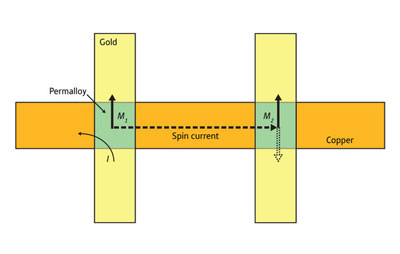
Spin currents: pure and clean
A team of scientists in Japan has demonstrated the possibility of switching the magnetization of a thin magnetic film with a non-conventional and innovative method, achieving a considerable step forward in magnetic data storage and the field known as spintronics.
February 13, 2009 Read more
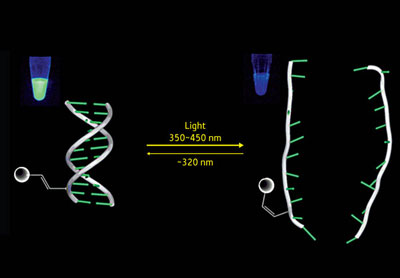
Potential nanotechnology applications arising from DNA switches
Two RIKEN researchers have developed a switch to control the formation and separation of DNA duplexes that may have implications in many biological processes, such as gene regulation.
February 13, 2009 Read more
 Subscribe to our Nanotechnology News feed