

Nanotechnology News – Latest Headlines
Researchers seed, heat and grow carbon Nanotubes in long tubing
In less than 20 minutes, researchers at New Jersey Institute of Technology (NJIT) can now seed, heat and grow carbon nanotubes in 10-foot-long, hollow thin steel tubing.
August 3, 2006 Read more
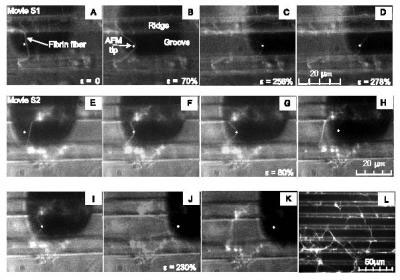
Blood clot fibers more elastic than spider web
The tiny fibers that comprise blood clots show extraordinary elasticity, on average stretching to almost three times their length while still retaining their ability to go back to their normal shape and expanding to more than four times their length before breaking.
August 3, 2006 Read more
Fabrics get smart
Electroactive textiles serve as switches, sensors, and more.
August 3, 2006 Read more
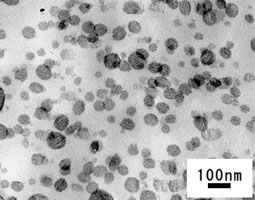
Successful development of a nanoscale dispersion and mixing technique for immiscible polymer blends
Researchers in Japan have developed a new polymer-blending technique using high-shear flow field, and succeeded in making miscible-polymer blends with nano-dispersion structures.
August 3, 2006 Read more
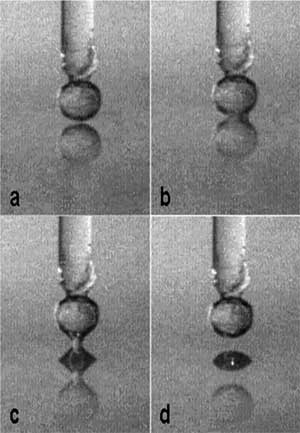
Researchers solve mystery of attractive surfaces
When smooth surfaces that hate water approach each other underwater, scientists have observed that they snap into contact. This is apparently due to attractive forces that extend for tens to hundreds of nanometers.
August 2, 2006 Read more
New method of using nanotube X-rays creates CT images faster than traditional scanners
Scientists at the University of North Carolina at Chapel Hill have developed a new method to create computed tomography (CT) images using carbon nanotube x-rays that works much faster than traditional scanners and uses less peak power.
August 2, 2006 Read more
Tiny inhaled particles take easy route from nose to brain
In a continuing effort to find out if the tiniest airborne particles pose a health risk, University of Rochester Medical Center scientists showed that when rats breathe in nano-sized materials they follow a rapid and efficient pathway from the nasal cavity to several regions of the brain.
August 2, 2006 Read more
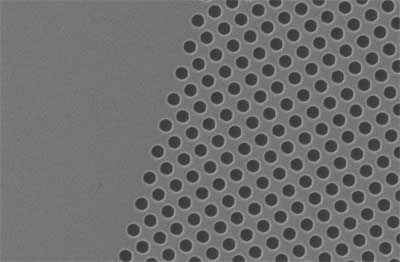
Optical breakthrough makes Lab-on-a-Chip possible
Georgia Tech researchers have found a way to shrink all the sensing power of sophisticated biosensors, such as sensors that can detect trace amounts of a chemical in a water supply or a substance in your blood, onto a single microchip.
August 2, 2006 Read more
Engineers lay groundwork for vertically oriented nanoelectronics
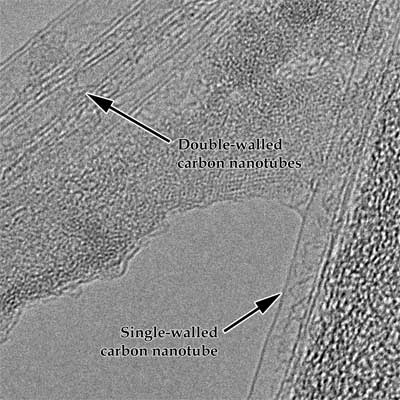
Engineers at Purdue University have developed a technique to grow individual carbon nanotubes vertically on top of a silicon wafer, a step toward making advanced electronics, wireless devices and sensors using nanotubes by stacking circuits and components in layers.
August 1, 2006 Read more
Intracellular tracking with coated gold nanoparticles
Researchers developed a new bifunctional coating that firmly attaches to the surface of gold nanoparticles while also providing an anchoring point for proteins and other molecules.
July 31, 2006 Read more
Magnetic nanocapsules for smart drug delivery
By combining peptide-based polymers with modified iron oxide nanoparticles, researchers have developed nanoparticles that can be manipulated in a magnetic field and that can respond to changes in pH and other physiologic stimuli.
July 31, 2006 Read more
Nanoscale devices advance biomedical sensing and screening applications
One of the hopes for nanotechnology is that researchers will be able to harness the power of the nanoscale to develop faster, more sensitive and less expensive assay techniques for use in diagnostic and drug discovery applications.
July 31, 2006 Read more
Nanoparticle pH meters
Having the ability to measure pH in a tissue without the need for a biopsy could provide clinicians with a rapid method for determining if a suspicious growth is malignant. Two novel nanoparticles raise the distinct possibility that making such measurements could soon be reality.
July 31, 2006 Read more
Scientists develop new, molecular approach to early cancer detection
Scientists have pioneered a new approach to detecting cancer cells, one that could eventually allow doctors to discover many malignancies earlier than currently possible.
July 27, 2006 Read more
Nanotechnology enables low-dose treatment of atherosclerotic plaques
In laboratory tests, one very low dose of a drug was enough to show an effect on notoriously tenacious artery-clogging plaques. What kind of drug is that potent?
July 27, 2006 Read more
Cosmetics and military nanotechnology are the hot topics in the August issue of Nanorisk
The August issue of nanoRISK looks at nanotechnology applications in the military; the use of nanoparticles in the cosmetics industry; reports on a new, collaborative approach to nanotoxicology at the National University of Singapore; and numerous briefs on papers, initiatives, upcoming events and new book releases.
July 27, 2006 Read more
 Subscribe to our Nanotechnology News feed