

Nanotechnology News – Latest Headlines
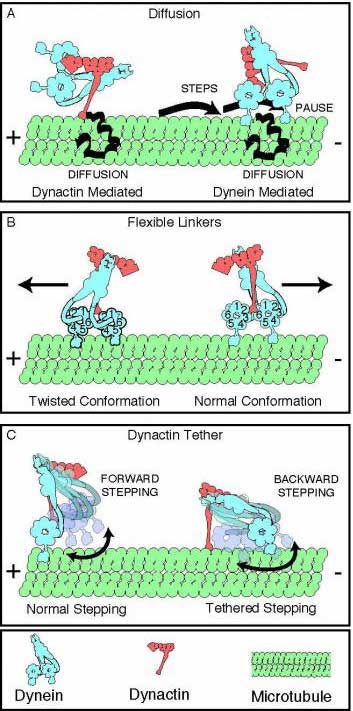
Discovery of agile molecular motors could aid in treating motor neuron diseases
Research shows proteins that function as molecular motors are surprisingly flexible and agile, able to navigate obstacles within the cell. These observations could lead to better ways to treat motor neuron diseases.
July 17, 2006 Read more
Development of a protein chip based biosensor
Chinese researchers succeeded in developing a protein-chip-based biosensor.
July 14, 2006 Read more
First direct observations of spinons and holons
A team of researchers has observed the theoretical prediction of electron spin-charge separation in a one-dimensional solid. These results hold implications for future developments in several key areas of advanced technology, including high-temperature superconductors, nanowires and spintronics.
July 13, 2006 Read more
Sharply-tuned nanostrings work at room temperature
Using a fast, low-cost fabrication technique that allows inexpensive testing of a wide variety of materials, Cornell researchers have come up with nanoscale resonators -- tiny vibrating strings -- with the highest quality factor so far obtainable at room temperature for devices so small.
July 13, 2006 Read more
Using DNA to direct nanowire assembly and growth
A research team led by Brown University engineers has harnessed the coding power of DNA to create zinc oxide nanowires on top of carbon nanotube tips.
July 13, 2006 Read more
Benchmark report on the U.S. nanotechnology industry
The study, conducted under NSF-sponsorship, documents the largest cross-industry survey of nanotechnology applications being commercialized by the U.S. manufacturing industry.
July 12, 2006 Read more
Paint-on semiconductor outperforms chips
Researchers at the University of Toronto have created a semiconductor device that outperforms conventional chips - and they made it simply by painting a liquid onto a piece of glass.
July 12, 2006 Read more
Laser tweezers sort atoms
Physicists of the University of Bonn in Germany have taken one more important hurdle on the path to what is known as a quantum computer.
July 12, 2006 Read more
Molecular electronics for faster and smaller computers
Scientists have succeeded in imaging and forming a unique bond between a single gold atom and a single organic molecule called a pentacene.
July 11, 2006 Read more
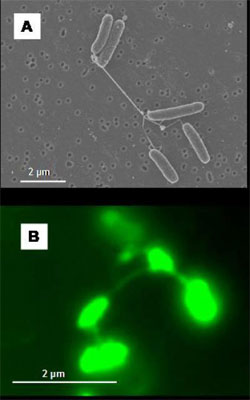
Our planet is hard-wired with electricity-producing bacteria
Many bacteria can form electrically conductive wires under a variety of environmental conditions.
July 11, 2006 Read more
Making the sharpest tip ever known
Scientists were able to coat peripheral atoms near the peak with nitrogen, making it a one atom-thick, tough protective paint job.
July 11, 2006 Read more
Finding about cellular microtubule rigidity could lead to development of new nano-materials
Microtubules, essential structural elements in living cells, grow stiffer as they grow longer, an unexpected property that could lead to advances in nano-materials development, an international team of biophysicists has found.
July 10, 2006 Read more
Quantum dot-peptide conjugates image intracellular reactions
Using a synthetic peptide modeled after the protein that the human immunodeficiency virus (HIV) uses to enter cells, a multi-institutional research team has created quantum dots that can penetrate the cell membrane and image internal structures in a cell.
July 10, 2006 Read more
Metal-organic hybrids yield versatile nanoparticle-based imaging agents
By combining the properties of inorganic and organic molecules in one material, researchers have developed a new class of nanomaterials that can be used to create multifunctional nanoparticles
July 10, 2006 Read more
Novel approach Images pancreatic tumors with nanoparticles
Researchers have created a targeting agent that binds to a molecule found only on healthy pancreatic tissue. They then used this peptide to create a multifunctional nanoparticle-based imaging agent.
July 10, 2006 Read more
Understanding potential toxic effects of carbon-based nanomaterials
Various types of carbon-based nanomaterials, such as buckyballs and nanotubes, have shown promise as drug delivery tools and imaging agents, but reports of toxicity associated with some of these materials have raised questions about their ultimate utility in clinical oncology. Three recent reports in the literature provide new insights into why certain carbon-based nanomaterials are toxic to cells and others are not.
July 10, 2006 Read more
 Subscribe to our Nanotechnology News feed