| Jun 11, 2021 |
Novel magnet design with magic mirror-like properties(Nanowerk News) Researchers at Tohoku University have demonstrated the designability of novel magnets with magic mirror-like characteristics in organic-inorganic hybrid perovskite (OIHP)-type compounds (Angewandte Chem International Edition, "Magneto-Electric Directional Anisotropy in Polar Soft Ferromagnets of Two-Dimensional Organic-Inorganic Hybrid Perovskites"). |
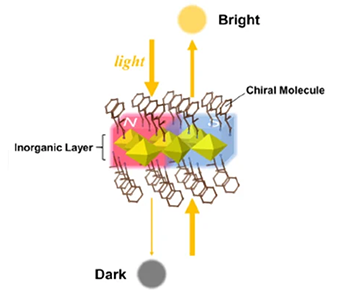 |
| The Magic mirror-like magnet. The brightness of the transmitted light from the magnet changes depending on whether the material is viewed from the front or the back. (Image: Kouji Taniguchi) |
| OIHP-type compounds, a type of material used to construct solar cells, possess exceptional optical properties and have recently attracted worldwide interest. Researchers are keen to harness their structural diversity. |
| Although the superior optical properties of OIHPs have been mainly studied for their photoelectric characteristics, several OIHP-type compounds are known to function as magnets that transmit light. Combining the excellent optical characteristics with magnetism, OIHP-type compounds are a promising platform for designing functional magneto-optical materials. |
| A multi-institutional Japanese team, led by Kouji Taniguchi of Tohoku University's Institute for Materials Research, developed a new magnet, in which brightness changes are determined by whether the material is viewed from the front or the back. |
| Taking advantage of OIHP-type compounds, they have designed low symmetry magnets, where magic mirror characteristics are expected, by introducing chiral organic molecules into layered crystal structure of inorganic magnets. |
| In addition, they found that the front and back of matter can be switched by a low magnetic field, which is obtainable by a ubiquitous permanent magnet. |
| "We hope the development of new magneto-optical materials based on the material design concept presented in this study will lead to the applications in spin photonic devices," said Taniguchi. |
| Source: Tohoku University |