| Aug 30, 2021 | |
AI helps to spot single diseased cells |
|
| (Nanowerk News) The Human Cell Atlas is the world’s largest, growing single-cell reference atlas. It contains references of millions of cells across tissues, organs and developmental stages. These references help physicians to understand the influences of aging, environment and disease on a cell – and ultimately diagnose and treat patients better. | |
| Yet, reference atlases do not come without challenges. Single-cell datasets may contain measurement errors (batch effect), the global availability of computational resources is limited and the sharing of raw data is often legally restricted. | |
| Researchers from Helmholtz Zentrum München and the Technical University of Munich (TUM) developed a novel algorithm called scArches, short for single-cell architecture surgery (Nature Biotechnology, "Mapping single-cell data to reference atlases by transfer learning"). | |
 |
|
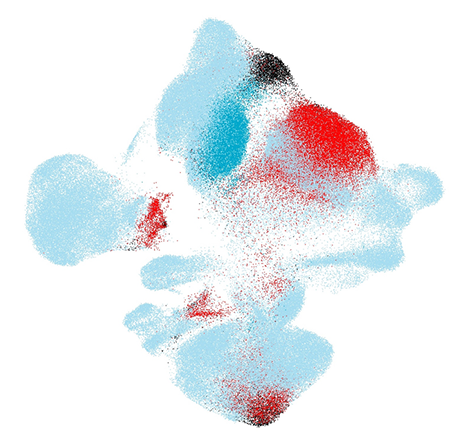
| Mapping new cohorts of cells of healthy individuals and COVID-19 patients onto a healthy cells reference atlas. (Image: Helmholtz Zentrum München / Mohammad Lotfollahi) | |
| The biggest advantage: “Instead of sharing raw data between clinics or research centers, the algorithm uses transfer learning to compare new datasets from single-cell genomics with existing references and thus preserves privacy and anonymity. This also makes annotating and interpreting of new data sets very easy and democratizes the usage of single-cell reference atlases dramatically,” says Mohammad Lotfollahi, the leading scientist of the algorithm. | |
Example COVID-19 |
|
| The researchers applied scArches to study COVID-19 in several lung bronchial samples. They compared the cells of COVID-19 patients to healthy references using single-cell transcriptomics. | |
| The algorithm was able to separate diseased cells from the references and thus enabled the user to pinpoint the cells in need for treatment, for both mild and severe COVID-19 cases. Biological variation between patients did not affect the quality of the mapping process. | |
| Fabian Theis: “Our vision is that in the future we will use cell references as easily as we nowadays do for genome references. In other word, if you want to bake a cake, you usually do not want to try coming up with your own recipe – instead you just look one up in a cookbook. With scArches, we formalize and simplify this lookup process.” |
| Source: Helmholtz Zentrum München - German Research Center for Environmental Health |