| Mar 11, 2026 |
AI designed RNA switch replicates digital NAND logic in living cells
Researchers engineered the first RNA-based NAND gate in living cells using deep learning and Bayesian optimization, testing only 82 variants to achieve near-digital switching.
|
|
(Nanowerk News) An interdisciplinary team of synthetic biologists and engineers has built the first RNA-based genetic switch that faithfully reproduces the logic of a NAND gate, one of the foundational elements of digital circuits. The work, carried out at the Centre for Synthetic Biology at TU Darmstadt and published in Nucleic Acids Research ("Iterative design of a NAND hybrid riboswitch by deep batch Bayesian optimization"), combines high-throughput laboratory screening with a Bayesian optimization pipeline to engineer a riboswitch that required testing only 82 sequence variants before reaching near-digital switching performance.
|
Key Findings
- Two riboswitches were seamlessly linked into a single hybrid construct that functions as a Boolean NAND gate, shutting off gene expression only when both chemical inputs are present simultaneously.
- A deep learning model paired with Bayesian optimization identified optimized RNA variants after screening just 82 candidates, dramatically reducing the experimental effort typically required.
- The best-performing riboswitch showed near-digital behavior with a clear separation between its on and off output states.
|
|
The switches are built from riboswitches, short RNA sequences of fewer than 100 nucleotides that change shape when a small molecule, called a ligand, binds to them. Embedded within a messenger RNA, a riboswitch can block the ribosome from translating the message into protein. Because riboswitches operate without additional proteins, occupy little genetic space, and consume minimal cellular energy, they place almost no metabolic burden on the host cell. These properties make them attractive building blocks for synthetic gene regulation.
|
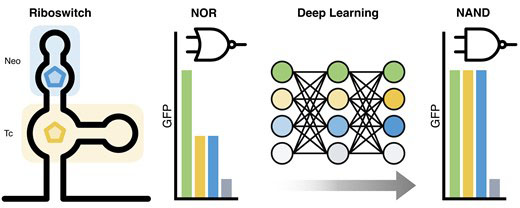 |
| Graphical abstract of the work. (Image: Reproduced from DOI:10.1093/nar/gkag145, CC BY)
|
|
By joining two riboswitches end to end, the researchers created a dual-input genetic element. Dr. Daniel Kelvin, a researcher at the Centre for Synthetic Biology, explained the logic the team aimed to implement. "We use these RNA-based dual-input switches to implement logical functions in living cells, similar to those in computers. To achieve this, we have constructed a combination of two riboswitches that functions like a Boolean NAND gate."
|
|
In digital electronics, a NAND gate returns an off signal only when both of its inputs are on. In every other input combination, the output stays on. Translated into a biological context, gene expression is suppressed only when both ligands bind to the riboswitch at the same time. If either ligand is absent, the gene remains active. This behavior has no known counterpart in natural biological systems, and because the number of possible sequence variants grows exponentially with length, engineering such a hybrid riboswitch posed a substantial design challenge.
|
|
To tackle that challenge, the team first assembled a hybrid riboswitch that showed approximate NAND-like behavior, then generated a library of thousands of sequence variants. The variants differed primarily in the central communication module, the RNA region that connects the two ligand-binding pockets. Each variant was tested by flow cytometry, which measured protein output under all four possible ligand combinations to quantify how closely each construct matched ideal NAND logic.
|
|
A deep learning model was then trained on the screening data to predict which sequences would best satisfy the NAND function. Erik Kubaczka, also a researcher at the Centre for Synthetic Biology, described the optimization loop. "A deep learning model then predicts which RNA variants best fulfill the NAND function. Our optimization algorithm, based on Bayesian optimization, then specifically selects new candidates – and learns with each experiment."
|
|
A critical feature of the approach is that the algorithm proposes multiple riboswitch candidates in a single round rather than one at a time. The researchers achieved this through the Kriging Believer method, an extension of sequential Bayesian optimization. After the algorithm suggests one candidate, it feeds its own prediction for that candidate back into the model as though real data had already been collected. The next candidate is then chosen in light of all previously selected sequences, preventing the selection of variants that are too similar and ensuring that each round of experiments yields maximum new information.
|
|
After evaluating only 82 variants, the pipeline produced several high-performance riboswitches. The top candidate displayed near-digital NAND behavior, with a pronounced gap between its on and off output levels, indicating precise and reliable switching.
|
|
The achievement carries broad implications for cellular engineering because NAND gates are functionally complete. Any Boolean logic function, whether AND, OR, XOR, or more complex operations, can be constructed entirely from NAND gates. With a working RNA-based NAND element in hand, researchers can in principle program cells to make multi-input logical decisions. Possible applications include programming cells to produce a target molecule only when a specific combination of nutrients or signaling molecules is detected. In medical and environmental sensing, RNA-based biosensors built from NAND logic could identify tumor signatures, detect metabolic states, or flag environmental toxins only when particular combinations of markers are present.
|
|
The platform developed by the groups of Professor Beatrix Süß, who leads the Synthetic RNA Biology group, and Professor Heinz Koeppl, who leads the Self-Organizing Systems group, both at the Centre for Synthetic Biology, provides a generalizable method for accelerating the construction of genetic circuits. The AI-guided design loop can be applied beyond NAND gates to engineer other RNA-based logic elements, potentially enabling more complex cellular programs for use in medicine, environmental technology, and industrial biotechnology. The work illustrates how machine learning can uncover functional RNA structures that natural evolution has never produced.
|