| Jul 07, 2026 |
3D printed hydrogel bioelectronics bridge soft tissue and medical devices
Researchers review how 3D printed hydrogel bioelectronics can improve sensing, adhesion and soft tissue interfaces in medical devices.
|
|
(Nanowerk News) Researchers from Jiangxi Science and Technology Normal University and Southern University of Science and Technology have reviewed how 3D printed hydrogel bioelectronics can reduce the mismatch between rigid medical electronics and soft living tissue.
|
|
Published in the Chinese Journal of Polymer Science ("Direct Ink Writing 3D Printing of Hydrogel Bioelectronics"), the review focuses on direct ink writing as a manufacturing route for conductive, adhesive and biocompatible devices used in sensing and therapy.
|
Key Findings
- Direct ink writing can print hydrogel inks into soft bioelectronic structures designed to match the mechanics of moving tissue.
- PEDOT:PSS based hydrogel inks have reached conductivities up to 28 S·cm⁻¹ with printing resolutions around 30 micrometers.
- Printed hydrogel electrodes increased EMG signal to noise ratios by 88% compared with commercial electrodes and maintained epicardial ECG recordings for more than 10,000 beating cycles.
|
|
Many bioelectronic devices used in medicine are built from silicon, metals and other rigid materials. These systems are important for monitoring and treating disorders ranging from Parkinson’s disease to cardiovascular disease, but their stiffness can create stress where the device meets tissue. Over time, that mechanical mismatch can contribute to inflammation, scar tissue formation and degradation of the device interface.
|
|
The review also addresses a second problem at the tissue device boundary. Living systems transmit information through ions and molecules, while conventional electronics rely on electrons. That difference can weaken signal quality and reduce therapeutic precision. The authors frame hydrogel ink design as a way to bring printability, electrical conductivity, tissue adhesion and biocompatibility into one material platform.
|
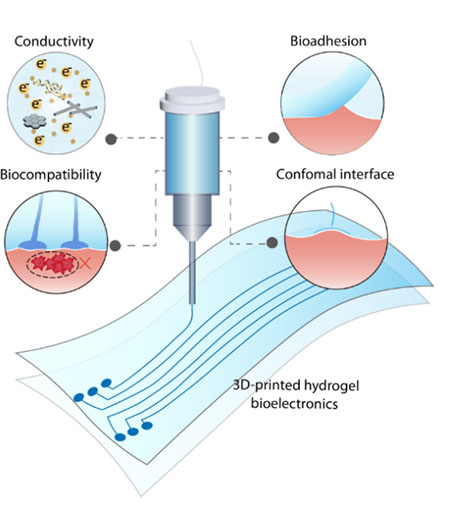 |
| Core attributes for bioelectronic interfacing. DIW 3D-printed hydrogel bioelectronics require the integrated optimization of electrical conductivity, tissue bioadhesion, biocompatibility, and conformal mechanical matching—together forming the foundational blueprint for devices that seamlessly interface with soft, living tissues. (Image: Chinese Journal of Polymer Science)
|
|
The review examines direct ink writing, or DIW, a 3D printing process that extrudes material through fine nozzles to build defined structures. For hydrogel bioelectronics, the ink must flow under pressure during printing and then hold its shape after deposition. This shear thinning behavior allows printed materials to form stable three dimensional architectures without losing the softness needed for contact with living tissue.
|
|
For electronic performance, the authors highlight conductive polymers, especially poly(3,4-ethylene dioxythiophene):poly(styrene sulfonate), known as PEDOT:PSS. PEDOT:PSS based inks have shown conductivities as high as 28 S·cm⁻¹ and printing resolutions near 30 micrometers. The review notes that this resolution is fine enough for recording signals from individual neurons.
|
|
Adhesion is treated as a core design requirement rather than an add on. Bioadhesive hydrogels that incorporate poly(acrylic acid)-N-hydroxysuccinimide, or PAA-NHS, chitosan, or CTS, and poly(vinyl alcohol), or PVA, have achieved interfacial toughness of approximately 200 J·m⁻². That level of adhesion can help maintain contact with beating hearts and other moving organs without delamination.
|
|
The reviewed application studies show how these material properties translate into device performance. DIW printed hydrogel electrodes increased electromyography, or EMG, signal to noise ratios by 88% compared with commercial electrodes. The same class of devices maintained stable epicardial electrocardiogram, or ECG, recordings for more than 10,000 beating cycles and enabled low voltage cardiac pacing at around 0.7 V.
|
|
The authors describe the central materials goal in terms of combining device performance with compatibility at the tissue interface.
|
|
“The key is that we’re no longer choosing between performance and biocompatibility—we can have both,” the authors said. “With DIW 3D printing, we can digitally design hydrogel inks that flow like liquids during printing but become soft, sticky, and electrically active implants afterward. This gives us unprecedented control over how these devices interact with the body, from the macro-scale down to the single-neuron level.
|
|
The vision is to create bioelectronic systems that the body doesn’t reject but rather embraces as part of itself.”
|
|
The review connects these advances to several potential medical uses. For cardiac arrhythmias, soft adhesive electrodes could provide interfaces that move with the heart instead of relying on bulkier device architectures. For spinal cord injury and stroke, the authors point to targeted neural stimulation as a possible route for restoring lost function. In wound care, conformable hydrogel patches can deliver electrical stimulation, including for difficult to treat diabetic wounds.
|
|
The authors also discuss real time biosensing. Printed multi electrode arrays could support simultaneous detection of biomarkers such as glucose and lactate, making continuous monitoring more practical in soft, body conforming formats. These examples depend on the same material balance: the device must conduct electrical signals, attach to tissue, remain biocompatible and move with the body.
|
|
The source image, credited to the Chinese Journal of Polymer Science, summarizes the core attributes needed for bioelectronic interfacing. It describes DIW 3D printed hydrogel bioelectronics as requiring integrated optimization of electrical conductivity, tissue bioadhesion, biocompatibility and conformal mechanical matching to interface with soft living tissues.
|
|
The review was published under DOI 10.1007/s10118-026-3570-4. The Chinese Journal of Polymer Science is a monthly English language journal sponsored by the Chinese Chemical Society and the Institute of Chemistry, Chinese Academy of Sciences. The journal publishes editorials, rapid communications, perspectives, tutorials, feature articles, reviews and research articles. According to Journal Citation Reports, its 2025 impact factor is 4.6. Its editorial board is headed by Professor Qi-Feng Zhou and supported by an international advisory board.
|
|
By treating ink formulation as the central engineering problem, the review places 3D printed hydrogel bioelectronics at the intersection of materials science, additive manufacturing and medical device design. The field’s progress now depends on how well researchers can combine conductivity, adhesion and mechanical compatibility in devices that maintain stable contact with living tissue.
|