Reference terms from Wikipedia, the free encyclopedia
 

Face validity

Face validity is the extent to which a test is subjectively viewed as covering the concept it purports to measure. It refers to the transparency or relevance of a test as it appears to test participants. In other words, a test can be said to have face validity if it "looks like" it is going to measure what it is supposed to measure. For instance, if a test is prepared to measure whether students can perform multiplication, and the people to whom it is shown all agree that it looks like a good test of multiplication ability, this demonstrates face validity of the test. Face validity is often contrasted with content validity and construct validity.

Some people use the term face validity to refer only to the validity of a test to observers who are not expert in testing methodologies. For instance, if a test is designed to measure whether children are good spellers, and parents are asked whether the test is a good test, this measures the face validity of the test. If an expert is asked instead, some people would argue that this does not measure face validity. This distinction seems too careful for most applications. Generally, face validity means that the test "looks like" it will work, as opposed to "has been shown to work".

 
Note:   The above text is excerpted from the Wikipedia article Face validity, which has been released under the GNU Free Documentation License.
 

Check out these latest Nanowerk News:
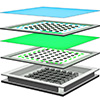
 

Shape-shifting surface adds touch to displays

A soft magnetic metasurface can morph into thousands of shapes, sense deformation, and show LED feedback, pointing to tactile interfaces, wearables, soft robotics, and AR/VR.

Plastic bottles could find new life in batteries as graphite

Graphene oxide helps turn PET plastic waste into synthetic graphite for lithium-ion battery anodes, offering a recycling route for battery materials.

Atomic defects tune carbon quantum dots for precise light control

Atomic defects can tune carbon quantum dots across UV to near-infrared light, guiding cleaner design of sensors, bioimaging and solar materials.

Molecules on a surface reach the ultimate quantum limit

Surface-bound molecules reached the Fourier quantum limit, enabling cleaner studies of emitters for quantum tech and nanoscale control.

Glass cells of atoms offer a new path to smarter, cheaper sensors

All-glass atomic vapor cells could enable smaller, cheaper, more stable sensors for navigation, radar and wireless signals without silicon interference.

Nanodiamonds emerge from a giant press and powerful X-rays

Researchers use extreme pressure and bright X-rays to track how nanodiamonds form, opening ways to tune ultra-hard materials for future technologies.

Exploring long-range magnetism with graphene

Graphene coated with magnetic molecules shows gate-tunable, long-range magnetism while preserving mobility, pointing to spintronic uses.

pH-triggered nanocomposite delivers dual blow to wound infections

Researchers design a ZIF-8-based platform that synchronizes the release of antibacterial and antioxidant agents, offering a new strategy for smart wound dressings.

Smart microneedles bend to heal diabetic wounds from within

AI-designed microneedles bend at body temperature to close diabetic wounds while delivering DNA therapy and antibacterial protection.

IBM debuts world's first sub-1 nanometer chip technology

Sub-1 nm chip tech stacks transistors vertically, letting more compute fit in less space while improving speed and efficiency.