

Smart Cities Explained
Table of Contents
Key Takeaways About Smart Cities
- Definition: Smart cities use integrated and automated information and communication technologies to optimize city operations, improve sustainability, and enhance quality of life
- Driving Force: Growing urbanization (projected 70% of world population in cities by 2050) creates new challenges that require innovative solutions
- Core Technologies: Internet of Things (IoT), high-speed communications networks, open data platforms, artificial intelligence, blockchain, and APIs
- Key Components: Connected infrastructure, environmental sensors, data analytics, and citizen engagement platforms
- Benefits: Can improve quality-of-life indicators by 10-30%, including reduced commute times, lower pollution, increased safety, and improved health outcomes
- Leading Examples: Singapore, New York City, and Dubai are pioneering smart city initiatives, while new cities like Songdo and Neom are being built as smart cities from the ground up
- Success Factor: Smart technologies must be combined with smart governance to achieve optimal results
Introduction to Smart Cities
Smart cities represent the convergence of urbanization, digital transformation, and sustainability goals through integrated technological frameworks. As urban centers face unprecedented population growth, smart city initiatives leverage IoT sensors, 5G communications networks, artificial intelligence, big data analytics, and blockchain technology to create interconnected urban ecosystems that optimize resource utilization, enhance service delivery, and improve quality of life for residents.
These intelligent urban environments utilize real-time data collection and analysis to transform traditional infrastructure—transportation systems, energy grids, waste management, water supply, healthcare, and government services—into responsive networks that anticipate needs, reduce inefficiencies, and minimize environmental impact.
The smart city paradigm represents a fundamental shift from reactive to proactive urban management, where data-driven decision making enables city administrators to allocate resources more effectively, implement evidence-based policies, and foster citizen engagement through digital platforms. With urbanization accelerating globally and climate challenges mounting, smart cities offer promising solutions for creating more resilient, inclusive, and sustainable metropolitan areas that can accommodate growing populations while maintaining or improving living standards and reducing ecological footprints.
What is driving the emergence of Smart Cities?
By 2050, cities will be home to almost 70% of the world’s population. Compared with today, this will add another 2.5 billion people to urban areas. According to the UN, today the most urbanized regions include Northern America (with 82% of its population living in urban areas in 2018), Latin America and the Caribbean (81%), Europe (74%) and Oceania (68%). The level of urbanization in Asia is now approximating 50%. By 2030, the world is projected to have 43 megacities with more than 10 million inhabitants, most of them in developing regions.
As the world continues to urbanize, sustainable development depends increasingly on the successful management of urban growth, especially in low-income and lower-middle-income countries where the pace of urbanization is projected to be the fastest. Many countries will face challenges in meeting the needs of their growing urban populations, including for housing, transportation, energy systems and other infrastructure, as well as for employment and basic services such as education and health care.
The world’s cities occupy just 3 per cent of the Earth’s land, but account for 60-80% of energy consumption and 75% of carbon emissions. These growing urban centers face increasing environmental pressures and infrastructure needs—and growing demands from residents to deliver a better quality of life and to do so at a sustainable cost.
A smart city is an infrastructure framework that addresses the growing urbanization challenges by embracing integrated and automated information and communication technologies to help optimize all city operations, help achieve sustainability goals and better quality of life for its citizens.
Simply put: Smart cities don’t just install digital interfaces in traditional infrastructure or streamline some city operations. Instead, they use big data analytics and technology to make better decisions. There is another determining factor: good management. Technology is only as effective as the entity that puts it to work. That means Smart Cities need smart government.
Only by combining smart technologies with smart governance can you achieve a more efficient, responsive and sustainable city that delivers a better quality of life for its residents.
What makes a city smart?
Smart cities rely on a range of core technologies that include the internet of things (IoT), smartphones, a plethora of sensors and high-speed communication networks.
Utilizing environmental sensors, satellite data like GPS, utility meters, counters, cameras, and other connected de¬vices has given cities more expansive data at an unprecedented scale.
That’s why layered on top of the IoT network are applications that translate this vast amount of data – that is continuously collected - into alerts, insight and actions.
A critical component for a smart city to work is public usage. Many applications succeed only if they are widely adopted and manage to change behaviors.
Another important characteristic is that city functions like health services, transportation or emergency services no longer operate within their own segregated silos but are all interconnected.
Take this example: In a smart city, traffic cameras capture traffic accidents in real time. AI systems instantly assess possible implications and automatically alert emergency services, transportation officials, and car navigation systems in the vicinity with location coordinates and other relevant information about the situation. This fast response could help save lives and reduce traffic congestion. At the same time, this information is fed into other AI systems that continuously process traffic data to understand changing patterns or emerging problem areas. They might even be able to predict accidents. They use this to propose improvements to city planners on how to re-engineer road layouts and traffic signs, traffic routing, traffic signal timing sequences, issue public alerts or take other pre-emptive actions.
The core infrastructure elements in a Smart City include all basic city operations: water and electricity supply (smart grids), sanitation including solid-waste management and recycling, efficient urban mobility (smart roads) and public transport, affordable housing, robust and fast Internet, digitalization of services (e-Governance) and citizen participation, sustainable environment, safety and security of citizens, health and education services.
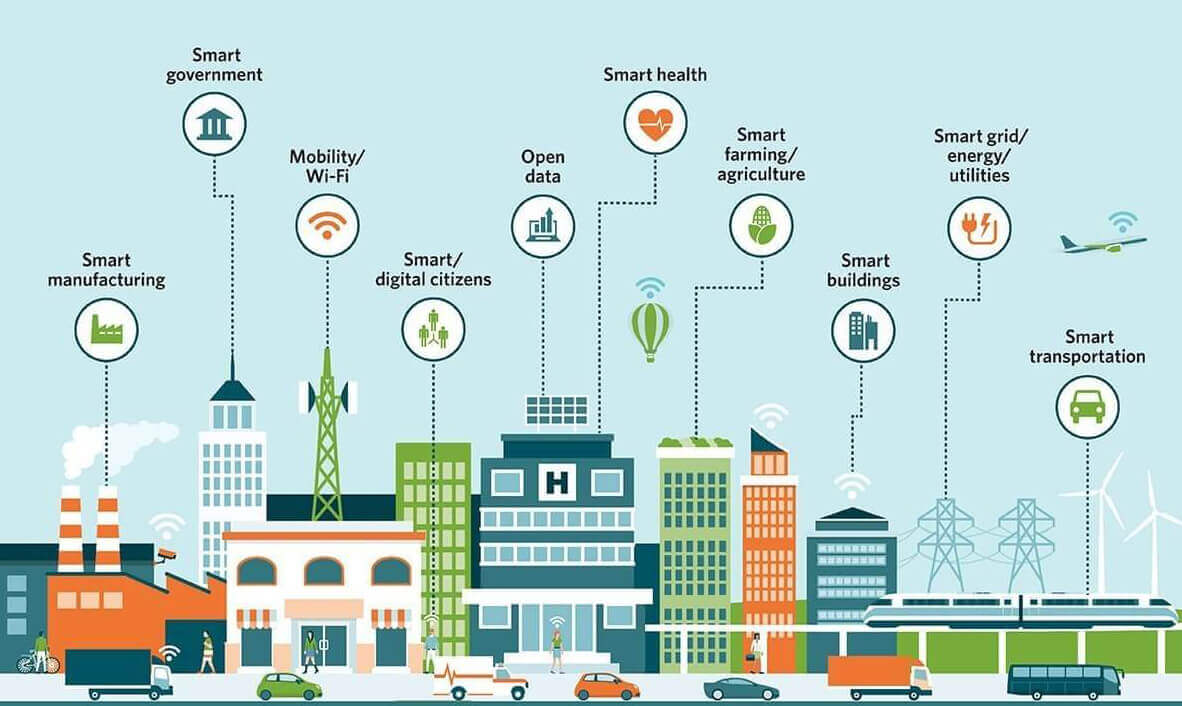
A smart city infrastructure helps its community to improve things like energy distribution, streamline trash collection, decrease traffic congestion, and improve air quality. For example:
Technology components of a Smart City
Before a city can become smart, it has to be connected. The required digital infrastructure includes a network of data-collecting sensors and devices, comprehensive broadband and wireless networks, and platforms on which data can be stored and shared. Because many applications require that individuals transmit and receive data anywhere, smartphones are a critical component.
IoT
With the rapid build-out of the Internet of Things (IoT), billions of “dumb” inanimate objects have become “smart”—that is, they have been outfitted with sensors and actuators and connected to the Internet. The IoT is now at work all around us.
RFID tags in packages track cargo shipments, GPS systems guide drivers to their destinations, streetlights dim when there is no car nearby, and smart thermostats turn off heat and air conditioning when rooms are unoccupied. Adoption has accelerated as the costs of IoT sensors, processing power, and cloud storage have steadily fallen.
Communications networks
Whereas IoT devices are the eyes and ears of a smart city, ubiquitous, stable and fast communication are its backbone. Ideally, free Wi-Fi will benefit tourists and residents without access to affordable mobile data.
Citizens can engage with smart city ecosystems in various ways using smartphones and other mobile devices, connected cars and homes.
Open data platforms
Smart technologies run on data—and cities, with their immense scale and complexity, generate endless streams of it. Data is generated by traffic flow, public transit systems, energy demand, crime incidents, waste disposal, noise, weather patterns, outbreaks of infectious disease, and countless other aspects of daily city life.
These huge amounts of data only become useful when applications turn them into useful and actionable information. Open data platforms do exactly that. They come in multiple forms, from centralized open data portals to specialized real-time travel information platforms. They allow for safe storage and adequate access to the different data sources that power a smart city, and they can provide the raw material for ongoing innovation.
The early days of smart city development has led to a misconception that smart cities are simply local government agencies purchasing software to operate subway and security systems more efficiently. But the reality has evolved into something broader and more collaborative. City governments do not have to provide every type of application and service themselves. There is room for private-sector companies, state-owned utilities, universities, foundations, and nonprofits to contribute. The ecosystem has become more intricate over time, with the degree and mix of private-sector participation varying from city to city. Technology is reconfiguring traditional roles and divisions of labor—and in a smart city, people and private companies actively participate.
This shift is particularly evident in new types of mobility systems. E-hailing services like Lyft and Uber; car sharing services like Miles and ShareNow; on-demand minibus services like Chariot; and numerous bike and scooter sharing services that have sprung up all across large cities.
Artificial Intelligence
Converting data sets into standardized, sharable formats and making them available on easy-to-use public portals gives external developers the raw material for making applications—and in particular, provides crucial input to AI systems, enabling them to perform more sophisticated functions.
With artificial intelligence, computers can analyze and learn from information at higher accuracy and speed than humans can, leading to faster and more accurate conclusions and decisions.
Blockchain
Cities have a variety of stakeholders and the exchange of data among stakeholders is essential for highly convenient urban services. Blockchain enables network participants to exchange data with a high degree of reliability and transparency without the need for a centralized administrator.
Blockchain technology will find a role in several Smart City applications such as for instance mobility as a service (MaaS). MaaS seamlessly connects multiple transportation systems to provide highly convenient mobility services. In the realization of MaaS, there is an effort to use blockchain for data exchange and revenue sharing among multiple transportation operators, and transportation may take place across cities. At the business model layer, it is necessary to solve the issues of data standardization – for example, for people movement information and that collected from Internet of Things (Iota) devices – and those of commercial models, such as how to distribute revenue among transportation operators.
A similar model could be applied to other sectors like energy. For example, Smart Dubai, is developing use cases for blockchain across multiple sectors such as finance, education and transportation. One of the projects is to facilitate enrollment procedures for students moving between emirates using blockchain.
APIs
Application programming interfaces (APIs) are a vital component of smart city development. APIs allow users to connect directly to the data they need without repeatedly searching through the huge volume that is produced. APIs can also help connect data and devices together to create a unique, shared information system that smart city services can be built on.
What are the benefits of smart cities?
Cities are using the data gained from their IoT networks to measure environmental conditions, set goals, and manage interventions that result in improvements for residents. They are tracking their fleets to optimize operations and implement preventive maintenance. They are monitoring the use of energy and water to increase efficiency. They are analyzing the flow of people to better plan public space.
Research by the McKinsey Global Institute (MGI) has shown that Smart City applications can improve some key quality-of-life indicators by 10 to 30 percent from the time they are introduced:
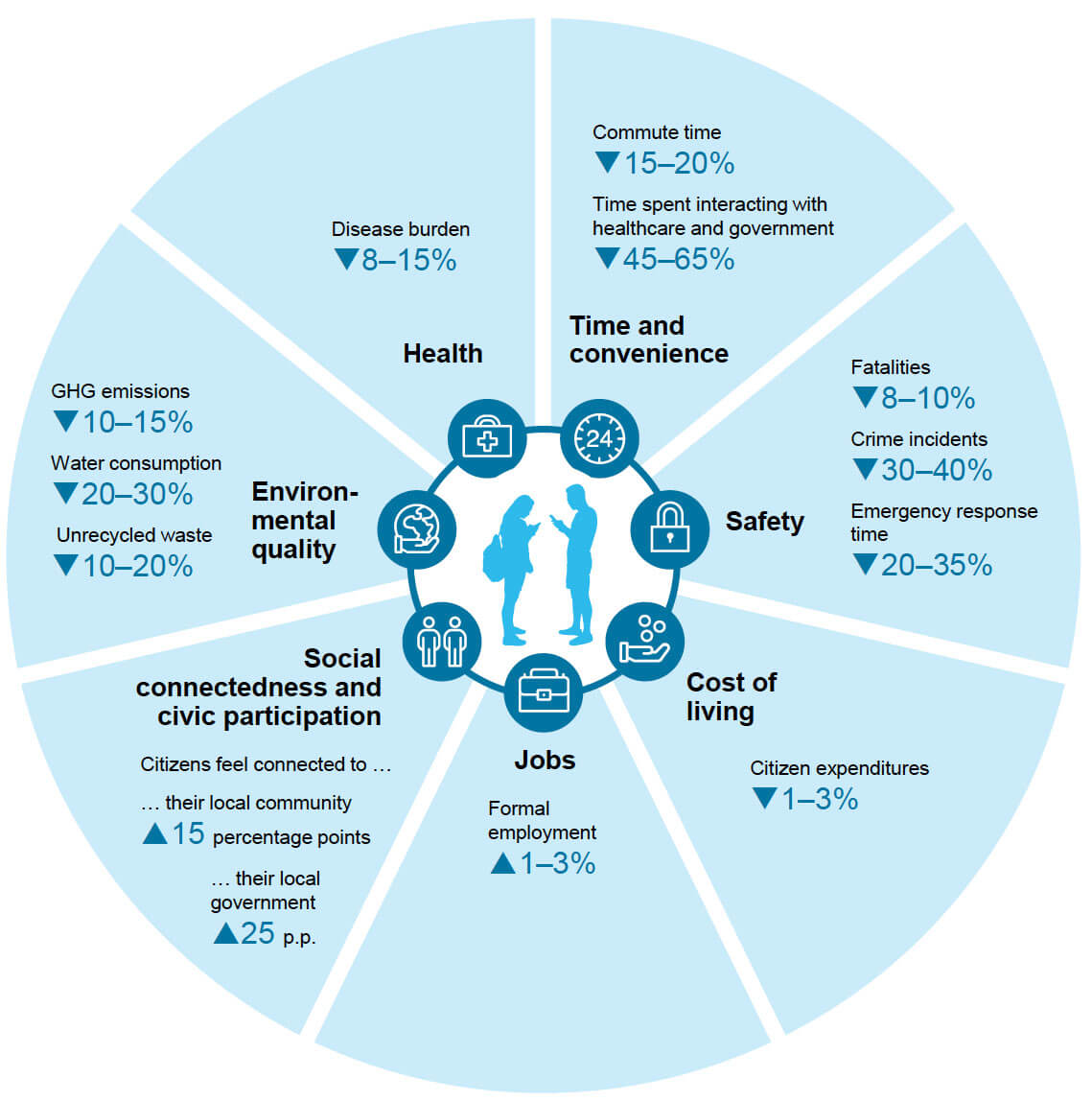
As the MGI report explains, “The wide range of outcomes reflects the fact that applications perform differently from city to city, depending on factors such as legacy infrastructure systems and on baseline starting points. Nearly half of the applications affect more than one aspect of the quality of life. Intelligent traffic signals, for instance, not only improve mobility but also lower emissions and make roads safer.”
Are Smart Cities Secure?
As with all online systems, there is a risk of cyber-attacks, hacking and data theft. At the moment technology is outpacing legal regulations, but legislation is already being put in place in different nations, such as the IoT Cybersecurity Improvement Act in the United States to help determine and establish minimum security requirements for connected devices in smart cities.
Leading Smart Cities of the World
In 2019, IMD Business School in Switzerland has started to publish a global ranking of smart cities. In its second edition, the IMD Smart City Index 2020 ranked 109 cities with Singapore as the leading smart city in the world. (Download the 2020 Smart City Index as PDF)
Singapore
In 2014, the nation state of Singapore created a Smart Nation initiative, overseen by a Smart Nation and Digital Government Office, with the goal to drive pervasive adoption of digital and smart technologies throughout Singapore.
New York City
NYC has been steadily increasing IoT technologies across the city with a number of applications. You can download a PDF of the New York City Internet of Things Strategy.
Among the City’s largest-scale IoT projects is the Department of Environmental Protection’s (DEP) integration of wirelessly connected water meters for buildings. These meters allow DEP to monitor water usage in over 800 000 buildings across the city, eliminating the need to send physical inspectors to read meters.
Another large-scale example is the Department of Citywide Administrative Services (DCAS)’s implementation of the nation’s largest tracking program for public vehicles.
Dubai
Since its inception in 2015, the Smart Dubai Office has launched over 130 initiatives in partnership with government and private sector entities. Some key initiatives include, the Dubai Data Initiative, the Dubai Blockchain Strategy, the Happiness Agenda, the Dubai AI Roadmap and the Dubai Paperless Strategy.
And then there are cities that are planned and built from scratch like New Songdo City in South Korea that was designed and created to be a smart city with IoT technology: computers are built into the buildings and streets, while sensors gather information on things like traffic flow and energy use.
Another smart city planned from scratch is Neom in Saudia Arabia, which plans to complete its first section by 2025.

Frequently Asked Questions about Smart Cities
What exactly is a smart city?
A smart city is an infrastructure framework that uses integrated and automated information and communication technologies to optimize city operations, improve sustainability goals, and enhance quality of life for citizens. It involves collecting data through sensors and devices, analyzing that data, and using the insights to make better decisions about city planning and management.
Why are smart cities becoming more important?
Smart cities are becoming increasingly important due to rapid urbanization. By 2050, nearly 70% of the world's population will live in urban areas, placing enormous pressure on infrastructure, resources, and services. Smart technologies help cities address these challenges by increasing efficiency, reducing waste, and improving service delivery to accommodate growing populations.
What technologies are essential for smart cities?
Essential technologies for smart cities include: Internet of Things (IoT) sensors and devices to collect data; high-speed communication networks (5G, Wi-Fi) to transmit data; open data platforms to store and share information; artificial intelligence to analyze data and make predictions; blockchain for secure transactions; and application programming interfaces (APIs) to connect various systems and applications.
How do smart cities benefit citizens?
Smart cities can improve citizens' quality of life in numerous ways, including: reducing commute times through intelligent traffic management; lowering pollution levels through environmental monitoring and green initiatives; enhancing public safety with connected surveillance and emergency response systems; improving health outcomes through better healthcare access and monitoring; and increasing citizen engagement through digital government services and participatory platforms.
What makes a smart city successful?
Successful smart cities combine technology with good governance. While technology provides the tools for optimization, governance ensures these tools are used effectively and ethically. Success factors include: clear vision and strategy; collaboration between government, private sector, and citizens; focus on solving real problems rather than implementing technology for its own sake; commitment to privacy and security; and inclusivity to ensure all citizens benefit.
What are some examples of smart city applications?
Smart city applications span numerous domains: smart traffic lights that adjust timing based on real-time conditions; connected trash bins that signal when they need emptying; smart utility grids that optimize energy distribution; environmental sensors that monitor air and water quality; digital government services that streamline bureaucratic processes; smart buildings that regulate energy usage; and mobile apps that provide real-time information about public transportation.
How do smart cities address sustainability?
Smart cities address sustainability through various initiatives: smart grids optimize energy usage and integrate renewable sources; intelligent transportation systems reduce emissions by minimizing congestion and promoting public transit; smart water management systems reduce waste and ensure quality; building automation systems reduce energy consumption; waste management systems optimize collection and recycling; and environmental monitoring provides data for policy decisions.
What challenges do smart cities face?
Smart cities face several challenges: cybersecurity risks from connected infrastructure; privacy concerns regarding data collection; digital divide issues that could exclude portions of the population; high implementation costs and funding constraints; interoperability between different systems and platforms; regulatory barriers; and governance challenges in coordinating among multiple stakeholders with different interests.

Check out our SmartWorlder section to read more about smart technologies.