Fermentation: Biochemistry, Major Types, and Role in Modern Biotechnology
What Is Fermentation?
Fermentation is the use of microorganisms to convert organic substrates into useful products. In its strict biochemical sense, fermentation is the anaerobic regeneration of the cofactor NAD+ that allows cells to extract energy from glucose without oxygen, yielding products such as ethanol or lactate. In broader industrial usage, the term covers any large-scale microbial cultivation, including aerobic processes that produce antibiotics, enzymes, and recombinant proteins. Both senses share the same hardware and most of the same engineering principles, and modern biotechnology relies on both.
Humans have used fermentation for thousands of years. Chemical residues from pottery at Jiahu, in central China, date a fermented beverage of rice, honey, and fruit to roughly 9,000 years ago, and similar antiquity is documented for cheese, beer, bread, and fermented vegetables across multiple continents. Scientific understanding began with Louis Pasteur, whose 1850s and 1860s experiments established that fermentation is caused by living microorganisms rather than spontaneous chemical decomposition. Eduard Buchner then showed in 1897 that cell-free yeast extracts could ferment sugar to ethanol, demonstrating that fermentation is catalyzed by specific enzymes.
Fermentation now spans a wider range of products and scales than any other biotechnology. Bread leavening relies on a few grams of baker’s yeast acting on dough at room temperature; recombinant insulin and other biopharmaceuticals are produced in stainless-steel bioreactors operating at tens of thousands of liters; and fuel ethanol is fermented at distilleries that hold 250,000 liters or more. Microbial enzymes, organic acids, antibiotics, vaccines, and an expanding catalog of animal-free proteins all reach the market through fermentation.
The Biochemistry of Fermentation
Fermentation begins with glycolysis, the ten-step pathway that converts one molecule of glucose into two molecules of pyruvate, generating two ATP and reducing two NAD+ to NADH along the way. In aerobic respiration, the NADH is reoxidized in the mitochondrial electron transport chain with oxygen as the terminal electron acceptor, yielding roughly 30–32 ATP per glucose molecule. When oxygen is absent or limited, this route is unavailable, and accumulating NADH would quickly halt glycolysis unless the cell can regenerate NAD+ by some other means.
Fermentation provides that route by transferring the electrons stored in NADH onto an organic acceptor instead of oxygen. In ethanol fermentation, pyruvate is decarboxylated to acetaldehyde and then reduced to ethanol; in homolactic fermentation, pyruvate is reduced directly to lactate. Both reactions regenerate NAD+, sustain glycolytic flux, and yield a net 2 ATP per glucose – an order of magnitude less than respiration but enough to support rapid growth on abundant substrates. The same logic applies to butanol, propionate, and acetate fermentations.
Different microbes channel pyruvate into different end products, and many use mixed pathways that produce several compounds at once. Saccharomyces cerevisiae is the classic ethanol fermenter, while lactic acid bacteria such as Lactobacillus, Streptococcus, and Lactococcus dominate lactic fermentations. Human muscle cells perform lactic acid fermentation when oxygen demand briefly exceeds supply during intense exercise, regenerating NAD+ to sustain glycolysis until oxidative metabolism resumes – biochemistry shared with the bacteria that ferment milk into yogurt.
Major Types of Fermentation
The principal fermentation types are distinguished by which organism is doing the work and which end products result. The table below summarizes the most industrially significant types, the organisms that drive them, the metabolites they produce, and the products they yield at commercial scale. Acetic acid “fermentation” is technically an aerobic oxidation of ethanol rather than a strict NAD+-regeneration pathway, but it is universally classified with fermentations in industrial practice and is included for that reason.
| Type | Key organisms | End products | Industrial uses |
|---|---|---|---|
| Alcoholic | Saccharomyces cerevisiae; engineered yeasts | Ethanol, CO2 | Beer, wine, sake, bread, fuel ethanol |
| Lactic acid (homofermentative) | Lactobacillus delbrueckii, Streptococcus thermophilus | Lactate | Yogurt, hard cheese, polylactic acid |
| Lactic acid (heterofermentative) | Leuconostoc, Lactobacillus brevis | Lactate, ethanol, acetate, CO2 | Sourdough, kefir, kimchi, sauerkraut |
| Acetic acid | Acetobacter, Gluconobacter | Acetic acid | Vinegar, food acidulants |
| Propionic acid | Propionibacterium freudenreichii | Propionate, acetate, CO2 | Swiss cheese flavor and eyes |
| Acetone–butanol–ethanol (ABE) | Clostridium acetobutylicum | Acetone, butanol, ethanol | Renewable solvents, biofuels |
| Mold organic acid | Aspergillus niger, Rhizopus | Citric, gluconic, itaconic acids | Food acidulants, chelators, polymer precursors |
The non-obvious tradeoff across these types is between yield and product complexity. Single-product fermentations such as alcoholic and homolactic give clean streams that are easy to purify but commit the cell’s metabolism to one molecule. Mixed-product fermentations such as ABE and heterolactic deliver several valuable molecules per gram of sugar but raise downstream-processing costs. Modern industrial design therefore picks an organism not just for what it makes but for what it does not make alongside it, and metabolic engineering is often used to redirect flux toward the most valuable product.
Fermented Foods and the Gut
Industrial fermented food production typically relies on defined starter cultures – deliberately selected and propagated strains of bacteria, yeasts, or molds – rather than spontaneous environmental microbiota. A standardized yogurt fermentation, for example, uses a 1:1 co-culture of Streptococcus thermophilus and Lactobacillus delbrueckii subsp. bulgaricus, in which the two organisms exchange metabolites and together acidify the milk to pH 4.5 within a few hours. Cheese, beer, soy sauce, and miso fermentations rely on similarly characterized starter consortia.
The 2021 ISAPP consensus statement defined fermented foods as “foods made through desired microbial growth and enzymatic conversions of food components,” a definition designed to clarify what does and does not qualify. A growing body of clinical research links their consumption to gut microbiome diversification and modest improvements in inflammatory and metabolic markers. Mechanisms include direct delivery of lactic acid bacteria and yeasts, fermentation-generated bioactive peptides, exopolysaccharides, and short-chain fatty acid precursors that interact with host metabolism.
Fermentation also occurs continuously inside the human colon. Resident gut bacteria ferment dietary fibers and resistant starches that escape digestion in the small intestine, producing the short-chain fatty acids acetate, propionate, and butyrate. Butyrate is the preferred energy substrate of colonic epithelial cells and contributes to gut barrier integrity, while propionate and acetate are absorbed into circulation and influence host metabolism, immunity, and inflammation. The same biochemistry that produces sauerkraut and kimchi runs in every healthy adult.
Industrial Fermentation: From Bioreactors to Biopharmaceuticals
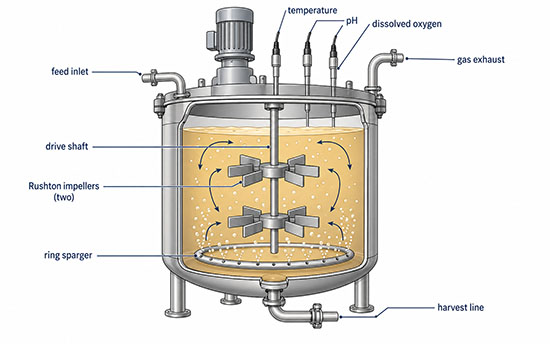
Industrial fermentation is carried out in bioreactors ranging from a few liters in research and development to more than 250,000 liters in fuel ethanol distilleries. The dominant configuration is the stirred-tank reactor, with mechanical agitation, sparged air or oxygen, and tightly controlled temperature, pH, and dissolved oxygen. Operations run in batch, fed-batch, or continuous mode: fed-batch is standard for high-value products such as recombinant proteins and antibiotics, because incremental substrate addition prevents the overflow metabolism that depresses yields at high cell densities.
The classical industrial fermentations have shaped the modern bioprocessing industry. Citric acid has been produced commercially by Aspergillus niger fermentation since 1917 and now exceeds 2 million tonnes per year. Penicillin scale-up in the 1940s – pioneered through the wartime US-UK consortium and Pfizer’s deep-tank submerged process – established submerged aerobic fermentation as the platform for antibiotic production, eventually delivering streptomycin, tetracycline, and the cephalosporins. Glutamate fermentation by Corynebacterium glutamicum, discovered in 1957, supplies the world’s monosodium glutamate and a portfolio of feed amino acids.
The 1979 demonstration by David Goeddel and colleagues at Genentech that E. coli carrying a chemically synthesized human insulin gene on a plasmid could express functional insulin chains marked the start of recombinant DNA-based biopharmaceutical manufacturing, and recombinant insulin reached the market in 1982 as the first product of genetic engineering. Microbial fermentation today supplies recombinant growth hormone, interferons, vaccines, and an expanding catalog of enzymes; mammalian cell culture uses the same bioreactor engineering principles to produce the monoclonal antibodies that dominate the biologics market.
Precision Fermentation and the Future of Sustainable Production
Precision fermentation extends recombinant protein manufacturing into food, materials, and consumer chemicals. Engineered yeasts, filamentous fungi, and bacteria produce milk proteins, egg-white proteins, collagen, hemoglobin, structural proteins, and dietary fats that are molecularly identical to their animal counterparts but are made entirely in stainless-steel bioreactors. The term distinguishes this work from traditional food fermentation by its molecular specificity: instead of cultivating a microbial community to transform a substrate, a single engineered strain produces a single defined target molecule.
Achieving the cost targets needed for food applications requires production titers above 50 grams per liter – several orders of magnitude higher than typical pharmaceutical protein processes – which has made strain engineering, fermentation optimization, and downstream process development the central technical challenges of the field. Synthetic biology tools shorten strain construction times, AI-guided metabolic modeling predicts optimal genetic edits, and digital-twin bioreactors enable real-time process control. Each of these capabilities was a frontier research topic five years ago and is becoming routine practice.
Companies including Perfect Day, The EVERY Company, and Impossible Foods have brought recombinant whey proteins, ovalbumin, and soy leghemoglobin to commercial release in beverages, cheese analogs, and plant-based meat under regulatory pathways such as the United States GRAS process. Beyond food, precision fermentation is increasingly used to produce industrial enzymes, fragrances, dyes, and pharmaceutical intermediates whose plant- or animal-derived supply is constrained, expensive, or volatile. Together these applications position fermentation as a primary platform for decarbonized chemical manufacturing alongside its traditional roles in food and medicine.
Frequently Asked Questions
What is the difference between fermentation and cellular respiration? Both pathways extract energy from organic molecules, but they differ in their final electron acceptor and energy yield. Cellular respiration uses oxygen (or another inorganic terminal electron acceptor) to fully oxidize glucose to carbon dioxide and water, generating roughly 30–32 ATP per glucose molecule. Fermentation regenerates NAD+ internally by reducing pyruvate or its derivatives to organic end products such as ethanol or lactate, yielding only the 2 ATP produced during glycolysis. Fermentation therefore allows energy production when oxygen is absent or when the cell deliberately avoids oxidative phosphorylation.
Are all fermented foods alcoholic? No. Alcoholic fermentation by yeasts produces beer, wine, sake, and bread dough, but most fermented foods rely on lactic acid bacteria, acetic acid bacteria, or filamentous fungi rather than yeasts. Yogurt, kefir, cheese, sauerkraut, kimchi, and traditional sourdough are produced by lactic acid fermentation and contain little or no ethanol. Vinegar is produced by acetic acid bacteria that oxidize ethanol to acetic acid. Soy sauce and miso involve mixed fermentations dominated by the mold Aspergillus oryzae together with lactic acid bacteria and yeasts.
What is precision fermentation and how does it differ from traditional fermentation? Precision fermentation uses genetically engineered microorganisms – typically bacteria, yeasts, or filamentous fungi – to produce a single, well-defined target molecule such as a recombinant whey protein, an enzyme, or a flavor compound. Traditional fermentation relies on the natural metabolism of unmodified microbial communities to transform substrates into a complex mixture of end products that gives a fermented food its characteristic flavor and texture. The two approaches share the same bioreactor hardware and many of the same process principles, but precision fermentation prioritizes molecular specificity, reproducibility, and high product titer.
Why does fermentation preserve food? Fermenting microbes lower the pH of the food by producing lactic, acetic, or other organic acids, and many simultaneously produce ethanol, carbon dioxide, and antimicrobial peptides such as bacteriocins. The combined acidification, oxygen depletion, and direct microbial competition create conditions in which most spoilage organisms and foodborne pathogens cannot grow. This is why fermented vegetables, cured sausages, hard cheeses, and traditional beers remained edible for months without refrigeration in pre-industrial societies, and why fermentation is still used today as a non-thermal preservation strategy.
What is the difference between submerged and solid-state fermentation? Submerged fermentation is the dominant industrial format, in which microorganisms grow suspended in a liquid medium inside a stirred-tank bioreactor that controls aeration, pH, and temperature. Solid-state fermentation grows microorganisms – typically filamentous fungi – on a moist solid substrate such as bran, soybean cake, or rice with little free water, mimicking the natural environment of these organisms. It is used for traditional foods such as koji, tempeh, and soy sauce starter, and for industrial production of certain enzymes where it can give higher yields than submerged culture.
Further Reading
Proceedings of the National Academy of Sciences, Expression in Escherichia coli of Chemically Synthesized Genes for Human Insulin
Proceedings of the National Academy of Sciences, Fermented Beverages of Pre- and Proto-Historic China
Nature Reviews Gastroenterology & Hepatology, The International Scientific Association for Probiotics and Prebiotics (ISAPP) Consensus Statement on Fermented Foods
Nature Reviews Microbiology, Microbial Interactions and Ecology in Fermented Food Ecosystems
Annual Review of Chemical and Biomolecular Engineering, Biopharmaceutical Manufacturing: Historical Perspectives and Future Directions
Annual Review of Food Science and Technology, The Next Food Revolution Is Here: Recombinant Microbial Production of Milk and Egg Proteins by Precision Fermentation
Current Opinion in Biotechnology, Precision Fermentation for Improving the Quality, Flavor, Safety, and Sustainability of Foods