

Cleantech and Environmental News – Latest Headlines
 Subscribe to our Cleantech News feed

Power play
Study shows how more R+D funding can accelerate the world energy revolution.
March 15, 2016 Read more
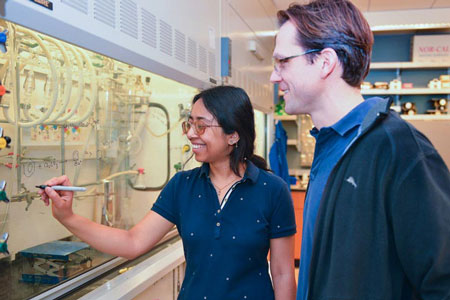
Scientists make renewable plastic from carbon dioxide and plants
Scientists have discovered a novel way to make plastic from carbon dioxide and inedible plant material, such as agricultural waste and grasses. Researchers say the new technology could provide a low-carbon alternative to plastic bottles and other items currently made from petroleum.
March 9, 2016 Read more

Personalized energy
The local food movement is booming. Can we do the same for electricity?
March 8, 2016 Read more

Modernizing a technology from the vacuum tube era to generate cheap power
Scientists look to thermionic energy conversion to provide clean and efficient power generation.
March 4, 2016 Read more

Re-thinking renewable energy predictions
Researchers explored some of the scientific problems involved in the fluctuations of renewable energy and how to better predict energy outputs.
March 3, 2016 Read more

New way to reduce plant lignin could lead to cheaper biofuels
Scientists have shown for the first time that an enzyme can be tweaked to reduce lignin in plants. Their technique could help lower the cost of converting biomass into carbon-neutral fuels to power your car and other sustainably developed bio-products.
March 2, 2016 Read more

Researchers' new advance in quest for second generation biofuels
An international team of researchers has made a significant step forward in understanding the processes naturally occurring enzymes use to degrade microbe-resistant biomass, a key aim in the development of biofuels.
March 2, 2016 Read more
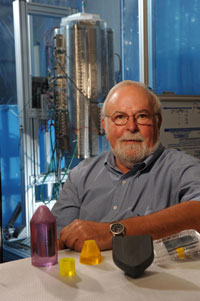
Researchers make key improvement in solar cell technology
Researchers improved the maximum voltage available from a cadmium telluride solar cell, overcoming a practical limit that has been pursued for six decades and is key to improving its efficiency.
February 29, 2016 Read more
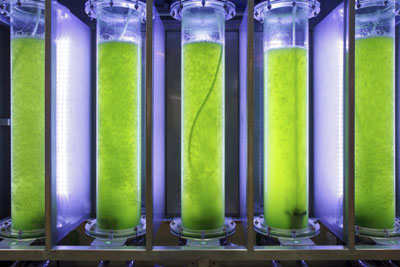
Biofuels from algae: A budding technology yet to become viable
Despite high expectations and extensive research and investment in the last decade, technological options are still in developing stages and key resources for algal growth are still too onerous for economically viable production of algal biofuels.
February 29, 2016 Read more

Optimizing biofuel production from algae using carbon dioxide emissions
Scientists report an optimized way of producing biofuel from algae that also removes CO2 emissions from the environment.
February 24, 2016 Read more

Better technology could take agriculture halfway towards climate targets
Researchers studied a range of measures for cutting food-related emissions. Besides reductions in beef and dairy consumption, they found that technology improvements will be crucial. Under favorable conditions, better technology could cut these emissions by as much as 50 percent.
February 24, 2016 Read more
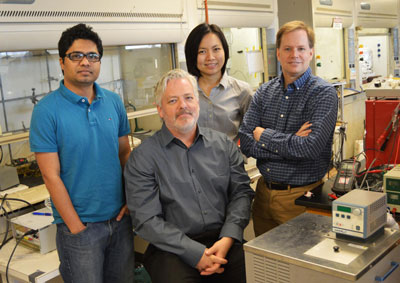
Proven one-step process to convert CO2 and water directly into liquid hydrocarbon fuel
A team of chemists and engineers have proven that concentrated light, heat and high pressures can drive the one-step conversion of carbon dioxide and water directly into useable liquid hydrocarbon fuels.
February 22, 2016 Read more

Biofuel tech straight from the farm
Natures figured it out already, how to best break down food into fuel. Now scientists have caught up, showing that fungi found in the guts of goats, horses and sheep could help fill up your gas tank too.
February 18, 2016 Read more
Organic waste for sustainable batteries
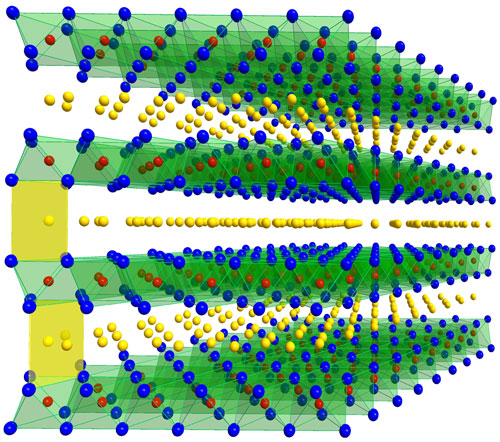
A carbon-based active material produced from apple leftovers and a material of layered oxides might help reduce the costs of future energy storage systems. Both were found to have excellent electrochemical properties and stand for the environmentally compatible and sustainable use of resources.
February 18, 2016 Read more

Fuels that do not produce any hazardous exhaust gases
Modern combustion engines become increasingly economical and clean. Engine developers, however, are now facing the technical conflict of whether fuel consumption or exhaust gas emission is to be further reduced. This Gordian knot might be cut by chemists' and engineers' further development of sophisticated fuels that help optimize combustion in the engine.
February 15, 2016 Read more

Engineers develop hybrid technology to create biorenewable nylon
Engineers have found a way to combine a genetically engineered strain of yeast and an electrocatalyst to efficiently convert sugar into a new type of nylon.
February 9, 2016 Read more

Realizing your true (solar) potential
Mapping website tells building owners if going solar is worth the cost of installation.
February 5, 2016 Read more
Battery technology could charge up water desalination (w/video)
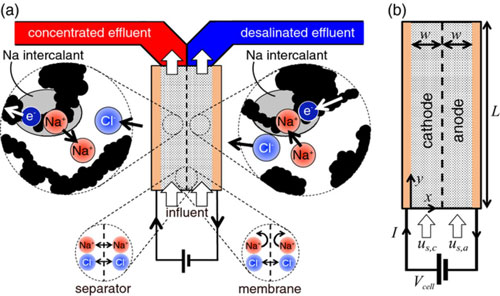
The technology that charges batteries for electronic devices could provide fresh water from salty seas. Electricity running through a salt water-filled battery draws the salt ions out of the water.
February 4, 2016 Read more