

Nanotechnology News – Latest Headlines
High Performance Computing in Materials Science: ThyssenKrupp Steel Europe to fund young researchers
From January 1, 2012 ThyssenKrupp Steel Europe AG will be funding a group of young researchers from Ruhr University Bochum. The computer scientists and mathematicians will carry out research jointly with the Interdisciplinary Centre for Advanced Materials Simulation (ICAMS) over a period of six years.
October 25, 2011 Read more
Wie Zellen mit Biomaterialien verschmelzen
Marga Lensen forscht mit dem Sofja-Kovalevskaja-Preis beim Exzellenzcluster UniCat an der TU Berlin.
October 25, 2011 Read more
2012 Symposia on VLSI Technology and Circuits announcc calls for papers
The 2012 Symposia on VLSI Technology and Circuits, to be held at the Hilton Hawaiian Village in Honolulu, HI, June 12-14, 2012 (Technology) and June 13-15, 2012 (Circuits), announce their respective Calls for Papers.
October 24, 2011 Read more
UAlbany NanoCollege launches Solar Energy Development Center to accelerate commercialization of innovative photovoltaics technologies
CNSE's Halfmoon, NY facility will retain 17 green collar jobs and create opportunities to grow high-tech workforce while enabling advances in CIGS-based thin film solar cells.
October 24, 2011 Read more

Nanoparticles and their size may not be big issues
If you've ever eaten from silverware or worn copper jewelry, you've been in a perfect storm in which nanoparticles were dropped into the environment, say scientists at the University of Oregon.
October 24, 2011 Read more

The exotic topological states of matter
Researchers in Austria have come up with new ideas to engineer exotic, so-called 'topological states of matter' in quantum mechanical many-body systems.
October 24, 2011 Read more
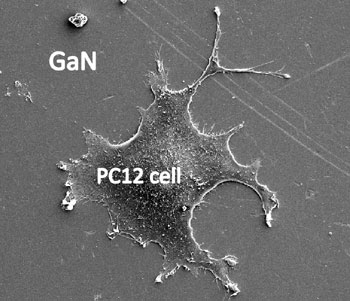
Semiconductor material gallium nitride is non-toxic and is compatible with human cells
Researchers from North Carolina State University and Purdue University have shown that the semiconductor material gallium nitride (GaN) is non-toxic and is compatible with human cells - opening the door to the material's use in a variety of biomedical implant technologies.
October 24, 2011 Read more
Biodesign researchers to develop new reagent pipeline for molecular medicine
New class of affinity reagents, DNA synbodies, gets four million dollar NIH boost.
October 24, 2011 Read more
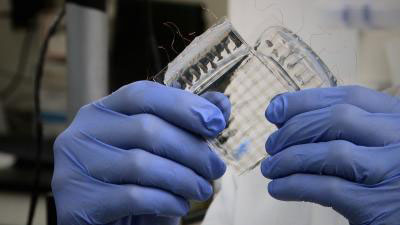
Transparent, super-stretchy skin-like sensor
Imagine having skin so supple you could stretch it out to more than twice its normal length in any direction - repeatedly - yet it would always snap back completely wrinkle-free when you let go of it. You would certainly never need Botox.
October 24, 2011 Read more
Self-organization gives rise to more efficient organic solar cells
The mechanisms and the timescale of charge separation in photovoltaics have been the subject of controversial scientific debate for many years. Scientists ave now been able to dissect the process in detail.
October 24, 2011 Read more
Relaxation dynamics of 2D nanoparticle systems
Researchers have developed a novel approach in which two orthogonal Wilhelmy plates have been utilized to measure the surface pressure in the two directions.
October 24, 2011 Read more
Leiden has two of the world's most advanced microscopes
NeCEN, a new high quality centre for electron microscopy, opens its doors in Leiden on October 27th. NeCEN has two of the most advanced cryo-transmission electron microscopes worldwide.
October 24, 2011 Read more
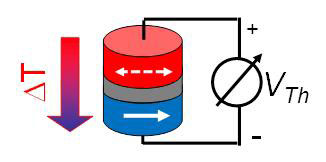
Magnetic nanoswitch for thermoelectric voltages
Due to a recently discovered effect in magnetic tunnel structures, thermoelectric voltages in nano-electronic junctions can be controlled.
October 24, 2011 Read more

Mit Nano-Cellulose zu neuartigen Verbundwerkstoffen
Empa-Forschende entwickelten ein Herstellungsverfahren fuer Nano-Cellulosepulver, aus dem sich Polymerverbundwerkstoffe herstellen lassen, die beispielsweise als Leichtbauwerkstoff im Automobilbau oder als Membran- oder Filtermaterial in der Biomedizin Verwendung finden koennten.
October 24, 2011 Read more
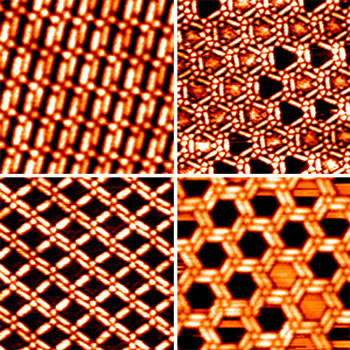
Shape shifting nanomaterials
Two-dimensional molecular porous networks of various structures can be produced from the same components by exploiting the hierarchy of hydrogen bonds.
October 24, 2011 Read more
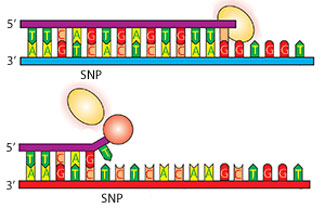
Gold nanoparticles speed up discovery of the genetic patterns responsible for disease
Many illnesses are now being linked to particular patterns of mutations in an individual's DNA. However, the search for these patterns, known as haplotypes, is generally a slow and painstaking process. Yongyong Shi and colleagues from Shanghai Jiao Tong University in China have now shown how gold nanoparticles can be used to turn haplotyping into a high-throughput process.
October 24, 2011 Read more
 Subscribe to our Nanotechnology News feed