

Nanotechnology News – Latest Headlines
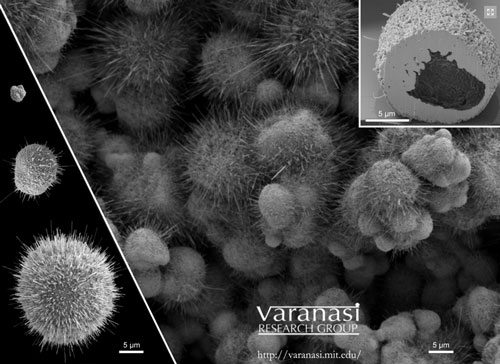
Bristly particles could be boon for powerplants
A well-known method of making heat sinks for electronic devices is a process called sintering, in which powdered metal is formed into a desired shape and then heated in a vacuum to bind the particles together. But in a recent experiment, some students tried sintering copper particles in air and got a big surprise.
October 17, 2011 Read more
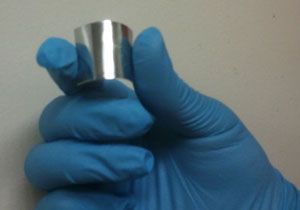
Silver nanoparticle ink for large-scale production of flexible electronics
Researchers have prepared silver films for flexible electronics at mild fabrication temperatures.
October 17, 2011 Read more
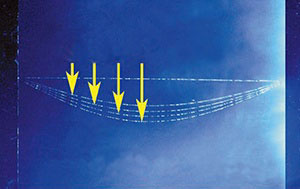
Carbon nanotubes: Pure storage power
Ultralong, defect-free carbon nanotubes could store mechanical energy at high energy densities for use in nano-devices.
October 17, 2011 Read more
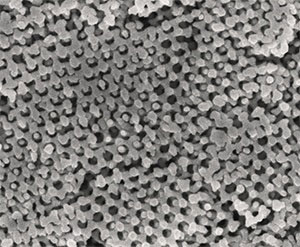
Nanoporous metals: Straight from the template
A templating method yields well-defined nanoporous nickel structures through the self-assembly of block copolymers.
October 17, 2011 Read more
Researchers do precise gene therapy without a needle
For the first time, researchers have found a way to inject a precise dose of a gene therapy agent directly into a single living cell without a needle. The technique uses electricity to "shoot" bits of therapeutic biomolecules through a tiny channel and into a cell in a fraction of a second.
October 16, 2011 Read more
Could a computer one day rewire itself?
Scientists develop new nanomaterial that 'steers' current in multiple dimensions.
October 16, 2011 Read more
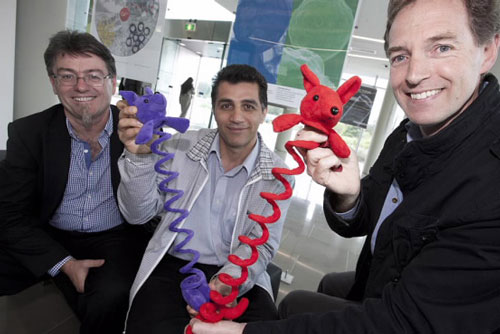
New muscles for nanorobots (w/video)
The possibility of a doctor using tiny robots in your body to diagnose and treat medical conditions is now one step closer to becoming reality thanks to research led by a team from the University of Wollongong.
October 16, 2011 Read more
Graphene: Piecing it together
In this progress report, the properties of graphene that make it so attractive as a material for electronics is introduced to the reader. The focus then centers on current synthesis strategies for graphene and their weaknesses in terms of electronics applications are highlighted.
October 15, 2011 Read more
Webinar: What is the US plan for environmental, health, and safety in nanotechnology?
Federal Agencies participating in the National Nanotechnology Initiative (NNI) are hosting a webinar to announce the release of the 2011 NNI Environmental, Health, and Safety (EHS) Research Strategy and to the discuss the development of this document and its key focus areas.
October 15, 2011 Read more
Frustration inspires new form of graphene
Researchers at Northwestern University have developed a new form of graphene that does not stack. The new material - inspired by a trash can full of crumpled-up papers - is made by crumpling the graphene sheets into balls.
October 14, 2011 Read more
A hidden order unraveled - microscopic views on quantum fluctuations
Fluctuations are fundamental to many physical phenomena in our everyday life, such as the phase transitions from a liquid into a gas or from a solid into a liquid. But even at absolute zero temperature, where all motion in the classical world is frozen out, special quantum mechanical fluctuations prevail that can drive the transition between two quantum phases. Researchers have now succeeded in directly observing such quantum fluctuations.
October 14, 2011 Read more
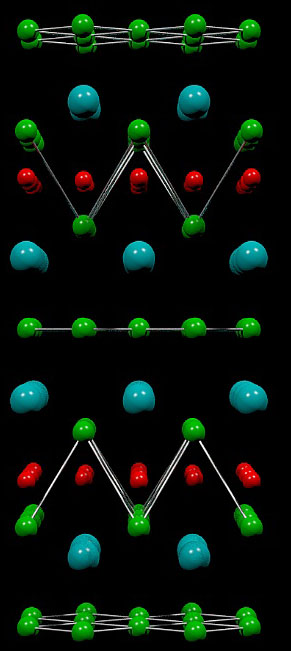
Researchers discover material with graphene-like properties
Together with colleagues from Korea, Dr. Frederik Wolff-Fabris from the Helmholtz-Zentrum Dresden-Rossendorf (HZDR) has now developed and analyzed a material which possesses physical properties similar to graphene.
October 14, 2011 Read more
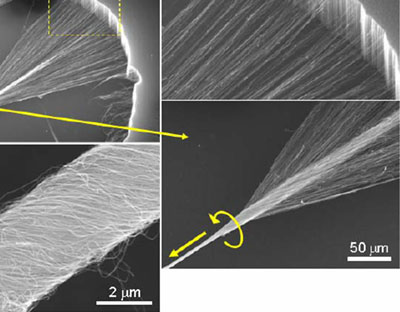
Researchers invent carbon nanotube artificial muscles with the strength, flexibility of elephant trunk (w/video)
An international team of researchers has invented new artificial muscles strong enough to rotate objects a thousand times their own weight, but with the same flexibility of an elephant's trunk or octopus limbs.
October 14, 2011 Read more
Swedish-Italian workshop on nanoscience and medical technology
The event, held on September 29-30 in Stockholm, was quite timely in view of the forthcoming calls for European projects, in particular the 7th EU Framework Programme in the fields of Health and Nanotechnology, with deadlines for proposal submission in November-December 2011.
October 14, 2011 Read more
Review of 2007-09 literature on toxcological and health-effects relating to six nanomaterials
NICNAS, the National Industrial Chemicals Notification and Assessment Scheme of the Australian Government regulator of industrial chemicals, commissioned a review and analysis available literature from 2007-2009 on six industrial nanomaterials, chosen as they were considered to already be in, or close to, commercial use in Australia.
October 14, 2011 Read more
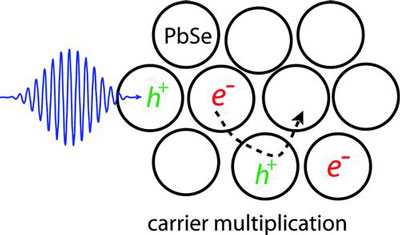
Three for the price of one - mobile electrons multiplied in quantum dot films
Researchers of the Opto-electronic Materials section of the TU Delft and Toyota Europe have demonstrated that several mobile electrons can be produced by the absorption of a single light particle in films of coupled quantum dots. These multiple electrons can be harvested in solar cells with increased efficiency.
October 14, 2011 Read more
 Subscribe to our Nanotechnology News feed