

Nanotechnology News – Latest Headlines
Nanotechnology researchers develop color-changing stress sensor
It is helpful - even life-saving - to have a warning sign before a structural system fails, but, when the system is only a few nanometers in size, having a sign that's easy to read is a challenge. Now, thanks to a clever bit of molecular design by University of Pennsylvania and Duke University bioengineers and chemists, such warning can come in the form of a simple color change.
August 18, 2011 Read more
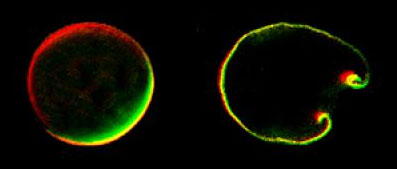
Researchers found a way to create every imaginable knot inside a liquid crystal
Silica microspheres in liquid crystals offer the possibility of creating every knot conceivable.
August 18, 2011 Read more
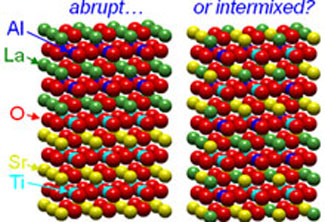
Complex oxide interfaces are more complex than previously thought
Using experimental resources at EMSL, scientists from the Pacific Northwest National Laboratory and University College London have shown that intermixing occurs at the interface of two perovskites - lanthanum aluminate and strontium titanate - for a range of compositions
August 18, 2011 Read more

University of Arkansas for Medical Sciences nanomedicine program receives $250000 gift
A $250,000 contribution today by ATT Arkansas in honor of outgoing board member Patti Upton gave a significant boost to the nanomedicine research program in the Winthrop P. Rockefeller Cancer Institute at the University of Arkansas for Medical Sciences.
August 18, 2011 Read more

Are those liquids explosive?
A team of researchers from the University of the Basque Country (Spain) has developed a method to determine the chemical composition of liquids seized by police and suspected to be explosive.
August 18, 2011 Read more
IBM unveils cognitive computing chips designed to emulate abilities of the brain
Today, IBM researchers unveiled a new generation of experimental computer chips designed to emulate the brain's abilities for perception, action and cognition. The technology could yield many orders of magnitude less power consumption and space than used in today's computers.
August 18, 2011 Read more
XXV International Conference on Photochemistry held in Beijing
The XXV International Conference on Photochemistry (ICP2011) was held in Beijing on August 7-12, 2011. It was for the first time that the ICP was held in China.
August 18, 2011 Read more
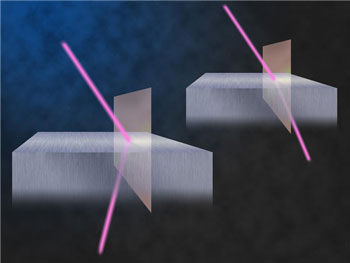
Bending light the 'wrong' way
For years, scientists have been trying to create special materials with a negative refractive index - their optical properties are quite different from those of normal materials. Researchers at the TU Vienna could now show that even common metals can have a negative refractive index, if they are placed in a magnetic field.
August 18, 2011 Read more
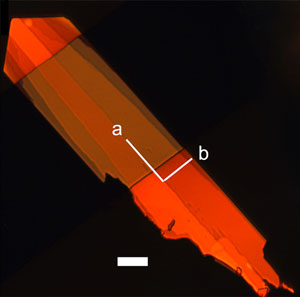
Faster organic semiconductors for flexible displays can be developed quickly with new method
A team led by researchers at Stanford and Harvard universities has not only created a new material for high-speed organic semiconductors, it has come up with a new approach that can take months, even years, off the development timeline.
August 18, 2011 Read more
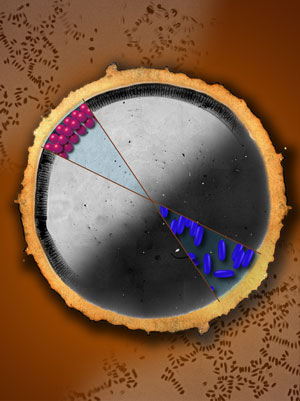
The future of inks, paints and coatings takes shape (w/video)
Researchers determine that particle shape affects the 'coffee ring effect'.
August 17, 2011 Read more
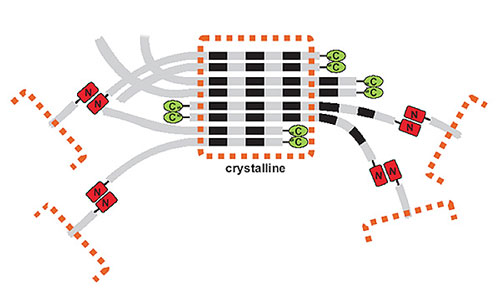
Why don't spiders drop off of their threads?
The source of spider silk's extreme strength unveiled.
August 17, 2011 Read more
Manipulating nanoparticles' surface chemistry holds medical promise
Swapping the chemical groups that originally coat iron oxide nanoparticles and making the particles soluble in biological solvents shows great promise for medical applications, such as drug delivery and contrast agents.
August 17, 2011 Read more
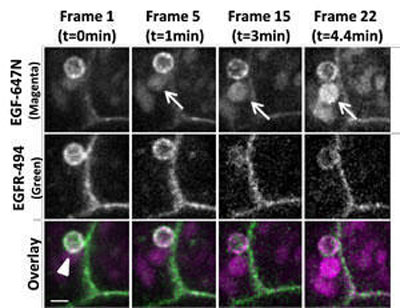
Research team achieves first 2-color STED microscopy of living cells
Researchers are able to achieve extremely high-resolution microscopy through a process known as stimulated emission depletion (STED) microscopy. This cutting-edge imaging system has pushed the performance of microscopes significantly past the classical limit, enabling them to image features that are even smaller than the wavelength of light used to study them.
August 17, 2011 Read more
YoungNanoProfessionals-Workshop: Nanotechnologische Aspekte der Energiespeicherung
YoungNanoProfessionals (YNP), eine Initiative der Aktionslinie Hessen-Nanotech, des NanoNetzwerkHessen und der DECHEMA vernetzt junge Wissenschaftler auf dem Gebiet der Nanowissenschaften und bietet Ihnen eine Plattform zum intensiven Austausch ueber aktuelle Forschung und Entwicklungen im Nano-Business, berufliche Aussichten und die Ergebnisse der Sicherheitsforschung an Nanomaterialien.
August 17, 2011 Read more

Quantum optical link sets new time records
Entanglement between two atomic systems is very fragile and up until now researchers have only been able to maintain the entanglement for a fraction of a second. But in new experiments at the Niels Bohr Institute researchers have succeeded in setting new records and maintaining the entanglement for up to an hour.
August 17, 2011 Read more
Researchers find way to align gold nanorods on a large scale
Researchers from North Carolina State University have developed a simple, scalable way to align gold nanorods, particles with optical properties that could be used for emerging biomedical imaging technologies.
August 17, 2011 Read more
 Subscribe to our Nanotechnology News feed