

Nanotechnology News – Latest Headlines
Stretching improves efficiency of material used in batteries, fuel cells and water purification
Researchers at Virginia Tech in Blacksburg, Va. recently found a way to improve electricity generating fuel cells, potentially making them more efficient, powerful and less expensive. Specifically, they discovered a way to speed up the flow and filtering of water or ions, which are necessary for fuel cells to operate.
June 21, 2011 Read more
Self-cleaning anodes could facilitate cost-effective coal-powered fuel cells
Using barium oxide nanoparticles, researchers have developed a self-cleaning technique that could allow solid oxide fuel cells to be powered directly by coal gas at operating temperatures as low as 750 degrees Celsius. The technique could provide a cleaner and more efficient alternative to conventional power plants for generating electricity from the nation's vast coal reserves.
June 21, 2011 Read more
Improving concrete performance with nanotechnology (w/video)
Every day, concrete structures crack and erode prematurely due to Alkali Silica Reactivity (ASR), a chemical reaction that causes fissures in the material as it sets. Jon Belkowitz, a doctoral student at Stevens Institute of Technology, plans to put an end to this problem through his study of chemical reactions within concrete at the nanoscale.
June 21, 2011 Read more
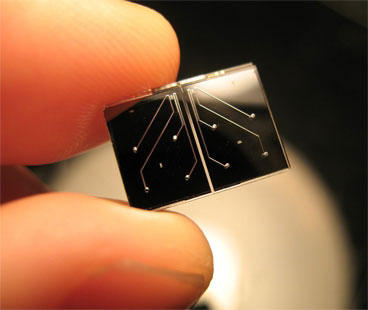
How dense is a cell?
Combining an ancient principle with new technology, MIT researchers have devised a way to answer that question.
June 21, 2011 Read more
KLA-Tencor and SEMATECH partner to advance EUV lithography technology at UAlbany NanoCollege
Collaboration will drive the development of critical processes for advanced defect detection to support EUVL introduction.
June 21, 2011 Read more
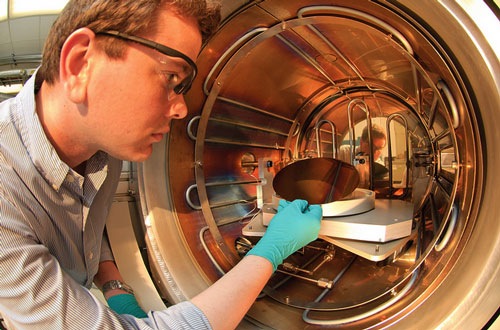
Nanotechnology pushes battery life to eternity
A simple tap from your finger may be enough to charge your portable device thanks to a discovery made at RMIT University and Australian National University.
June 21, 2011 Read more
Battery research gets extra juice with research center
Argonne's Center for Electrical Energy Storage is one of three Argonne-led Energy Frontier Research Centers (EFRCs) that were established in 2009 thanks to a special block grant from the U.S. Department of Energy that sought to establish five-year interdisciplinary programs focused around discrete scientific challenges.
June 21, 2011 Read more
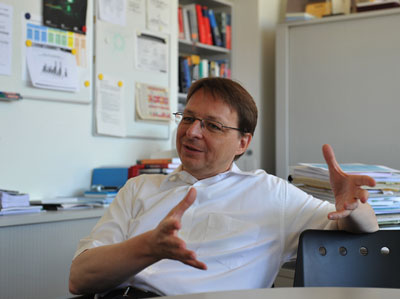
Talking about nanotechnology's unimagined possibilities
The term "nanotechnology" covers a multitude of different technologies, and so a differentiated view of it is needed. This is the opinion of ETH Zurich Professor Christofer Hierold, whose research is in nanotechnology. He says that, to avoid risks and hazards, these must be analysed for each specific example of materials, structures and their applications.
June 21, 2011 Read more
Nanoparticles disguised as red blood cells will deliver cancer-fighting drugs
Researchers at the University of California, San Diego have developed a novel method of disguising nanoparticles as red blood cells, which will enable them to evade the body's immune system and deliver cancer-fighting drugs straight to a tumor.
June 20, 2011 Read more
Carbon nanotubes to the rescue: brain cells rescued by gene silencing offers new options for stroke
Research into the use of nanotechnology in treating stroke has produced evidence of significant motor function recovery. The use of carbon nanotubes to deliver short strands of RNA (siRNA) and induce gene silencing of specific target areas in the brain responsible for motor functions has allowed scientists to 'switch off' proteins that contribute to neuronal tissue loss.
June 20, 2011 Read more
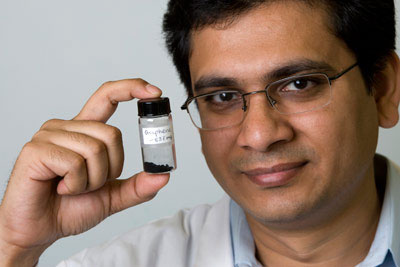
Scientists discover simple, green and cost-effective way to produce high yields of graphene
Scientists at Northern Illinois University say they have discovered a simple method for producing high yields of graphene with a new method that converts carbon dioxide directly into few-layer graphene by burning pure magnesium metal in dry ice.
June 20, 2011 Read more
Improving LED lighting
Researcher from the University of Miami helps create a smaller, flexible LED.
June 20, 2011 Read more
New compact microspectrometer design achieves high resolution and wide bandwidth
A new microspectrometer architecture that uses compact disc-shaped resonators could address the challenges of integrated lab-on-chip sensing systems that now require a large off-chip spectrometer to achieve high resolution.
June 20, 2011 Read more
Nanotechnology characterization seminars available on free CD
Keithley Instruments, Inc., a world leader in advanced electrical test instruments and systems, has assembled a new collection of its nanotechnology-focused web tutorials and seminars in a convenient CD format.
June 20, 2011 Read more
Researchers identify cost-effective method for eliminating contaminants from carbon nanotubes
Semiconductor Research Corporation (SRC), the world's leading university-research consortium for semiconductors and related technologies, and researchers from SEMATECH and The University of Texas at Dallas are the first to demonstrate that specific potentially hazardous organic contaminants present in a type of single-walled carbon nanotubes can be easily removed.
June 20, 2011 Read more
U.S. Department of Defense to study need for nanotechnology center
U.S. Senator Kirsten Gillibrand, member of the Armed Services Committee, secured approval for an increased focus on nanotechnology research by the Defense Department, including a study to determine the need for a center for nanotechnology.
June 20, 2011 Read more
 Subscribe to our Nanotechnology News feed