

Nanotechnology News – Latest Headlines
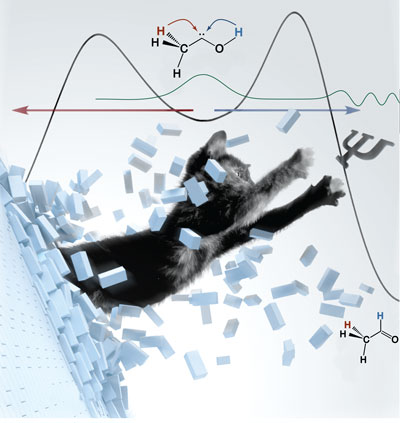
Discovery of a new driving force for chemical reactions
New research just published in the journal Science by a team of chemists at the University of Georgia and colleagues in Germany shows for the first time that a mechanism called tunneling control may drive chemical reactions in directions unexpected from traditional theories.
June 9, 2011 Read more

National Science Foundation launches Science360 for iPad application
Science360 for iPad gives users easy access to latest science information.
June 9, 2011 Read more
FDA takes first step toward greater regulatory certainty around nanotechnology
Agency outlines roadmap for discussion on nanotechnology in regulated products.
June 9, 2011 Read more
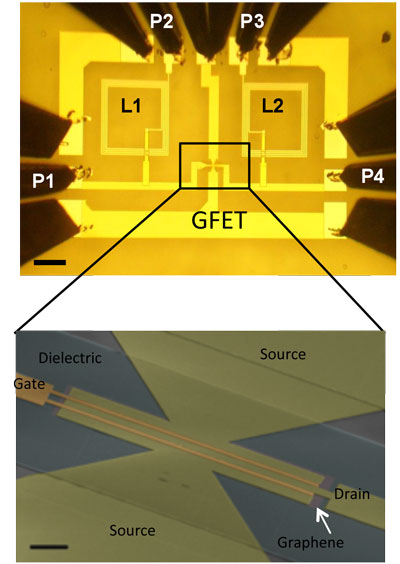
Scientists build first wafer-scale graphene integrated circuit
In a just-published work in the magazine Science, IBM researchers announced the first integrated circuit fabricated from wafer-size graphene, and demonstrated a broadband frequency mixer operating at frequencies up to 10 gigahertz.
June 9, 2011 Read more
Responsible realization of nanotechnology's full potential
The White House Emerging Technologies Interagency Policy Coordination Committee (ETIPC) has developed a set of principles specific to the regulation and oversight of applications of nanotechnology, to guide the development and implementation of policies at the agency level.
June 9, 2011 Read more
EPA proposes policy on nanomaterials in pesticide products
The U.S. Environmental Protection Agency announced today it plans to obtain information on nanoscale materials in pesticide products. Under the requirements of the law, EPA will gather information on what nanoscale materials are present in pesticide products to determine whether the registration of a pesticide may cause unreasonable adverse effects on the environment and human health. The proposed policy will be open for public comment.
June 9, 2011 Read more
Researchers discover method for direct measurement of the quantum wavefunction
Scientists around the world now have a new tool to investigate the elementary units of nature. Until now, the quantum wavefunction was believed to be impossible to measure directly, since the very act of observing it would alter it.
June 9, 2011 Read more
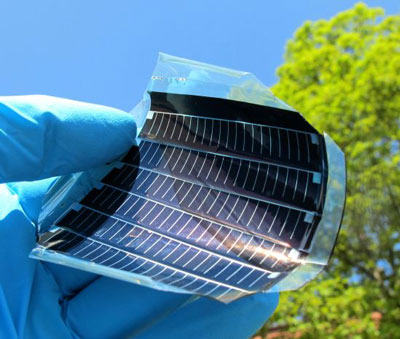
Efficiency record for flexible CdTe solar cell due to novel polyimide film
New superstrate material enables flexible, lightweight and efficient thin film solar modules.
June 9, 2011 Read more
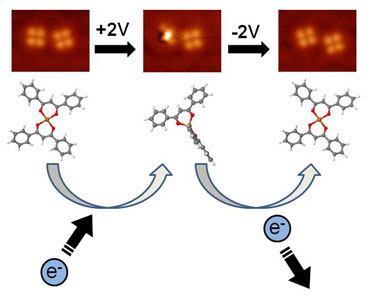
A molecule that switches on and off makes it usable as a bit of information
A single molecule whose charge state and shape can be changed at will: the latest breakthrough at CEMES should prove a key advantage in the race for miniaturization.
June 9, 2011 Read more
Rethink nanotechnology to convert a car's waste heat into electrical power
No one is happy about rising gas prices, and to make matters worse, up to 60 percent is wasted, lost as heat that pours out of the exhaust pipe. But what if some of that heat could be collected and converted back into electricity that can recharge the battery that powers the lights, wipers, power steering, or even the electric motor in a hybrid vehicle? The technology to do just that exists, but it's still a work in progress
June 9, 2011 Read more
Artificial leaf moves closer to reality
MIT researchers develop a device that combines a solar cell with a catalyst to split water molecules and generate energy.
June 9, 2011 Read more
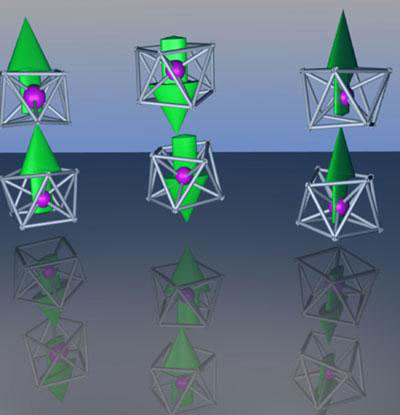
Researchers discover superatoms with magnetic shells
A team of Virginia Commonwealth University scientists has discovered a new class of 'superatoms' - a stable cluster of atoms that can mimic different elements of the periodic table - with unusual magnetic characteristics.
June 8, 2011 Read more
Citrate key in bone's nanostructure
Bone is one of nature's surprising "building materials." Pound-for-pound it's stronger than steel, tough yet resilient. Scientists at the U.S. Department of Energy's Ames Laboratory have identified the composition that gives bone its outstanding properties and the important role citrate plays, work that may help science better understand and treat or prevent bone diseases such as osteoporosis.
June 8, 2011 Read more
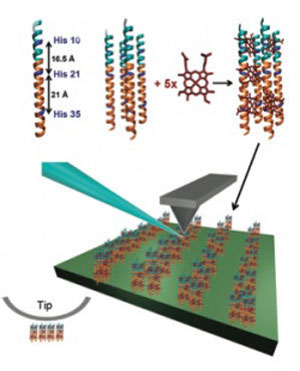
Researchers develop biological circuit components, new microscope technique for measuring them
Electrical engineers have long been toying with the idea of designing biological molecules that can be directly integrated into electronic circuits. University of Pennsylvania researchers have developed a way to form these structures so they can operate in open-air environments, and, more important, have developed a new microscope technique that can measure the electrical properties of these and similar devices.
June 8, 2011 Read more
Water's surface not all wet
Air and water meet over most of the earth's surface, but exactly where one ends and the other begins turns out to be a surprisingly subtle question. A new study in Nature narrows the boundary to just one quarter of water molecules in the uppermost layer - those that happen to have one hydrogen atom in water and the other vibrating freely above.
June 8, 2011 Read more
UAlbany NanoCollege selects 24 undergraduate students for prestigious nanotechnology Summer Internship Program
Twenty-four exceptional undergraduate students will spend the summer exploring the emerging science of nanotechnology after being selected to participate in the prestigious Summer Internship Program at the College of Nanoscale Science and Engineering (CNSE) of the University at Albany.
June 8, 2011 Read more
 Subscribe to our Nanotechnology News feed