

Nanotechnology News – Latest Headlines
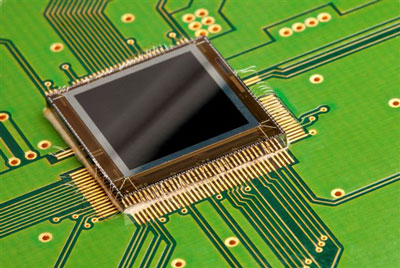
Seebetter, new European project to develop an advanced silicon retina for artificial vision
In February 2011, a new European project called Seebetter was launched with the goal to design and build a high-performance silicon retina using advanced photodetector and packaging technology. It is expected that these new vision sensors will revolutionize artificial vision and find wide applications in industry.
April 18, 2011 Read more
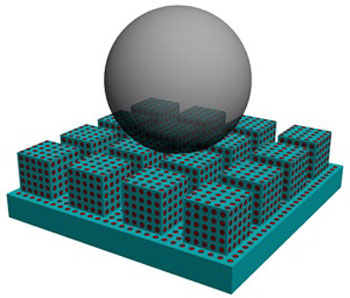
Self-healing protection inspired by natural surfaces
Inspired by natural surfaces, a self-healing scheme allows the exceptional water- and oil-repelling properties of a nanostructured alumina surface to be repaired after damage.
April 18, 2011 Read more
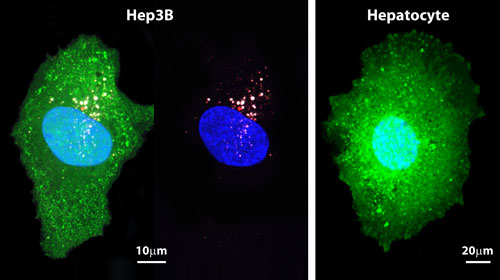
Boosting medicine with nanotechnology strengthens drug cocktail many times over
Melding nanotechnology and medical research, Sandia National Laboratories, the University of New Mexico, and the UNM Cancer Research and Treatment Center have produced an effective strategy that uses nanoparticles to blast cancerous cells with a melange of killer drugs.
April 18, 2011 Read more
Specialized invisible needles make us see surfaces at the nanoscale
Scientists are developing a cantilever array that can have an important impact on synthesis and analysis of nanostructures that can improve the quality control of mobile phone camera lenses.
April 18, 2011 Read more
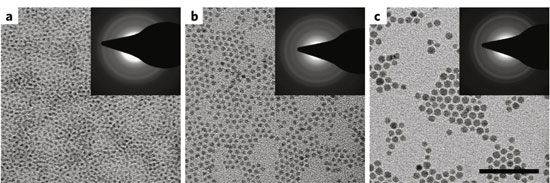
New kid on the plasmonic block: Researchers find plasmonic resonances in semiconductor nanocrystals
To date, plasmonic properties have been limited to nanostructures that feature interfaces between noble metals and dielectrics. Now, researchers have shown that plasmonic properties can also be achieved in the semiconductor nanocrystals known as quantum dots. This discovery should make the field of plasmonics even hotter.
April 18, 2011 Read more
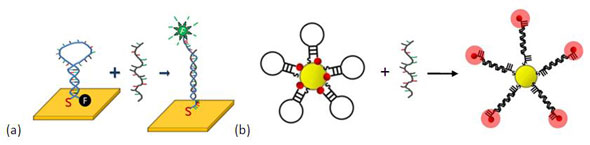
Sensitive label-free DNA sensing based on metal/fluorophore interactions
With two recent studies, imec scientists contribute to the field of label-free DNA sensing. The measurement technique they have refined is based on the fact that metallic films and nanoparticles absorb the light of nearby light-emitting fluorophores. In one study, the quenching and enhancement of the emitted light was studied and quantified with a wide range of gold nanoparticles and DNA hairpin probes. In a second study and using similar probes, the technique was used to demonstrate a functional label-free genosensor.
April 18, 2011 Read more
Improved bulk FinFET fabrication process
A new process flow to fabricate FinFETs in bulk Si has shown significant advancements in critical FinFET fabrication steps. Key issue of the new fabrication method is the use of a plasma-free dry oxide removal process. FinFETs, obtained with this new integration scheme and co-integrated with planar CMOS in the same wafer, showed good morphological and electrical characteristics.
April 18, 2011 Read more
Imec reports two breakthroughs in its EUV mask defectivity assessment
Imec, together with some of its partners in the Advanced Lithography Program, has demonstrated the need for improved capability of the EUV supplier community to detect printing mask blank defects. And together with Zeiss SMS, a compensation technique to mitigate such defects has been demonstrated experimentally.
April 18, 2011 Read more
Researchers discover a rare physical phenomenon at low temperatures and high magnetic fields
There are numerous materials which become superconducting at ultralow temperatures. However, this property competes with ferromagnetism which normally suppresses superconductivity. This does not happen with a material consisting of the elements bismuth and nickel with a diameter of only a few nanometers.
April 18, 2011 Read more
Pinpointing graphene's varying conductivity levels
Researchers at North Carolina State University have found one of the first roadblocks to utilizing graphene by proving that its conductivity decreases significantly when more than one layer is present.
April 18, 2011 Read more
China to boost integrated circuit sector as "state strategy"
China will boost the integrated circuit (IC) sector at a "state strategy" level over the next five years through 2015, Yang Xueshan, vice minister of industry and information technology has said.
April 18, 2011 Read more
Bringing laboratory technology into the age of automation
Select Biosciences, organisers of European Lab Automation (ELA) 2011, are delighted to announce that the Advances in Microarray Technology, Lab-on-a-Chip European Congress and Next Gen Sequencing Europe meetings will be joining the streams of this new, highly topical conference and exhibition, held in Hamburg, Germany, from 30 June - 1 July 2011.
April 18, 2011 Read more
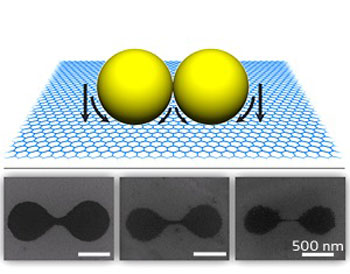
Polysterene spheres self-assembled onto graphene can be used to pattern ribbons and other shapes
Sheets of graphene are useful in many situations for their lack of an energy barrier, or bandgap, to prevent electrons from moving freely. For electronic devices such as transistors, however, a bandgap and the corresponding semiconducting behavior are essential, and narrow ribbons of graphene are known to display this property. Researchers have now reported a simple and scalable method for manufacturing such graphene nanoribbons.
April 18, 2011 Read more
Curing quantum dots with ultraviolet light causes a permanent increase in their light emission efficiency
Semiconductor-based light-emitting devices that produce while light are beginning to replace incandescent light-globes in homes and offices around the world thanks to their high efficiency. Researchers have now shown that curing polymer-embedded quantum dots with ultraviolet light can permanently increase the light-emitting efficiency of these elements as part of white-light devices.
April 18, 2011 Read more
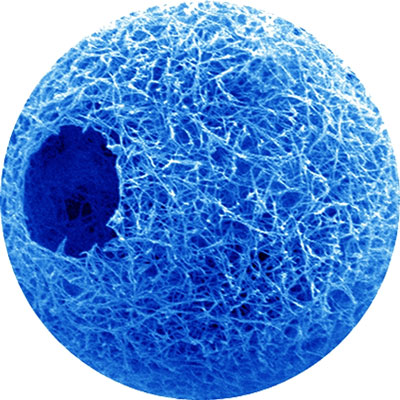
Researchers inject nanofiber spheres carrying cells into wounds to grow tissue
For the first time, scientists have made star-shaped, biodegradable polymers that can self-assemble into hollow, nanofiber spheres, and when the spheres are injected with cells into wounds, these spheres biodegrade, but the cells live on to form new tissue.
April 17, 2011 Read more
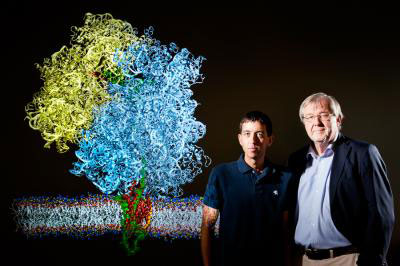
Researchers get a first look at the mechanics of membrane proteins
In two new studies, researchers provide the first detailed view of the elaborate chemical and mechanical interactions that allow the ribosome - the cell's protein-building machinery - to insert a growing protein into the cellular membrane.
April 17, 2011 Read more
 Subscribe to our Nanotechnology News feed