

Nanotechnology News – Latest Headlines
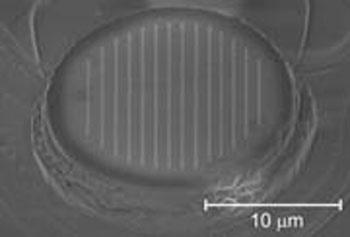
Nanostrukturierung mit Halbleiterlasern
Elektronenmikroskope nutzen einen fokussierten Elektronenstrahl, um winzige Objekte sichtbar zu machen. Wird das Instrument mit einem Gasinjektionssystem kombiniert, lassen sich Materialproben manipulieren und nanometerfeine Oberflaechenstrukturen darauf "schreiben". Empa-Forschende haben mit Wissenschaftlern der EPFL diese Methode nun genutzt, um Laser zu verbessern.
April 12, 2011 Read more
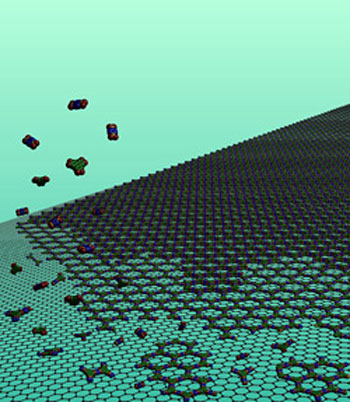
Molecular frameworks show potential for better solar cells
Solar cells made from organic materials are inexpensive, lightweight and flexible, but their performance lags behind cells that contain silicon or other inorganic materials. Cornell chemist William Dichtel and colleagues have found a way to synthesize ordered organic films that could be a major step toward solving this problem.
April 12, 2011 Read more
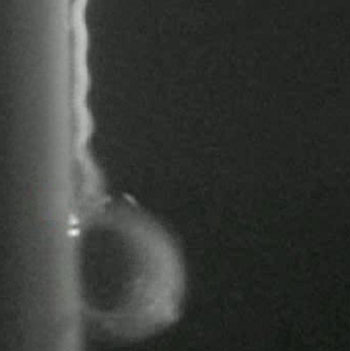
Controlled production of nanometric drops
A new study details the different physical conditions needed to destabilize a fluid and create droplets according to the wetting properties of the surface it is in contact with.
April 12, 2011 Read more
Barriers for researchers trying to bring their nanotechnology innovations to the market
An initiative that aims to complement the support provided by the offices of technology transfer is the European Commission-funded project ProNano - Promoting Technology Transfer of Nanosciences, Nanotechnologies, Materials and new Production Technologies. Ten companies from Spain, Germany, the UK, Italy, Denmark and France have joined forces within ProNano, to help 30 research groups develop attractive investment propositions and get in contact with interested investors.
April 12, 2011 Read more
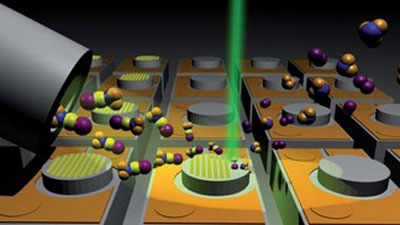
Better lasers for optical communications
A new laser procedure could boost optical fiber communications. This technique could become essential for the future expansion of the Internet. It also opens up new frontiers in basic research.
April 12, 2011 Read more

Tissue engineers use new system to measure biomaterials, structures
As cells assemble into a doughnut shape and ascend a hydrogel cone, they do work and thereby reveal the total power involved in forming a three-dimensional structure. That measure not only could help tissue engineers understand their living building materials better, but could also add insight to the understanding of natural tissue formation.
April 12, 2011 Read more
Tiny antibody fragments raised in camels find drug targets in human breast cancer cells
A new discovery promises to help physicians identify patients most likely to benefit from breast cancer drug therapies. If the compound, called "Nanobody", proves effective in clinical trials, it would represent a significant advance for breast cancer drug therapy because some drugs are effective only in some people.
April 11, 2011 Read more
DOE announces nearly $170 million in available funding to advance solar energy technologies
As part of the Department of Energy's SunShot Initiative, Energy Secretary Steven Chu announced nearly $170 million in available funding over three years to support a range of solar photovoltaic (PV) technology areas.
April 11, 2011 Read more
New class of nanoscale contrasting agents to bring color to the black-and-white world of MRI
A University of Houston engineering researcher is trying to bring color to the black-and-white world of magnetic resonance imaging to make MRIs easier to read.
April 11, 2011 Read more
Tandem catalysis in nanocrystal interfaces: Could be a boon to green energy
In a development that holds intriguing possibilities for the future of industrial catalysis, as well as for such promising clean green energy technologies as artificial photosynthesis, researchers with the Lawrence Berkeley National Laboratory (Berkeley Lab) have created bilayered nanocrystals of ametal-metal oxide that are the first to feature multiple catalytic sites on nanocrystal interfaces. These multiple catalytic sites allow for multiple, sequential catalytic reactions to be carried out selectively and in tandem.
April 11, 2011 Read more
The world's smallest wedding rings
Two interlocking rings of DNA are only visible through the scanning force microscope.
April 11, 2011 Read more
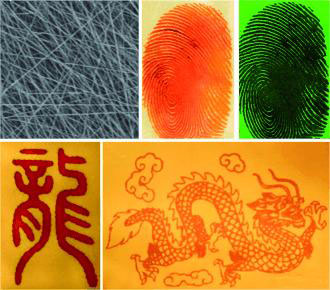
Caught red-handed - Detection of latent fingerprints through release of fluorescein from a nanofiber mat
When a forensic agent dusts a surface with powder or exposes it to the vapors of an iodine chamber, mystery fans know what is going on: This is how latent fingerprints are made visible so that they can be compared to those of a suspect. Scientists have now developed a new process for especially rapid and simple detection of fingerprints. All it takes is a special nanofiber mat that is pressed onto the suspect surface and briefly treated with hot air - the fingerprints appear as red ridge patterns.
April 11, 2011 Read more
Project to develop a novel nanocarrier-based approach to improve the treatment of inflammatory bowel disease
CEA-Leti today announced a new project designed to develop a novel nanocarrier-based approach to improve the treatment of inflammatory bowel disease, and increasingly common condition in Europe.
April 11, 2011 Read more
Solarstrom auf die Spitze getrieben
Kuenftig laesst sich vielleicht schon mit einer einzigen Solarzelle etwas anfangen. Forscher des Max-Planck-Instituts fuer Mikrostrukturphysik haben naemlich einen Effekt entdeckt, aufgrund dessen ein fotovoltaisches Element aus Bismutferrit eine Spannung von bis zu 40 Volt und nennenswerte Stromdichten liefert.
April 11, 2011 Read more
New method for self-assembling molecules
Researchers at the University of Sheffield have discovered a new way of making small molecules self-assemble into complex nanopatterns, which will push the limits of what is possible in 'bottom-up' methods of nanopatterning for advanced functional materials through molecular self-assembly.
April 11, 2011 Read more
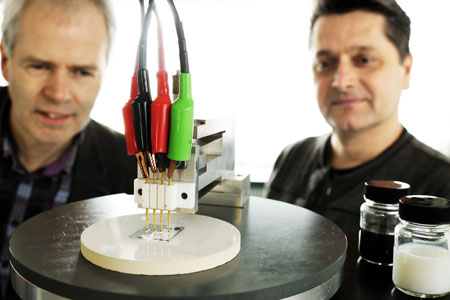
Nanotechnology researchers find replacement for rare material indium tin oxide
Researchers at Eindhoven University of Technology have developed a replacement for indium tin oxide (ITO), an important material used in displays for all kinds of everyday products such as TVs, telephones and laptops, as well as in solar cells. Unfortunately indium is a rare metal, and the available supplies are expected to be virtually exhausted within as little as ten years. The replacement material is a transparent, conducting film produced in water, and based on electrically conducting carbon nanotubes and plastic nanoparticles. It is made of commonly available materials, and on top of that is also environment-friendly.
April 11, 2011 Read more
 Subscribe to our Nanotechnology News feed