

Nanotechnology News – Latest Headlines
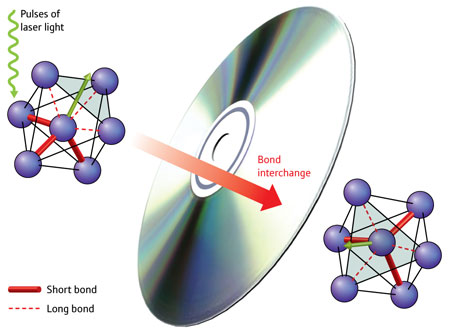
Atomic-level crystal gazing
Revelation of the crystallization mechanism that enables fast writing of data to DVDs shows potential for quicker data storage in the future.
April 8, 2011 Read more
NanoVation New York
The German Center for Research and Innovation (GCRI), in cooperation with the Consortium of the Ruhr Universities (ConRuhr) and the Consulate General of the Federal Republic of Germany, will host a discussion on nanotechnology and its applications in the fields of energy, electronics, medicine, and science.
April 8, 2011 Read more
Nanoparticles increase biofuel performance
How to put more bang in your biofuels? Nanoparticles! A new study shows that the addition of alumina nanoparticles can improve the performance and combustion of biodiesel, while producing fewer emissions.
April 8, 2011 Read more
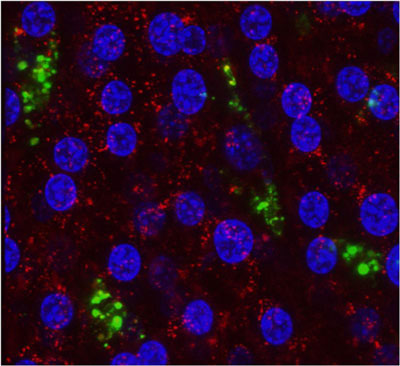
Forscher aus aller Welt diskutieren in Hamburg die Mikro- und Nanoebene des Immunsystems
Vom 7. bis 9. April 2011 findet im Bernhard-Nocht-Institut fuer Tropenmedizin in Hamburg erstmals ein Symposium des Sonderforschungsbereiches 841 "Leberentzuendung: Infektion, Immunregulation und Konsequenzen" (SFB 841) statt.
April 8, 2011 Read more
IBM's infection-fighting nanotechnology caps century of healthcare innovation
IBM's announcement of the first biodegradable nanoparticles that can seek out and destroy drug-resistant bacteria caps off a century of healthcare and life sciences innovation from IBM. To celebrate IBM's Centennial, the company is unveiling an "icon of progress" representing IBM's contributions to fighting infectious diseases and contributions to world health.
April 7, 2011 Read more
Scientists push quantum mechanics closer to the everyday world
Proof of the quantum wave nature of large organic molecules has been reported by an international team of physicists. The findings may be a step towards reducing quantum interference on a bigger scale than previously achieved.
April 7, 2011 Read more
Argonne to host annual Science Careers in Search of Women conference
To encourage and inspire more young women to pursue careers in science, Argonne will host its 24th annual Science Careers in Search of Women Conference on April 14, 2011, welcoming approximately 350 high school students from across the Chicago area to experience science and engineering first hand.
April 7, 2011 Read more
A new nanotechnology application to manufacture a one terabyte USB stick in the near future
Dr. Simon Elliott from the Tyndall National Institute in Ireland is coordinating the EU research project REALISE and working on the next generation of USB flash memories. Rare earth oxides have been introduced to improve their storage capacity.
April 7, 2011 Read more
Large surfaces can be machined with nanometer precision
On 7 April 2011, Empa's new laser centre, which houses the only UV laser facility of its kind in the world, was opened in Thun. The facility will help researchers to develop new kinds of surfaces. Commercial partners will be able to use it to structure large films with micro to nanometre precision.
April 7, 2011 Read more
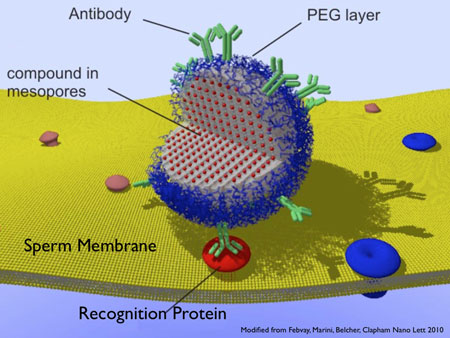
Nanoparticle-based contraceptive makes sperm impotent
It's found only in the tails of sperm. It takes seven genes to build it. It gets activated as the sperm gets closer to the egg, giving it that extra whip and thrust to make it across the finish line. David Clapham, its discoverer, named it CatSper. Blocking it could literally make sperm impotent. This could be the basis of a new contraceptive gel or a pill that could be used by men or women.
April 7, 2011 Read more
Nanopillars yield more precise molecular photography
A Stanford research team uses glowing nanopillars to give biologists, neurologists and other researchers a deeper, more precise look into living cells.
April 7, 2011 Read more
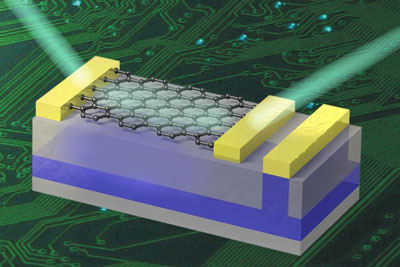
Forscher ebnen den Weg zu elektronische Schaltungen aus Graphen
Graphen gilt wegen seiner physikalischen und chemischen Eigenschaften als eines der vielversprechendsten neuen Materialien. Wissenschaftler haben jetzt ein Verfahren entwickelt, das es erlaubt, Bauelemente aus Graphen mithilfe einer integrierten Elektrode gezielt anzusteuern - eine wichtige Voraussetzung fuer industrielle Anwendungen.
April 7, 2011 Read more
Last call for registrations - free webinar: Nanomaterials for Biological Applications
This online workshop on 'Nanomaterials for Biological Applications' will enable participants to meet and find out about each other's expertise and research interests in this field.
April 7, 2011 Read more
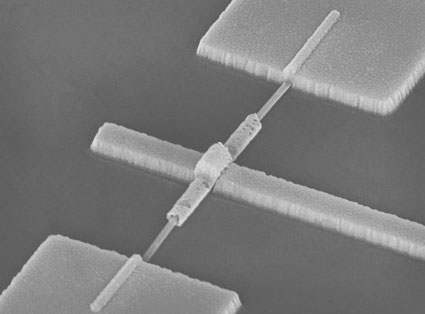
Nanoscale engineering feat leads to first nanowire transistor featuring a 'wrap-gate'
In an interesting feat of nanoscale engineering, researchers at Lund University in Sweden and the University of New South Wales have made the first nanowire transistor featuring a concentric metal 'wrap-gate' that sits horizontally on a silicon substrate.
April 7, 2011 Read more
Beetle foot pads may inspire novel artificial adhesives
The arrays of fine adhesive hairs or 'setae' on the foot pads of many insects, lizards and spiders give them the ability to climb almost any natural surface. Research by James Bullock and Walter Federle from the University of Cambridge in England found that the different forces required to peel away these adhesive hairs from surfaces are what allows beetles to adhere to diverse surfaces, thereby reducing the risk of detachment.
April 7, 2011 Read more
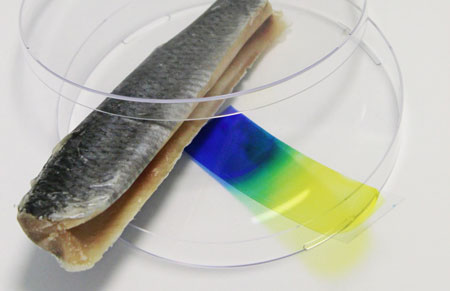
Food packaging takes over the role of quality control
When it comes to packaged fish or meat, it is nearly impossible to distinguish between fresh goods and their inedible counterparts. Researchers have now developed a sensor film that can be integrated into the package itself, where it takes over the role of quality control. And if the food has spoiled, it changes color to announce the fact.
April 7, 2011 Read more
 Subscribe to our Nanotechnology News feed