

Nanotechnology News – Latest Headlines

Quantum mapmakers complete first voyage through spin liquid
Scientists from Oxford University have mapped a state of matter called 'quantum spin liquid', whose existence was proposed in the 1970s but which has only been observed recently.
April 1, 2011 Read more
Feasibility studies will help stimulate development of nanotechnologies
Eight British companies are set to receive a total of nearly GBP 200,000 in government investment for feasibility studies aimed at helping to stimulate innovation with technologies that will be able to address potential environmental health and safety (EHS) aspects of the development of nanoscale technologies.
April 1, 2011 Read more

World record: Calculations with 14 quantum bits
Quantum physicists from the University of Innsbruck have set another world record: They have achieved controlled entanglement of 14 quantum bits (qubits) and, thus, realized the largest quantum register that has ever been produced. With this experiment the scientists have not only come closer to the realization of a quantum computer but they also show surprising results for the quantum mechanical phenomenon of entanglement.
April 1, 2011 Read more
Nanoparticles shorten roundworms' lives
Even though nanoparticles are increasingly entering the environment, scientists still have a lot to learn about their biological effects. Now Chinese researchers have found that exposure to cerium dioxide nanoparticles shortens the lifespan of the roundworm Caenorhabditis elegans.
April 1, 2011 Read more

Electrons set free
Free-floating electrons on top of liquid helium yield insights into their transport behavior.
April 1, 2011 Read more
New nanomaterial can detect and neutralize explosives
Scientists described development and successful initial tests of a spray-on material that both detects and renders harmless the genre of terrorist explosives responsible for government restrictions on liquids that can be carried onboard airliners.
April 1, 2011 Read more
Researchers electrify polymerization
New method allows for more precise control over ATRP, a popular technique used for creating specialized plastics.
March 31, 2011 Read more
Novel nanowires boost fuel cell efficiency
A team of engineers at the Yale School of Engineering and Applied Science has created a new fuel cell catalyst system using nanowires made of a novel material that boosts long-term performance by 2.4 times compared to today's technology.
March 31, 2011 Read more
Biological molecules select their spin
Do the principles of quantum mechanics apply to biological systems? Until now, both biologists and physicists have considered quantum systems and biological molecules to be like apples and oranges. But new research definitively shows that a biological molecule - DNA - can discern between quantum states known as spin.
March 31, 2011 Read more

NSF CAREER Award for work on microring resonators
Lynford L. Goddard, an assistant professor in electrical and computer engineering, has received a National Science Foundation (NSF) CAREER Award, for his project, entitled, "Theory and Application of Reflective Microring Resonators".
March 31, 2011 Read more

Microstructures innovation recognized as industry "game-changer"
Industry is eager to harness the potential of micro-technology, but has been unable to do so for most consumer products because of the high manufacturing cost.
March 31, 2011 Read more
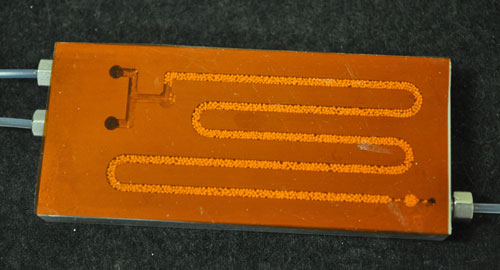
Microreactors: Small scale chemistry could lead to big improvements for biodegradable polymers
Using a small block of aluminum with a tiny groove carved in it, a team of researchers is developing an improved "green chemistry" method for making biodegradable polymers. Their recently published work is a prime example of the value of microfluidics, a technology more commonly associated with inkjet printers and medical diagnostics, to process modeling and development for industrial chemistry.
March 31, 2011 Read more
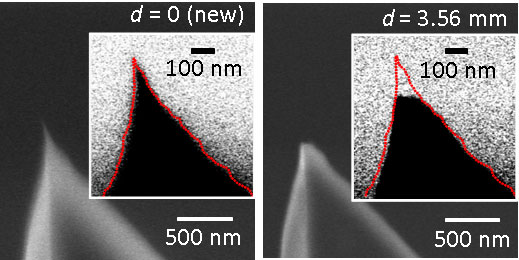
Real-time monitoring of atomic force microscope probes adjusts for wear
Scientists at the National Institute of Standards and Technology (NIST) have developed a way to measure the wear and degradation of the microscopic probes used to study nanoscale structures in situ and as it's happening. Their technique can both dramatically speed up and improve the accuracy of the most precise and delicate nanoscale measurements done with atomic force microscopy (AFM).
March 31, 2011 Read more
In time with the molecules
Christian Spielmann receives Thuringian Research Award
March 31, 2011 Read more
Fast-recharge, lithium-ion battery could be perfect for electric cars
The next-generation battery, like next-generation TV, may be 3-D, scientists reported at the 241st National Meeting and Exposition of the American Chemical Society (ACS). They described a new lithium-ion (Li-ion) battery, already available in a prototype version, with a three-dimensional interior architecture that could be perfect for the electric cars now appearing in auto dealer showrooms.
March 31, 2011 Read more
Neutral atoms made to act like electrically charged particles
Completing the story they started by creating synthetic magnetic fields, scientists from the Joint Quantum Institute (JQI) have now made atoms act as if they were charged particles accelerated by electric fields.
March 31, 2011 Read more
 Subscribe to our Nanotechnology News feed