

Nanotechnology News – Latest Headlines
Discovery paves way for development of efficient, inexpensive plastic solar cells
The discovery reveals that energy-carrying particles generated by packets of light can travel on the order of a thousand times farther in organic (carbon-based) semiconductors than scientists previously observed.
October 10, 2010 Read more
Building a smaller, lighter future: Understanding polymer behaviors below one nanometer
New research sheds light on key behaviors of polymers in specially engineered confined spaces, opening the door to a level of control that has previously been impossible.
October 10, 2010 Read more
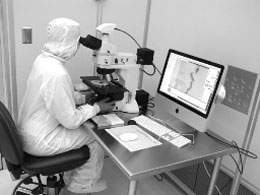
California NanoSystems Institute opens 9,700-square-foot cleanroom facility
The California NanoSystems Institute at UCLA has opened its new Integrated Systems Nanofabrication Cleanroom (ISNC), more than doubling the amount of cleanroom space available on the Westwood campus and extending research capabilities to researchers in biology and medicine.
October 10, 2010 Read more
Researchers discover a new class of highly electronegative chemical species
An international team of researchers has discovered a new class of highly electronegative chemical species called hyperhalogens, which use superhalogens as building blocks around a metal atom. The new chemical species may have application in many industries.
October 8, 2010 Read more
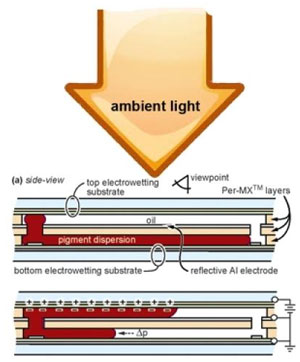
Breakthrough e-display means electronics with high speed, high readability and low power usage
The Oct. 4 issue of the high-impact journal, Applied Physics Letters, contains a new electrofluidics design from the University of Cincinnati and start-up company Gamma Dynamics that promises to dramatically reshape the image capabilities of electronic devices.
October 8, 2010 Read more
European and U.S. specialists discuss nanotechnology risks and opportunities
On October 4th/5th, 2010, more than 200 European and US specialists were discussing the risks and opportunities offered by nanotechnology at a symposium in Lucerne organised by the Chemistry Section of the International Social Security Association (ISSA).
October 8, 2010 Read more
Thailand launches consumer nanoproduct certification - NanoQ
At a recent launch of the Nanotechnology Association of Thailand in Bangkok on October 7, Prof. Sirirurg Songsivilai, President of Nanotechnology Association of Thailand said the aim of the association is to work closely with industries, researchers, and decision makers to effectively launch NanoQ in 2011.
October 8, 2010 Read more
Microelectronic devices harvest their own waste energy
Dr. Long Que, assistant professor of electrical engineering at Louisiana Tech University, has reported success in designing and fabricating a device that allows microscale electronic devices to harvest their own wasted energy.
October 8, 2010 Read more
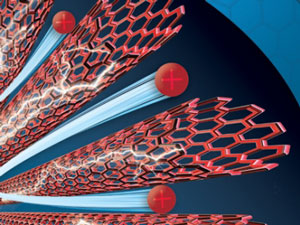
Carbon nanotubes form 'express lanes' for ions
Researchers have devised a new way for ions to travel more quickly between electrodes than they do in traditional polymers.
October 8, 2010 Read more
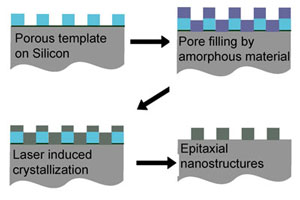
Single-crystal films could advance solar cells
Cornell researchers have developed a new method to create a patterned single-crystal thin film of semiconductor material that could lead to more efficient photovoltaic cells and batteries.
October 8, 2010 Read more
BDBDB2 Workshop on biological diffusion and Brownian dynamics simulations in Heidelberg
Following a very successful workshop on the simulation and experimental study of biomolecular diffusional processes in Heidelberg in 2007, a second workshop will take place on October 11-13, 2010, at the Studio, Villa Bosch.
October 8, 2010 Read more
Oxidation mechanisms at gold nanoclusters unravelled
Researchers believe that the puzzle of catalytic gold is now partially solved. Gold can catalyse an oxidation reaction by first oxidising itself. New research evidence on gold-oxide phase at room temperature and atmospheric pressure help us to finally understand the oxidation mechanisms of catalytic gold nanoclusters in these conditions.
October 8, 2010 Read more
Nice pics - A good Micrograph is worth more than the MegaByte it consumes
Here are some of the images from a micro- and nanograph contest held at the 36th International Conference on Micro + Nano Engineering (MNE), held in Genoa, Italy from September 19 to 22, 2010.
October 8, 2010 Read more
Cell phones bring spectroscopy to the classroom
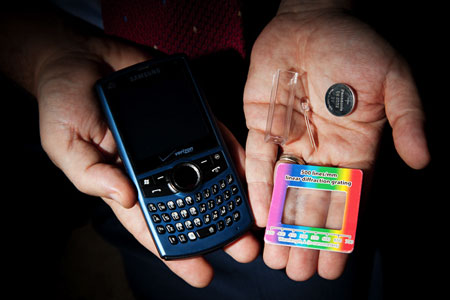
University of Illinois chemistry professor Alexander Scheeline wants to see high school students using their cell phones in class. Not for texting or surfing the Web, but as an analytical chemistry instrument. Scheeline developed a method using a few basic, inexpensive supplies and a digital camera to build a spectrometer, an important basic chemistry instrument.
October 8, 2010 Read more
Nanoimprint lithography NSF grant awarded to Micro Device Lab at Stevens
Dr. Eui-Hyeok Yang, Associate Professor of Mechanical Engineering and Director of the Micro Device Laboratory (MDL) at Stevens Institute of Technology, will receive funding from the National Science Foundation (NSF) for the acquisition of a Nanoimprint Lithography System (NIL) for the purpose of nanoscience research and education based on low-dimensional materials at Stevens.
October 7, 2010 Read more
Technique allows researchers to examine how materials bond at the atomic level
An approach pioneered by researchers at North Carolina State University gives scientists new insight into the way silicon bonds with other materials at the atomic level. This technique could lead to improved understanding of and control over bond formation at the atomic level, and opportunities for the creation of new devices and more efficient microchips.
October 7, 2010 Read more
 Subscribe to our Nanotechnology News feed