

Nanotechnology News – Latest Headlines
Plasmonic nanobubbles kill cancer cells
Using lasers and nanoparticles, scientists at Rice University have discovered a new technique for singling out individual diseased cells and destroying them with tiny explosions.
February 4, 2010 Read more
Pharmaceutical nanotechnology makes drugs more effective
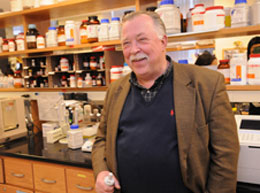
Vladimir Torchilin, distinguished professor of pharmaceutical sciences at Northeastern University, recently received a $1.36 million grant from the National Institutes of Health's Cancer Institute to examine a new, nanotechnology-based method of drug development.
February 4, 2010 Read more
'Quantum logic clock' based on aluminum ion is now world's most precise clock
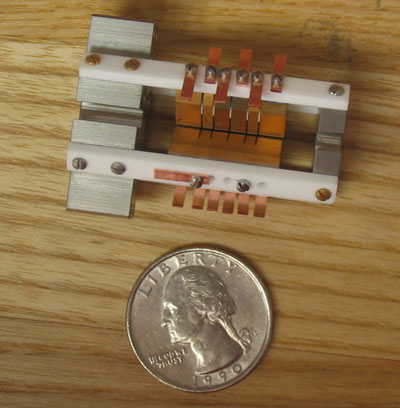
Physicists at the National Institute of Standards and Technology (NIST) have built an enhanced version of an experimental atomic clock based on a single aluminum atom that is now the world's most precise clock, more than twice as precise as the previous pacesetter based on a mercury atom.
February 4, 2010 Read more
The first comprehensive nanoscience textbook ever assembled
Stuart Lindsay, an ASU Regents' Professor and director of the Biodesign Institute's Center for Single Molecule Biophysics, has released the first comprehensive guide to a tiny world 1 million times smaller than a single grain of sand.
February 4, 2010 Read more
Beilstein-Institut funds joint research project NanoBiC
The effects of high-energy beam on nano components and human cells will be investigated in detail by scientists in Frankfurt and Darmstadt. One goal of the NanoBiC project is to construct - like craftsmen - functional elements on surfaces e.g. transistors, sensors, quantum dots or memory elements according to a building plan. A further aim is to acquire detailed knowledge of the effects of cosmic rays on human cells which is particularly important for manned space missions.
February 4, 2010 Read more
Phantoms Foundation coordinates the Spain Pavilion at nano tech 2010 in Tokyo
The Phantoms Foundation and the Spanish Institute for Foreign Trade (ICEX), in cooperation with the Embassy of Spain (Economic and Commercial Office) in Tokyo will bring together for the third time a nanoscience and nanotechnology Spain Pavilion at nano tech 2010.
February 4, 2010 Read more
New European network for research and training in soft matter physics launched
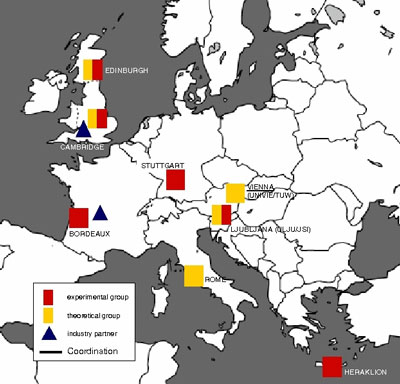
COMPLOIDS will focus on adding complexity to colloids. By integrating the experimental, computational and theoretical research programs of the member groups, the network will advance the state-of-the-art of colloidal science via the training of a cohort of graduate students and junior researchers.
February 4, 2010 Read more
ThyssenKrupp Steel Europe funds Center for Electrochemical Sciences
ThyssenKrupp Steel Europe AG and the state of North Rhine-Westphalia are jointly funding the Center for Electrochemical Sciences (CES) at Ruhr University Bochum. The new center is also cooperating with the Max Planck Institute for Iron Research. It will focus on a discipline which is regarded as the basis for numerous high-tech applications.
February 4, 2010 Read more
Germanium laser in move toward computers that use light instead of electricity to move data
MIT researchers have demonstrated the first laser built from germanium that can emit wavelengths of light useful for optical communications. It's also the first germanium laser to operate at room temperature.
February 4, 2010 Read more
Introducing innovative nanotechnology into the value chain of the lubricants market
Infineum UK Limited along with 14 other partners have secured funding from the Framework Programme 7 of the EC to start the collaborative project AddNano on 1 October 2009. The strong partnership from industry and academia across Europe and Israel, will work on the development of new formulation lubricants with improved performance.
February 4, 2010 Read more
Auf den Nanopunkt gebracht
Neue Farbstoffsonden erhoehen mikroskopische Aufloesung.
February 4, 2010 Read more
ScotGrid and Lumerical team up to boost UK nanophotonics research
Lumerical Solutions has donated FDTD Solutions Engine licenses to ScotGrid, one of the largest grid computing sites in the United Kingdom. The donated licenses will enable photonics researchers at academic institutions to perform large-scale simulations of devices such as silicon photonics components, solid-state light emitters, and thin-film solar cells.
February 4, 2010 Read more
Photothermal technique provides new way to track nanoparticles
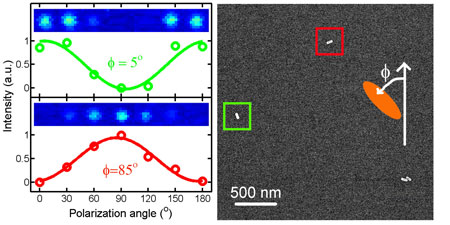
Rice University researchers have found a way to use gold nanorods as orientation sensors by combining their plasmonic properties with polarization imaging techniques.
February 3, 2010 Read more
Scientists find quantum mechanics at work in photosynthesis
A team of University of Toronto chemists have made a major contribution to the emerging field of quantum biology, observing quantum mechanics at work in photosynthesis in marine algae.
February 3, 2010 Read more
Inexpensive silicon microchip reliably detects viruses
A team of Brigham Young University engineers and chemists has created an inexpensive silicon microchip that reliably detects viruses, even at low concentrations.
February 3, 2010 Read more
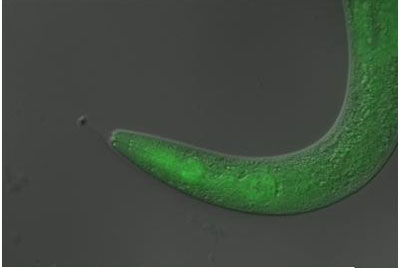
Star Trek anyone? Light beam temporarily paralyzes animals
In an advance with overtones of Star Trek phasers and other sci-fi ray guns, scientists in Canada are reporting development of an internal on-off 'switch' that paralyzes animals when exposed to a beam of ultraviolet light. The animals stay paralyzed even when the light is turned off. When exposed to ordinary light, the animals become unparalyzed and wake up.
February 3, 2010 Read more
 Subscribe to our Nanotechnology News feed