

Nanotechnology News – Latest Headlines
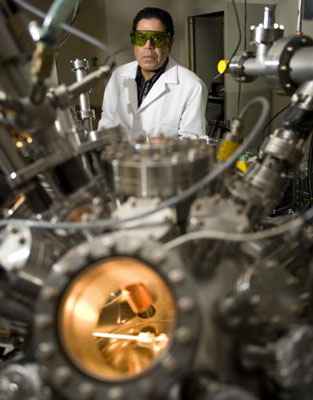
Nuclear fusion research key for a new class of nanolithography
Researchers are adapting the same methods used in fusion-energy research to create extremely thin plasma beams for a new class of nanolithography required to make future computer chips.
August 18, 2009 Read more

Young scientist recognized for developing cheap solar cell technology
A young Berkeley Lab and University of California, Berkeley scientist has been recognized by Technology Review magazine as among the world's top innovators under age 35.
August 18, 2009 Read more
Newly discovered mechanism in cell division has implications for understanding cancer
'A biologist, a physicist, and a nanotechnologist walk into a ...' sounds like the start of a joke. Instead, it was the start of a collaboration that has helped to decipher a critical, but so far largely unstudied, phase of how cells divide.
August 18, 2009 Read more
Mapping nanotechnology in the U.S.
Data released today by the Project on Emerging Nanotechnologies (PEN) highlights more than 1,200 companies, universities, government laboratories, and other organizations across all 50 U.S. states and in the District of Columbia that are involved in nanotechnology research, development, and commercialization.
August 18, 2009 Read more
NanoEurope 2009 - call for posters
NanoEurope is, since 2003, the premium annual European symposium on selected areas of nanotechnology research, development and commercialization of industrial applications. Submit your poster contribution. Don't miss this unique opportunity. Present breaking results, ongoing research projects, and speculative or innovative work in progress.
August 18, 2009 Read more
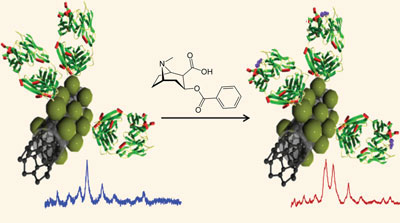
Nanotechnology sensor detects drug abuse
Spanish scientists have made antibody-coated nanoparticles that can detect bioanalytes indicative of drug abuse.
August 18, 2009 Read more
Auf Reisen durch die Zelle
Virtuelle Proteinforschung und eine Datenbank fuer biochemische Reaktionen.
August 18, 2009 Read more

'Cornell dots' make the world's tiniest laser
Researchers have modified nanoparticles known as 'Cornell dots' to make the world's tiniest laser - so small it could be incorporated into microchips to serve as a light source for photonic circuits.
August 18, 2009 Read more
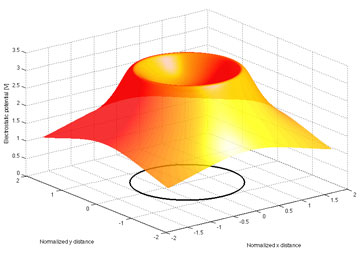
Molecular trapping technique for nanoparticles
A chemist at the University of Wisconsin-Milwaukee has developed a kind of invisible fence for trapping and controlling particles as small as a single virus or large protein.
August 18, 2009 Read more
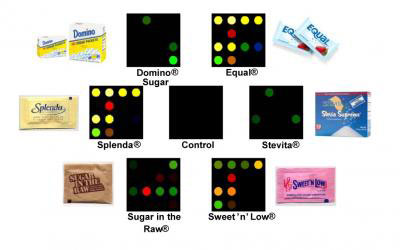
'Electronic tongue' with a taste for sweets
In a new approach to an effective 'electronic tongue' that mimics human taste, scientists in Illinois are reporting development of a small, inexpensive, lab-on-a-chip sensor that quickly and accurately identifies sweetness.
August 17, 2009 Read more
Secrets of the sandcastle worm could yield a powerful medical adhesive
Scientists have copied the natural glue secreted by a tiny sea creature called the sandcastle worm in an effort to develop a long-sought medical adhesive needed to repair bones shattered in battlefield injuries, car crashes and other accidents.
August 17, 2009 Read more
Nano-magnets guide stem cells for damaged tissue repair
Magnetic nanoparticles have been used to bring stem cells to sites of cardiovascular injury in a new method designed to increase the capacity of cells to repair damaged tissue.
August 17, 2009 Read more
Flat bacteria in nanoslits
It appears that bacteria can squeeze through practically anything. In extremely small nanoslits they take on a completely new flat shape. Even in this squashed form they continue to grow and divide at normal speeds.
August 17, 2009 Read more
Researcher says microchannels could advance tissue engineering methods
Utilizing fractal patterns similar to those created by lightning strikes, Victor Ugaz, associate professor in the Artie McFerrin Department of Chemical Engineering at Texas A+M University, has created a network of microchannels that could advance the field of tissue engineering by serving as a three-dimensional vasculature for the support of larger tissue constructs, such as human organs.
August 17, 2009 Read more
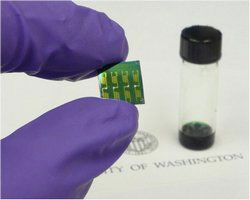
Organic electronics a two-way street, thanks to new plastic semiconductor
Until now, circuits built with organic materials have allowed only one type of charge to move through them. New research from the University of Washington makes charges flow both ways.
August 17, 2009 Read more
Carbon nanocapsules for drug and energy storage
Two nanoscale devices recently reported by University of Pittsburgh researchers in two separate journals harness the potential of carbon nanomaterials to enhance technologies for drug or imaging agent delivery and energy storage systems, in one case, and, in the other, bolster the sensitivity of oxygen sensors essential in confined settings, from mines to spacecrafts.
August 17, 2009 Read more
 Subscribe to our Nanotechnology News feed