

Nanotechnology News – Latest Headlines

Novel polymer could improve protein-based drugs
A new method for attaching a large protective polymer molecule to a protein appears to improve protein drugs significantly.
August 19, 2009 Read more

Making smart phone touch-screens more glare and smudge resistant
In a report today at the 238th National Meeting of the American Chemical Society, scientists describe development of a test for performance of smudge- and reflection-resistant coatings and its use to determine how to improve that performance.
August 19, 2009 Read more
Intrinsic changes in protein shape influence drug binding
Computational biologists at the University of Pittsburgh School of Medicine have shown that proteins have an intrinsic ability to change shape, and this is required for their biological activity.
August 19, 2009 Read more
New report from public interest groups warns of risks from nanomaterials in sunscreens
Friends of the Earth, Consumers Union, and the International Center for Technology Assessment (ICTA) released a report today detailing why consumers should be wary of sunscreens that contain nanomaterials.
August 19, 2009 Read more
Cancer-seeking nanomissile
Nano-bio material kills cancer cells, leaves healthy cells in unharmed.
August 19, 2009 Read more
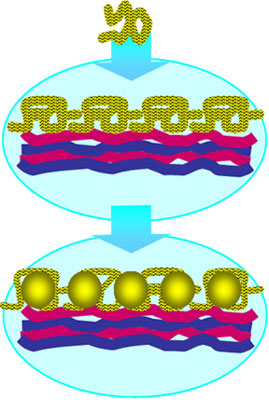
Bio-enabled technique forms strong and flexible silk nanocomposites
Using thin films of silk as templates, researchers have incorporated inorganic nanoparticles that join with the silk to form strong and flexible composite structures that have unusual optical and mechanical properties.
August 19, 2009 Read more
A non-toxic way to make zinc oxide nanorods
A non-toxic and environmentally friendly way to make tiny nanorods of zinc oxide has been developed for the first time by researchers in Saudi Arabia.
August 19, 2009 Read more
NSF Emerging Frontiers' program supports development of smart materials based on study of fish
After engineers and scientists at Virginia Tech, Harvard and Drexel finish studying the locomotion of fish in water, Michael Phelps may find he still has a few new ways to increase his own world-breaking Olympic times.
August 19, 2009 Read more
Molten proteins - surface-modified liquid protein with liquid-crystalline properties
A team at the University of Bristol (UK) and the Max Planck Institute of Colloids and Interfaces in Golm (Germany) has now successfully liquefied a protein without the assistance of a solvent.
August 19, 2009 Read more
Trapped electrons spell longer life
Researchers in France, Germany, Switzerland and the UK have discovered new electron properties that could lead to useful applications in computers and lasers.
August 19, 2009 Read more
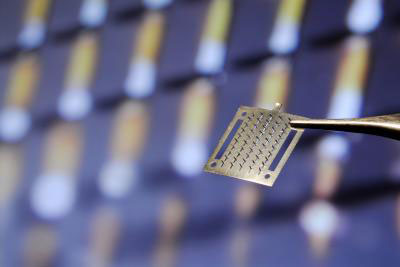
Painless microneedle patch may take the sting out of shots
Good news for people fearful of needles and squeamish of shots: Scientists report the design of a painless patch that may someday render hypodermic needles - as well as annual flu shots - a thing of the past.
August 19, 2009 Read more
Ultra-thin antibacterial material requires only low doses of silver
In a presentation today to the American Chemical Society meeting, Ankit Agarwal, a postdoctoral researcher at the University of Wisconsin-Madison, described an experimental approach to wound healing that could take advantage of silver's anti-bacterial properties, while sidestepping the damage silver can cause to cells needed for healing.
August 19, 2009 Read more
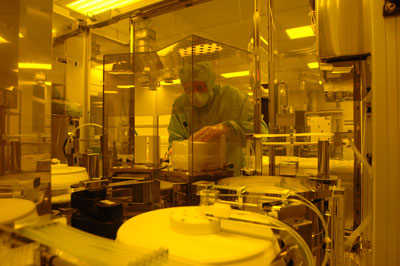
Southampton Nanofabrication Centre poised to save industry time and money
The Southampton Nanofabrication Centre, which opens on 9 September will make smaller, more powerful nano- and bio-nanotechnologies possible and save industry time and money.
August 19, 2009 Read more
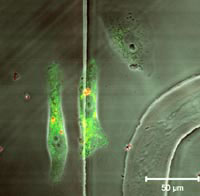
Mit dem Mikro-Shuttle in lebende Zellen
Wissenschaftlern des Max-Planck-Institutes fuer Kolloid- und Grenzflaechenforschung in Potsdam-Golm, der Jacobs University Bremen und der Queen Mary University London ist es erstmals gelungen stoffwechselresistente Mikrokapseln in lebende Zellen einzuschleusen und deren Inhalt durch Laserimpuls mit exakter zeitlicher Kontrolle freizusetzen.
August 19, 2009 Read more
Researchers in China link nanoparticle exposure to lung failure deaths
A study published in the forthcoming issue of the European Respiratory Journal (ERJ), has for the first time claimed a concrete link between exposure to nanoparticles in adhesive paint and development of severe pulmonary fibrosis in a group of young female workers; two of whom went on to suffer fatal lung failure.
August 19, 2009 Read more
Mercury nanoparticles key to becoming toxic in the environment
Naturally occurring organic matter in water and sediment appears to play a key role in helping microbes convert tiny particles of mercury in the environment into a form that is dangerous to most living creatures.
August 18, 2009 Read more
 Subscribe to our Nanotechnology News feed