| Jun 26, 2026 |
Paintable roof coating cools buildings and harvests raindrop electricityA layered roof coating keeps radiative cooling intact while harvesting raindrop pulses for low-power sensing during wet weather. |
| (Nanowerk Spotlight) Passive radiative cooling lets a surface shed heat without electricity by reflecting sunlight and emitting thermal radiation into the sky. For buildings, that makes roofs and walls active parts of thermal management rather than inert outer shells. But the same sky-facing pathway that makes the effect useful also makes it fragile: clouds, humidity, dust, and seasonal heating demand can reduce or even reverse the benefit. |
| Rain exposes a sharper conflict. It disrupts the clear-sky conditions that radiative cooling relies on, yet falling droplets can generate electrical pulses when they hit the right surface. The difficulty is putting both effects into the same roof coating without letting the electrical design damage the cooling design. |
| A cooling coating must reflect most incoming sunlight and emit heat in the mid-infrared range where the atmosphere allows radiation to escape. A droplet electricity generator needs a different set of features: a water-contact surface that builds charge, dielectric layers that store it, and electrodes that collect it. Those electrical components can absorb light or obstruct heat emission. The cooling structures, meanwhile, can lose performance when outdoor droplets and dust degrade the surface. |
| A paper in Advanced Materials ("A Paintable Bioinspired Stratified Skin Resolving the Cooling‐Electricity Trade‐Off for All‐Weather Building Retrofits") addresses this conflict with a paintable coating called BRIDGE. Its central finding is not simply that one material can cool and generate electricity. It is that a vertically layered coating can keep those functions from interfering. The outer layer handles water contact, droplet electrification, and self-cleaning. Buried nanoparticle-polymer layers handle solar scattering, thermal emission, and charge storage. |
| The coating assigns each function to the depth where it causes the least damage. The water-facing perfluoroelastomer layer sits on top because droplets must contact it directly. Light-scattering fillers sit below, where they can reject sunlight without occupying the electrical interface. The electrode stays buried so charge can be collected without turning the surface into an optical penalty. |
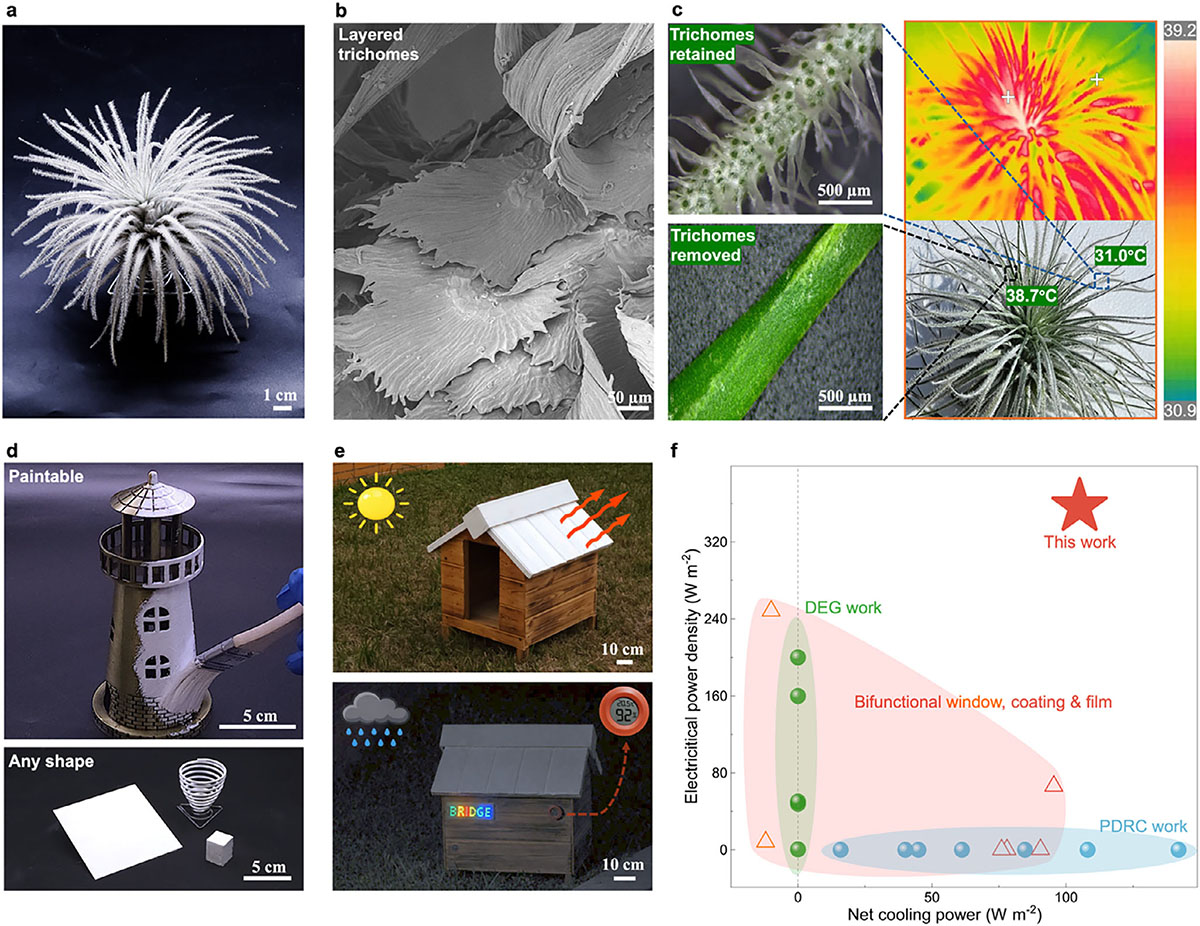 |
| Bioinspired bifunctional stratified design, deployment, and benchmarking of BRIDGE skin. (a) Photograph of a Tillandsia air plant showing the white trichomes covering the leaf surface. (b) SEM image of the layered microstructure of the Tillandsia trichome. (c) Photographs and infrared thermographs of leaves with trichomes retained or removed (1:00 pm, Nov. 8, 2025; RH ≈ 76%; ambient temperature ≈ 28°C). (d) Photographs of representative BRIDGE skin samples and paint-based installation. (e) Demonstration of dual-mode operation on a scaled wooden cabin model. (f) Comparison of previously reported PDRC, DEG, and bifunctional systems in terms of net cooling power and electrical power density. (Image: Reproduced with permission from Wiley-VCH Verlag) (click on image to enlarge) |
| Earlier polymer coatings for passive daytime radiative cooling showed how paint-like materials can cool surfaces by combining strong solar reflection with high thermal emission. BRIDGE keeps that cooling logic but adds electrical hardware that such coatings normally avoid. Its performance therefore depends on whether the rain-harvesting structure can be added without degrading the cooling optics. |
| BRIDGE reflects 96.2% of incoming sunlight and emits 96.5% of thermal radiation in the atmospheric window. A single mixed layer containing the same nanoparticle fillers did not match that reflectance. Boron nitride and zirconia work near the surface as low-loss sunlight scatterers. Titania sits deeper, where its stronger scattering helps while its ultraviolet absorption imposes less of a penalty. |
| Tillandsia air plants cover their leaves with layered trichomes that manage both light and water. BRIDGE translates that organization into an artificial coating stack rather than copying a biological shape. The top surface controls droplets. The buried layers control sunlight, heat flow, and stored charge. The biological cue becomes a rule for keeping incompatible tasks apart. |
| Dust turns a cooling surface into a weaker cooling surface because it increases solar absorption. BRIDGE’s water-repellent top layer lets droplets roll across the coating and carry particles away. In contamination tests, that self-cleaning behavior preserved reflectance far better than commercial white paint. The droplet-facing layer therefore protects the cooling channel at the same time that it enables electrical pulses. |
| Clean-surface optics translated into outdoor cooling. On a rooftop under hot, humid conditions, BRIDGE stayed below ambient temperature during daytime and nighttime measurements, while white paint did not maintain the same behavior. The coating reached a peak net cooling power of 104 W m⁻² and continued to show sub-ambient cooling after more than 6 months outdoors. Those results support durability, but not yet building-lifetime performance. |
| Raindrops activate the second channel only in short bursts. Contact with the perfluoroelastomer surface builds charge. As a droplet spreads and connects with the top electrode, the circuit closes and releases that charge as a pulse. The multilayer dielectric stack improves charge storage, so the electrical channel benefits from the same buried architecture that keeps the cooling surface optically clean. |
| BRIDGE reaches a peak electrical power density of 357 W m⁻² under load-matched laboratory conditions, but this value describes short droplet-driven pulses rather than steady power from a rainy roof. In demonstrations, droplets powered small liquid-crystal displays directly and charged capacitors that later ran a Bluetooth sensor and a larger display. The practical target is rain-triggered sensing and monitoring, not building electrification. |
| Earlier work on raindrop-triggered solar cells showed how falling droplets can add an electrical channel to a weather-exposed energy device. BRIDGE applies that broader idea to a different primary function. Cooling remains the main energy-saving pathway, while rainfall supplies a secondary pulse-based channel during conditions that weaken radiative cooling. |
| Cooling-only coatings gain the most in hot regions, where reflected sunlight directly reduces air-conditioning demand. Their advantage shrinks in colder regions, where continued heat rejection can increase heating demand. Rainfall follows a different map, so a precipitation-driven electrical channel can add value in places where cooling alone becomes marginal. Across 1803 cities, adding the rainfall channel expanded the modeled net-positive latitude span from 114.3° for cooling alone to 153.1° for BRIDGE. |
| The model separates peak-based electrical estimates from more realistic average-output bounds. Under realistic assumptions, the electrical channel fits low-duty-cycle electronics on roofs, facades, or distributed monitoring systems. BRIDGE is not a replacement for grid electricity or a power source for high-current building loads. Its electrical value lies in small, intermittent functions that coincide with wet weather. |
| The coating can be brushed or sprayed, but the current process still does not match ordinary construction practice. The researchers applied it to a wooden roof, showing that the stack can move beyond small spin-coated samples. Yet the perfluoroelastomer top layer needs high-temperature curing, which points toward pre-cured panels rather than direct painting on finished roofs. Outdoor use would also require durable electrical connections and resistance to abrasion, snow, hail, pollution, and maintenance wear. |
| BRIDGE does not solve every problem facing multifunctional building coatings. It still needs longer durability testing, better power management, and a manufacturing route that fits construction practice. Its stronger contribution is the way it organizes conflict. By moving water contact, optical scattering, charge storage, and charge collection into different layers, the coating shows how a roof surface can gain a second weather-dependent function without giving up the first. |
 By
Michael
Berger
– Michael is author of four books by the Royal Society of Chemistry:
Nano-Society: Pushing the Boundaries of Technology (2009),
Nanotechnology: The Future is Tiny (2016),
Nanoengineering: The Skills and Tools Making Technology Invisible (2019), and
Waste not! How Nanotechnologies Can Increase Efficiencies Throughout Society (2025)
Copyright ©
Nanowerk LLC
By
Michael
Berger
– Michael is author of four books by the Royal Society of Chemistry:
Nano-Society: Pushing the Boundaries of Technology (2009),
Nanotechnology: The Future is Tiny (2016),
Nanoengineering: The Skills and Tools Making Technology Invisible (2019), and
Waste not! How Nanotechnologies Can Increase Efficiencies Throughout Society (2025)
Copyright ©
Nanowerk LLC
|

ORCID information
|

Become a Spotlight guest author! Join our large and growing group of guest contributors. Have you just published a scientific paper or have other exciting developments to share with the nanotechnology community? Here is how to publish on nanowerk.com. |


