| Jun 22, 2026 |
Nanorobotic swarming boosts photothermal therapy by concentrating heatNanorobotic swarming concentrates photothermal particles into heat-retaining clusters, helping the same material outperform dispersed nanoparticles under near-infrared light. |
| (Nanowerk Spotlight) Photothermal therapy can fail even when its particles do exactly what they were designed to do. The treatment places light-responsive nanoparticles near diseased cells and illuminates them with near-infrared light. The particles absorb that light and convert it into heat, which can damage cells once the local temperature crosses a therapeutic threshold. But if the particles spread too far apart, their heat spreads with them. The chemistry works, yet the temperature never builds where it is needed. |
| In biological fluids and tissues, particle concentration can vanish before heat becomes useful. Nanoparticles spread through fluid, disperse across tissue, and lose density under flow. Each particle may still convert light into heat, but scattered heat drains into the surrounding volume before the target becomes hot enough. A capable photothermal particle can fail because it occupies the wrong spatial state. |
| Higher doses can push the temperature upward, but they also place more material where it may not be wanted. Larger particle loads raise concerns about off-target accumulation, toxicity, and blockage in confined spaces. Much of photothermal research has focused on improving the absorber itself. |
| A study in Advanced Science ("Photothermal Amplification via Nanorobotic Swarming Dynamics") shows another route: crowd existing photothermal particles with magnetic fields so their heat stays local. |
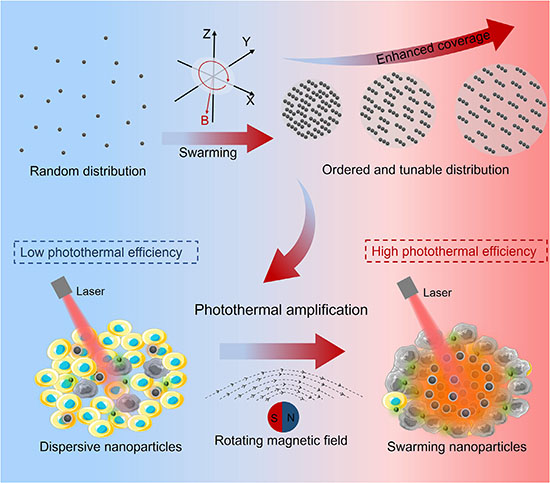 |
| The schematic shows the enhanced photothermal conversion via the swarming dynamics of the magnetic nanoparticles. (Image: Reproduced from DOI:10.1002/advs.76128, CC BY) |
| The work uses Fe₃O₄@PDA nanoparticles, combining magnetic iron oxide with a polydopamine coating that absorbs near-infrared light and can hold doxorubicin. Under a rotating magnetic field, loose particles gather into a microswarm that can tighten, spread, move, and hold together. The swarm is not a new particle chemistry. It is a new physical state for the same heat-generating material. |
| The difference appeared as soon as the researchers compared scattered particles with crowded ones. Dispersed Fe₃O₄@PDA particles warmed weakly because each particle released heat into nearby liquid. Crowded into a microswarm, they raised the local temperature by 23 °C more than the dispersed particles. Their areal density rose from 0.127 to 7.53 µg/mm², changing a dilute suspension into a compact heat source. |
| The temperature gain came from where heat could escape. Dispersed particles generated heat across a broad fluid volume, giving the environment many routes to pull energy away. A compact swarm generated heat in a smaller region, so dissipation occurred mainly from the cluster boundary. Simulations reproduced the same separation between crowded and scattered particles, supporting the paper’s explanation that swarming amplifies heat by limiting dissipation. |
| Magnetic control gave the heat source an adjustable shape. A tight cluster produced the highest local temperature. A broader cluster covered more area while remaining above 42 °C, the common threshold for therapeutic hyperthermia. The same particles could therefore favor intensity or coverage depending on their arrangement. Heat delivery became something researchers could tune by changing how the swarm occupied space. |
| A smaller particle load reached the same thermal goal when the particles gathered instead of spreading. A 20 µg microswarm exceeded 42 °C under laser irradiation, while dispersed nanoparticles required 100 µg for a similar temperature. The comparison does not prove lower risk in animals or patients. It shows that total dose can mislead if most particles sit too far apart to heat efficiently. |
| Doxorubicin followed the same spatial rule. The drug loaded into the polydopamine coating, and near-infrared irradiation accelerated its release. When particles dispersed, both the heat and the drug-bearing surfaces dispersed. When particles gathered, light absorption, temperature rise, and drug release came from the same local cluster. The swarm did not merely carry chemotherapy. It made heat and drug exposure coincide. |
| That coincidence changed the cell response. Dispersed Fe₃O₄@PDA particles left cancer cell viability near 100 % after laser exposure, consistent with insufficient local heating. Drug-loaded dispersed particles also produced limited killing. Drug-loaded swarms under near-infrared light produced a 7-fold improvement in cancer cell-killing efficiency compared with the dispersion-based treatment, with 42.88 % total apoptosis in the combined swarm, drug, and laser group. |
| The swarm also had to stay intact before light could activate it. Magnetic actuation guided the microswarm through tortuous channels, where 91.7 % of the nanoparticles reached the target region after transport. In pig blood, ultrasound imaging tracked the cluster as it moved under flow and retained its structure. Access rates stayed above 80 % against a blood-flow velocity of 4.34 cm/s before stronger opposing flow degraded transport. |
| Nanowerk has covered related strategies for steering small therapeutic carriers, including magnetic microbots for precision medicine delivery and hydrogel robots for targeted drug delivery. The difference here is that assembly does more than move cargo to a target. The magnetic field creates the crowded state that lets absorbed light become localized heat. |
| The rat bladder experiment put the same idea into a living, fluid-filled organ where heat could dissipate into surrounding tissue and fluid. After injection, ultrasound imaging showed dispersed nanoparticles gathering into a dense microswarm under a rotating magnetic field. The cluster moved along the curved bladder wall to a target site and then back toward its starting position. It stayed compact instead of breaking apart into the surrounding fluid. |
| The bladder data gave the paper its cleanest biological contrast. Under the same 808 nm laser irradiation, dispersed particles reached only 37.8 °C, below the usual hyperthermia threshold. Magnetic assembly pushed the same particle system to 42.3 °C. The increase was smaller than in dish experiments, but it carried the central claim into living conditions: scattered particles fell short, while crowded particles crossed the threshold. |
| The study stops short of showing that these swarms can treat tumors in animals or operate safely after repeated dosing. It does show that magnetic assembly can make photothermal particles heat more strongly, move under guidance, remain visible with ultrasound, kill cancer cells in vitro, and cross the hyperthermia threshold in a living bladder model. |
| That last comparison is the point. The particles did not need to become better absorbers to perform better. They needed to stop acting alone. When they remained scattered, heat leaked away. When a magnetic field crowded them into a swarm, the same material became a stronger local heater and a more effective drug-releasing cluster. For photothermal therapy, the state particles occupy after delivery may decide whether their chemistry ever gets a chance to matter. |
 By
Michael
Berger
– Michael is author of four books by the Royal Society of Chemistry:
Nano-Society: Pushing the Boundaries of Technology (2009),
Nanotechnology: The Future is Tiny (2016),
Nanoengineering: The Skills and Tools Making Technology Invisible (2019), and
Waste not! How Nanotechnologies Can Increase Efficiencies Throughout Society (2025)
Copyright ©
Nanowerk LLC
By
Michael
Berger
– Michael is author of four books by the Royal Society of Chemistry:
Nano-Society: Pushing the Boundaries of Technology (2009),
Nanotechnology: The Future is Tiny (2016),
Nanoengineering: The Skills and Tools Making Technology Invisible (2019), and
Waste not! How Nanotechnologies Can Increase Efficiencies Throughout Society (2025)
Copyright ©
Nanowerk LLC
|
|
ORCID information
|

Become a Spotlight guest author! Join our large and growing group of guest contributors. Have you just published a scientific paper or have other exciting developments to share with the nanotechnology community? Here is how to publish on nanowerk.com. |


