| Jul 11, 2026 |
Friction turns carbon debris into diamond and grapheneFriction between amorphous carbon surfaces transforms wear debris into diamond and graphene while maintaining exceptionally low resistance. |
| (Nanowerk Spotlight) When two surfaces move against each other, friction does more than wear material away. The pressure, heat, and repeated shear at their contact can break chemical bonds, rearrange atoms, and create structures that were absent before sliding began. A frictional interface can therefore become a site of materials processing. |
| Carbon makes these effects especially consequential because different carbon allotropes derive their properties from distinct bonding patterns. Graphite consists of soft, easily sheared layers, while diamond forms a rigid three-dimensional network. Both contain only carbon, yet their structures give them very different behavior. |
| Amorphous carbon coatings protect cutting tools, bearings, automotive components, and computer hard drives from friction and wear. Their atoms do not form the repeating crystal structure found in graphite or diamond. Instead, they contain a disordered mixture of graphite-like and diamond-like bonds. Sliding usually makes this material more graphite-like, producing layers that shear easily and help lower friction. |
| A study published in Advanced Materials ("Diamond Formation at Superlubric Sliding Interface") now shows that sliding can drive part of this disordered carbon toward diamond while maintaining exceptionally low friction. |
| An aluminum oxide ball moving across molybdenum disulfide-coated amorphous carbon produced a friction coefficient as low as 0.008. Within the resulting wear layer, some carbon debris became graphene while another fraction formed diamond. |
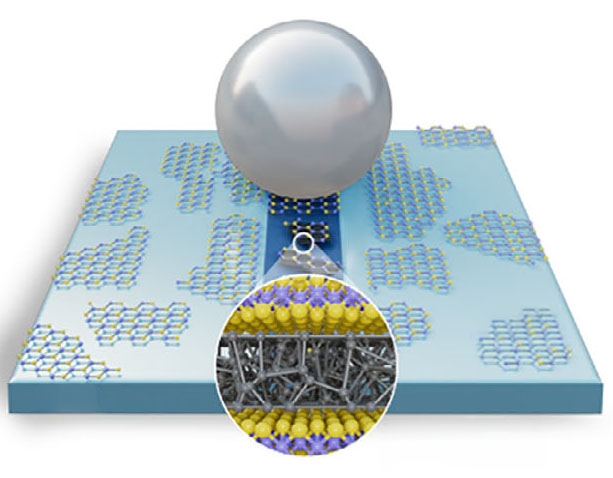 |
| Schematic of the sliding contact. An alumina ball moves across a molybdenum disulfide (MoS₂)-coated amorphous carbon surface, where friction generates carbon wear debris that later becomes confined between MoS₂ layers. (Image: Adapted with permission from Wilez-VCH Verlag) |
| Superlubricity describes a state in which surfaces move with barely any resistance. Diamond gains its hardness from a dense network of strong bonds and normally forms only under intense pressure and heat. The experiment brought both outcomes together within the same layered wear film. |
| As the aluminum oxide ball crossed the coated surface in vacuum, it removed nanoscale particles from the amorphous carbon. The fragments slipped between larger flakes of molybdenum disulfide, or MoS₂, whose stacked sheets are held together by weak van der Waals forces. Continued motion aligned the flakes with the sliding direction and enclosed the debris within a layered film. |
| Friction fell after this film assembled during the running-in period, when the surfaces adjusted through wear and deformation. Bare amorphous carbon remained much less slippery under comparable conditions. The MoS₂-coated system reached superlubricity once the debris-filled layers formed a continuous, load-bearing structure. |
| The trapped carbon did not become a uniform graphite-like film. Atomic-scale images revealed graphene nanoribbons beside nanodiamonds. Diffraction indicated predominantly cubic diamond, accompanied by defects and limited alternative stacking. Neither crystalline graphene nor diamond appeared in the original amorphous coating, ruling out the possibility that sliding had merely exposed material already present. |
| Some MoS₂ crystal planes have spacings close to those of diamond, so lattice images alone could not establish the new phase. The suspected diamond regions also contained mainly sp³-bonded carbon, the three-dimensional bonding arrangement characteristic of diamond, and their density approached that of bulk diamond. Nearby graphene-rich regions remained less dense and consisted almost entirely of planar sp² bonds. |
| Graphene and diamond occupied separate regions rather than appearing as stages in a direct conversion from one phase to the other. The researchers describe this division into lower-density graphene and denser diamond as disproportionation. Both products developed from the same disordered debris, but variations within that starting material sent neighboring regions toward opposing atomic structures. |
| When the initial contact pressure increased from 1.08 to 1.40 GPa, the confined film thinned and the estimated diamond fraction rose more than threefold. The calculation based on spectroscopic maps was only semi-quantitative, but other measurements supported the same pressure-dependent shift. At the highest load, one mapped region contained diamond-dominant carbon without a detectable graphene signal. |
| Conventional diamond synthesis typically requires sustained high pressure together with temperatures above 900 °C. The sliding experiment supplied no external heat, and its average contact pressure remained below that synthesis regime. Any conditions capable of supporting diamond formation would therefore have needed to arise locally, within particle contacts and microscopic surface peaks far smaller than the visible wear track. |
| A contact-mechanics estimate suggested that some of these tiny contacts might reach pressures near 25 GPa, even though the average applied pressure was much lower. The authors also propose that the MoS₂ enclosure slowed heat loss from the debris. Heat released as some carbon became graphitic may then have helped neighboring regions overcome the barrier to diamond formation. |
| The experiment could not capture those short-lived pressures and temperatures directly. In simulations designed to represent the proposed environment, uneven-density amorphous carbon confined between MoS₂ sheets separated into graphene-rich and diamond-rich regions during repeated compression, heating, and sliding. Encapsulation reduced the calculated energy difference associated with diamond formation by 30% and accelerated structural relaxation twofold compared with unconfined carbon. |
| Sulfur atoms at the MoS₂ surfaces encouraged nearby carbon to form six-membered rings in the model. Larger, flatter regions moved toward graphene, while smaller compressed domains produced diamond nuclei that grew as carbon atoms migrated toward them. The simulations suggest that MoS₂ helped organize the carbon and preserve weakly bonded sliding boundaries. |
| Contact calculations and thermal arguments provide separate support for possible roles of pressure concentration and heat retention. The model cannot establish that the real interface followed the same atom-by-atom sequence, but its proposed pathway fits the spatial separation observed in the wear film. |
| Because the diamond remained embedded within a composite of MoS₂, graphene, and residual amorphous carbon, it did not become an exposed sliding surface. Weakly bonded boundaries remained available for motion across the load-bearing film, allowing diamond formation to coexist with superlubricity across the wear track. |
| The study produced diamond nanoparticles inside a mixed wear layer rather than isolated crystals. The experiments also took place under vacuum, and the researchers did not determine whether the transformation would persist in air or with other material combinations. The proposed local synthesis conditions came from calculations, while estimates of phase content depended partly on image analysis. |
| Wear products are usually treated as damage or as raw material for a lubricating film. Here, they also became a confined reaction medium. The work does not yet offer a practical route to diamond production, but it shows that graphitization is not the only structural fate available to amorphous carbon during sliding. With the right enclosure, friction can help determine what the worn material becomes. |
 By
Michael
Berger
– Michael is author of four books by the Royal Society of Chemistry:
Nano-Society: Pushing the Boundaries of Technology (2009),
Nanotechnology: The Future is Tiny (2016),
Nanoengineering: The Skills and Tools Making Technology Invisible (2019), and
Waste not! How Nanotechnologies Can Increase Efficiencies Throughout Society (2025)
Copyright ©
Nanowerk LLC
By
Michael
Berger
– Michael is author of four books by the Royal Society of Chemistry:
Nano-Society: Pushing the Boundaries of Technology (2009),
Nanotechnology: The Future is Tiny (2016),
Nanoengineering: The Skills and Tools Making Technology Invisible (2019), and
Waste not! How Nanotechnologies Can Increase Efficiencies Throughout Society (2025)
Copyright ©
Nanowerk LLC
|

ORCID information
|

Become a Spotlight guest author! Join our large and growing group of guest contributors. Have you just published a scientific paper or have other exciting developments to share with the nanotechnology community? Here is how to publish on nanowerk.com. |


