| Jul 08, 2026 |
A stitched MOF membrane tackles PFAS in water without sacrificing flowEdge-stitched MOF membranes improve water purification by reinforcing weak seams while preserving PFAS rejection, water flow, and fouling resistance. |
| (Nanowerk Spotlight) Water filters built from stacked, atom-thin sheets can strain out some of the hardest pollutants to remove, down to the forever chemicals that shrug off ordinary treatment. One flaw has kept them in the lab. The sheets are bound to one another so weakly that the filter swells and falls apart in the very water it is meant to clean. The sheets can be graphene oxide, MXenes, or a metal-organic framework, a porous solid of metal atoms linked by organic molecules. |
| Adding material between or around the sheets can keep the stack from shifting, but it can also change how the filter works. The exposed sheet surfaces help control which molecules pass, how water moves, and how easily contaminants stick. A stabilizing material spread too broadly across the membrane can cover those surfaces. Too little reinforcement leaves the membrane unstable. Too much turns it into a less efficient filter. |
| Previous designs have added binders, spacers, or polymer coatings to keep layered membranes intact. Those additions can reduce swelling while blocking useful pathways or hiding the surface chemistry that helps the material reject pollutants and resist fouling. Related work on precision nanoengineering of layered membranes has shown how strongly separation performance depends on controlling chemistry inside stacked 2D channels. |
| In Advanced Functional Materials ("Edge‐Stitched Lamellar Metal–Organic Framework Membranes for Resilient and Selective Water Purification"), researchers describe a membrane that places polyamide reinforcement at the weak seams between metal-organic framework nanosheets instead of covering the filtering surface. |
| The membrane uses Cu-TCPP, a copper-based metal-organic framework, as the layered scaffold. Polyamide supplies the reinforcement, but not as the continuous layer familiar from many nanofiltration membranes. Spread across a MOF surface, polyamide can bury ordered pores and active chemical groups. Confined to the seams, it can close unstable gaps while leaving the framework exposed. |
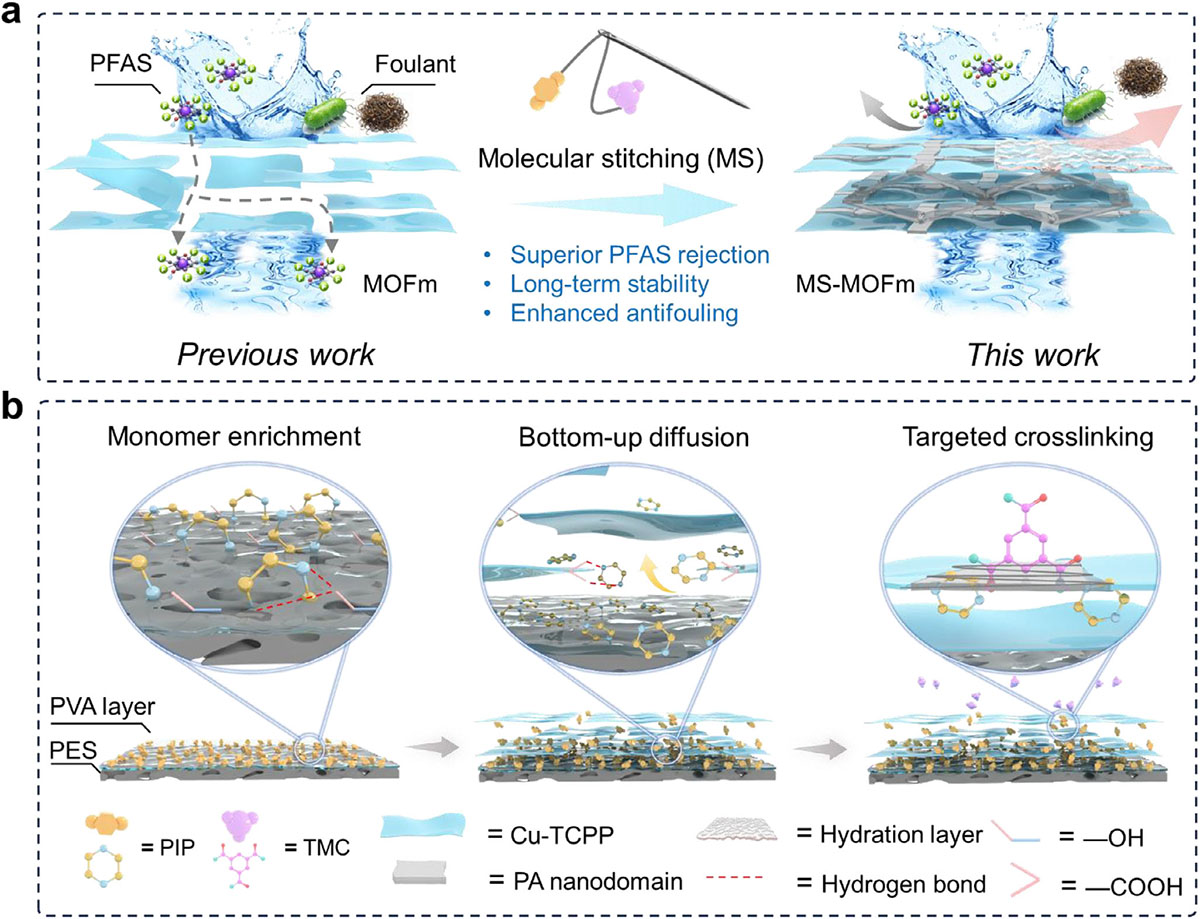 |
| Structural and design concept of molecular stitching metal–organic framework membranes (MS-MOFm) enabled by molecular stitching-interfacial polymerization (MS-IP). (a) Schematic comparison of the structural and performance features of MOFm and MS-MOFm. (b) Schematic illustration of the MS-IP strategy. (Image: Reproduced with permission from Wiley-VCH Verlag) (click on image to enlarge) |
| The fabrication depends on controlled movement inside the stack. Piperazine, a polyamide building block, begins below the MOF layer on a polyvinyl alcohol-coated support. The coating holds piperazine long enough for it to enter the forming stack gradually. As it moves upward, the MOF surface draws it toward lateral gaps between nanosheets. Trimesoyl chloride then reacts with it from above, forming polyamide where the sheets are most likely to separate. |
| A narrow timing window makes the chemistry useful. Too little upward movement leaves gaps underfilled. Too much movement lets polymer collect near the surface and become the coating the design is meant to avoid. With the timing tuned, polyamide appears as confined domains inside the layered structure. The sheets remain stacked, but the weak routes between them become tighter and less prone to opening in water. |
| Water does not need to destroy every sheet to ruin the filter. It only needs to widen enough gaps for the membrane to lose control over what passes through. The stitched domains reduce those openings and pull the nanosheets into a more coherent selective layer. Compared with the unstitched MOF film, the stitched membrane kept tighter spacing and resisted delamination more effectively in water. |
| The membrane has to give water a fast path while denying PFAS the leaks, pores, and surface interactions that would let them through. Recent Nanowerk coverage of PFAS removal from water using nanofiltration materials shows why this balance is difficult: contaminant rejection, water throughput, and fouling control often have to improve together. The stitched membrane rejected more than 89 % of nine tested PFAS compounds while maintaining a water permeance of 25.6 L m⁻² h⁻¹ bar⁻¹. The unstitched membrane removed only 20 % to 60 %. |
| Polyamide and Cu-TCPP remained visible together on the stitched membrane surface. In the conventional MOF-polyamide control, polyamide dominated the exterior. The difference showed up in water flow. The stitched membrane kept a thinner active layer and more accessible transport paths, while the polymer-covered control added resistance. |
| Proteins, organic matter, and bacteria collect on membranes, slow flow, and start biofilms. The stitched surface placed hydrophilic polyamide domains beside more hydrophobic MOF regions. That mixed wetting stabilized interfacial water at the membrane surface. Foulants had to displace that water before making close contact, which made adhesion less favorable. |
| Less bovine serum albumin attached to the stitched surface, and rinsing restored more of the lost flux. During E. coli exposure, fewer cells remained attached and a larger share of those cells were dead. The smoother hydrated surface reduced attachment, while exposed copper sites in the MOF domains damaged bacteria that still reached the membrane. |
| For 30 days, river water brought salts, dissolved organics, particles, and microbes to the same surface. The stitched membrane lost 29.7 % of its flux, compared with 80.6 % for the conventional control. The fouling layer that formed on the stitched surface was thinner, less compact, and lower in organic content, with fewer early biofilm-forming bacterial groups. |
| The copper sites that help damage bacteria must remain in the framework rather than leach into treated water. During continuous tap-water filtration, the researchers reported no detectable copper leaching under the tested conditions, and measured copper concentrations stayed below drinking-water guideline values. Longer tests under harsher waters would still need to confirm that stability. |
| Uniform stitching still has to scale beyond small samples. The layered framework has to tolerate repeated cleaning, shifting pH, and feed waters with different organic loads. Operation beyond the tested month remains unproven, and water-treatment materials often fail when stable laboratory conditions give way to variable field conditions. |
| The edge-stitched membrane is not a finished PFAS filter, but it makes a clear materials point: layered membranes do not have to choose between staying intact and keeping their active surfaces exposed. By placing polymer reinforcement only where the stack is vulnerable, the design preserves water flow, PFAS rejection, and fouling resistance in the same structure. The next test is whether that balance survives scale-up, repeated cleaning, and more varied real-world water. |
 By
Michael
Berger
– Michael is author of four books by the Royal Society of Chemistry:
Nano-Society: Pushing the Boundaries of Technology (2009),
Nanotechnology: The Future is Tiny (2016),
Nanoengineering: The Skills and Tools Making Technology Invisible (2019), and
Waste not! How Nanotechnologies Can Increase Efficiencies Throughout Society (2025)
Copyright ©
Nanowerk LLC
By
Michael
Berger
– Michael is author of four books by the Royal Society of Chemistry:
Nano-Society: Pushing the Boundaries of Technology (2009),
Nanotechnology: The Future is Tiny (2016),
Nanoengineering: The Skills and Tools Making Technology Invisible (2019), and
Waste not! How Nanotechnologies Can Increase Efficiencies Throughout Society (2025)
Copyright ©
Nanowerk LLC
|

|

Become a Spotlight guest author! Join our large and growing group of guest contributors. Have you just published a scientific paper or have other exciting developments to share with the nanotechnology community? Here is how to publish on nanowerk.com. |


