| Jul 02, 2026 |
Broken symmetry could unlock room-temperature quantum Hall materialsDeliberately breaking crystal symmetry widens topological bandgaps in 2D magnets made from light elements, predicting quantum anomalous Hall insulators robust enough to survive far above cryogenic temperatures. |
| (Nanowerk Spotlight) Every electronic device wastes energy the same way. Electrons traveling through a chip collide with atomic defects and lattice vibrations, scatter in random directions, and shed part of their energy as heat. This is why processors need fans and data centers need cooling plants. Resistance is not an engineering oversight. It follows directly from how electrons move through ordinary matter. |
| Physics permits an exception. In a special class of two-dimensional materials, electrons flow along the edges in one direction only, through channels where reversing course is quantum mechanically forbidden. With no path available for backscattering, the current meets no resistance, and the effect needs no external magnet. These materials, called quantum anomalous Hall insulators, reached the laboratory in 2013 and underpin many proposals for ultra-low-power electronic devices built on topological materials. |
| The catch is that these materials only work when frozen. Every experimental demonstration to date requires cryogenic cooling, often to below one kelvin. The obstacle is a built-in contradiction in materials design. Robust magnetism, which the effect requires, comes from light transition metals. A protective bandgap large enough to survive thermal agitation traditionally comes from the strong relativistic effects of heavy elements such as bismuth. Compounds that excel at one condition tend to fail the other, and the few predicted materials that manage both still lean on heavy elements. |
| A study published in Advanced Functional Materials ("A Symmetry Strategy for Large Bandgap Quantum Anomalous Hall Insulators") now proposes a way out that requires no heavy atoms at all. Instead of adding mass, the researchers remove symmetry. |
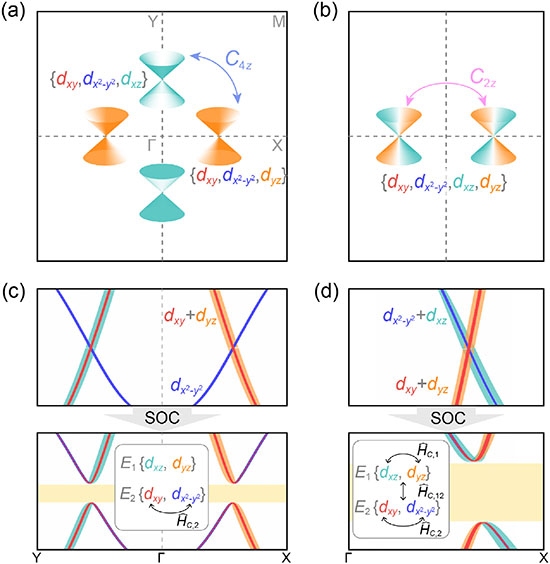 |
| How lowering symmetry creates a larger topological gap. This figure illustrates the main idea of the paper: a material’s symmetry can control how its electron orbitals mix, and that mixing can greatly enlarge the energy gap needed for a robust quantum anomalous Hall insulator. In the higher-symmetry P4/nmm structure, shown in panels a and c, the fourfold rotational symmetry keeps key d orbitals separated into different Dirac cones in momentum space. Because the orbitals do not strongly mix, only a limited correlation channel contributes to opening the spin–orbit-coupling gap, so the resulting gap is relatively small. In the lower-symmetry Pmmn structure, shown in panels b and d, symmetry reduction brings different d-orbital sets together within the same Dirac cone. This activates orbital hybridization and allows both intra-set and inter-set electron correlations to work together, producing a much larger SOC gap. In simple terms, the figure shows that carefully “breaking” symmetry does not merely distort the electronic structure; it unlocks new orbital interactions that make the topological insulating state much stronger. This is the core mechanism behind the authors’ strategy for designing large-bandgap quantum anomalous Hall materials without relying on heavy elements. (Image: Reproduced with permission from Wiley-VCH Verlag) |
| The idea rests on how electrons organize into Dirac cones, the crossing points in a material's electronic structure where the topological gap opens. Two families of orbitals can feed these cones. In the high-symmetry form of the tetragonal lattice studied here, the fourfold rotation distributes the second family's orbitals across different cones, so the two families never fully meet at any one of them. |
| Distorting the crystal into a lower symmetry removes that separation. Both orbital families then mix within the same Dirac cone, and this hybridization opens additional channels through which electron-electron repulsion widens the gap. The authors show that previous theoretical work overlooked this contribution, and that it survives even when strong electronic hopping or lattice distortions suppress the mechanism that earlier strategies relied on. |
| A tight-binding model confirms the picture: as electron-electron interactions strengthen, the gap of the distorted lattice grows substantially faster than that of its high-symmetry counterpart, so the broken symmetry itself, not any change in chemistry, drives the enhancement. |
| To test whether real materials follow the rule, high-throughput first-principles calculations screened more than 170 tetragonal monolayer compounds pairing transition metals with light elements. Four emerged as new quantum anomalous Hall insulators: VAs, VP, TiAs, and TiP. Among them, vanadium arsenide stands out. The calculations predict magnetic order up to 850 K and a topological bandgap of roughly 1 eV, or 650 meV by a more conservative method. Either value exceeds the thermal energy at room temperature many times over. A quantized Hall conductance and a single one-way edge channel within the gap confirm the topological character. |
| The clearest evidence comes from a computational trick: an artificial VAs monolayer forced to keep the high-symmetry structure. Its gap shrinks from 1018 to 857 meV, a difference owing to the orbital hybridization that only the lower symmetry permits. The same split shows up in all four candidates. VP, which also adopts the distorted structure, keeps a gap above half an electronvolt alongside magnetic order well past room temperature, while the two titanium compounds, locked in the high-symmetry form, manage less than a sixth of that. |
| Symmetry lowering also works as a tuning knob applied from outside. The TiTe monolayer, a previously predicted quantum anomalous Hall insulator containing heavy tellurium, has a gap of 181 meV in its symmetric form. Stretching the lattice by 3% along one axis breaks the fourfold rotation and raises the local gap along the strained direction to 231 meV. |
| Strain does not act evenly, though. The gap along the perpendicular direction barely responds, so the overall bandgap does not grow steadily, and compression narrows it despite also reducing the symmetry. The authors extend the analysis to hexagonal lattices such as monolayer FeSe with similar results, and point to earlier work by another group showing that a substrate alone can distort a monolayer and widen its topological gap without any applied strain. |
| These materials exist so far only in calculations, and their properties await experimental scrutiny. The synthesis route, however, looks plausible. The same tetragonal motif appears in FeSe and CoSe monolayers grown epitaxially on strontium titanate, and the predicted lattice constants match several standard substrates. The authors suggest a substrate could do double duty, serving as growth template while nudging the lattice toward the lower symmetry. |
| Materials design for topological electronics has treated high crystal symmetry as a given and heavy elements as the price of a usable bandgap. This work inverts both assumptions, arguing that carefully broken symmetry can extract more from light, strongly magnetic elements than heavy atoms deliver. If experiments bear out the predictions, the payoff would be electron channels that conduct without loss under everyday conditions, and a design principle that extends to other electronic states shaped by the same relativistic physics. |
 By
Michael
Berger
– Michael is author of four books by the Royal Society of Chemistry:
Nano-Society: Pushing the Boundaries of Technology (2009),
Nanotechnology: The Future is Tiny (2016),
Nanoengineering: The Skills and Tools Making Technology Invisible (2019), and
Waste not! How Nanotechnologies Can Increase Efficiencies Throughout Society (2025)
Copyright ©
Nanowerk LLC
By
Michael
Berger
– Michael is author of four books by the Royal Society of Chemistry:
Nano-Society: Pushing the Boundaries of Technology (2009),
Nanotechnology: The Future is Tiny (2016),
Nanoengineering: The Skills and Tools Making Technology Invisible (2019), and
Waste not! How Nanotechnologies Can Increase Efficiencies Throughout Society (2025)
Copyright ©
Nanowerk LLC
|

|

Become a Spotlight guest author! Join our large and growing group of guest contributors. Have you just published a scientific paper or have other exciting developments to share with the nanotechnology community? Here is how to publish on nanowerk.com. |


