| Jun 23, 2026 |
MXene chemistry programs underwater sound absorptionMXene-polymer bonding lets a thin underwater absorber tune resonance and damping chemically, shifting acoustic control from structure to material chemistry. |
| (Nanowerk Spotlight) Materials that absorb underwater sound are built to solve a practical wave-control problem: reduce reflection, suppress noise, and manage acoustic signals in water. That matters for sonar, underwater communication, detection systems, marine equipment, and acoustic stealth for underwater platforms, such as submarines and unmanned underwater vehicles. The difficulty is that water carries sound efficiently, while many solid materials send much of that sound back instead of letting it enter and dissipate. |
| Acoustic metamaterials address this problem by making compact materials interact with sound in ways ordinary absorbers cannot. They use designed internal structures to create resonances, slow sound, match acoustic impedance, or concentrate vibration where it can be dissipated. |
| In principle, this allows thin materials to absorb sound wavelengths far larger than the material itself, as related work on underwater sound sensing with piezoelectric metamaterials shows. |
| These materials are normally designed from the outside in. Researchers prescribe a geometry, such as a cavity, membrane, grating, or layered resonator, and that structure sets how the material interacts with sound. The approach can produce unusual acoustic responses, but it also creates a hard limit: once the geometry is made, the strongest absorption bands are largely locked in. |
| Research published in a paper in Advanced Science ("Chemically Programmable Underwater Sound‐Absorbing Metamaterial via MXene Self‐Assembly") reverses that design logic. Instead of making acoustic performance depend mainly on a fixed macroscopic structure, it programs the response through chemistry inside a self-assembled Ti₃C₂Tₓ MXene and polyvinyl alcohol film. By adjusting the crosslinking network, the authors shift resonance bands, damping behavior, and impedance matching inside a 10 mm rubber composite. |
| The central finding is that underwater sound absorption can be tuned by editing internal bonding, not only by redesigning geometry. |
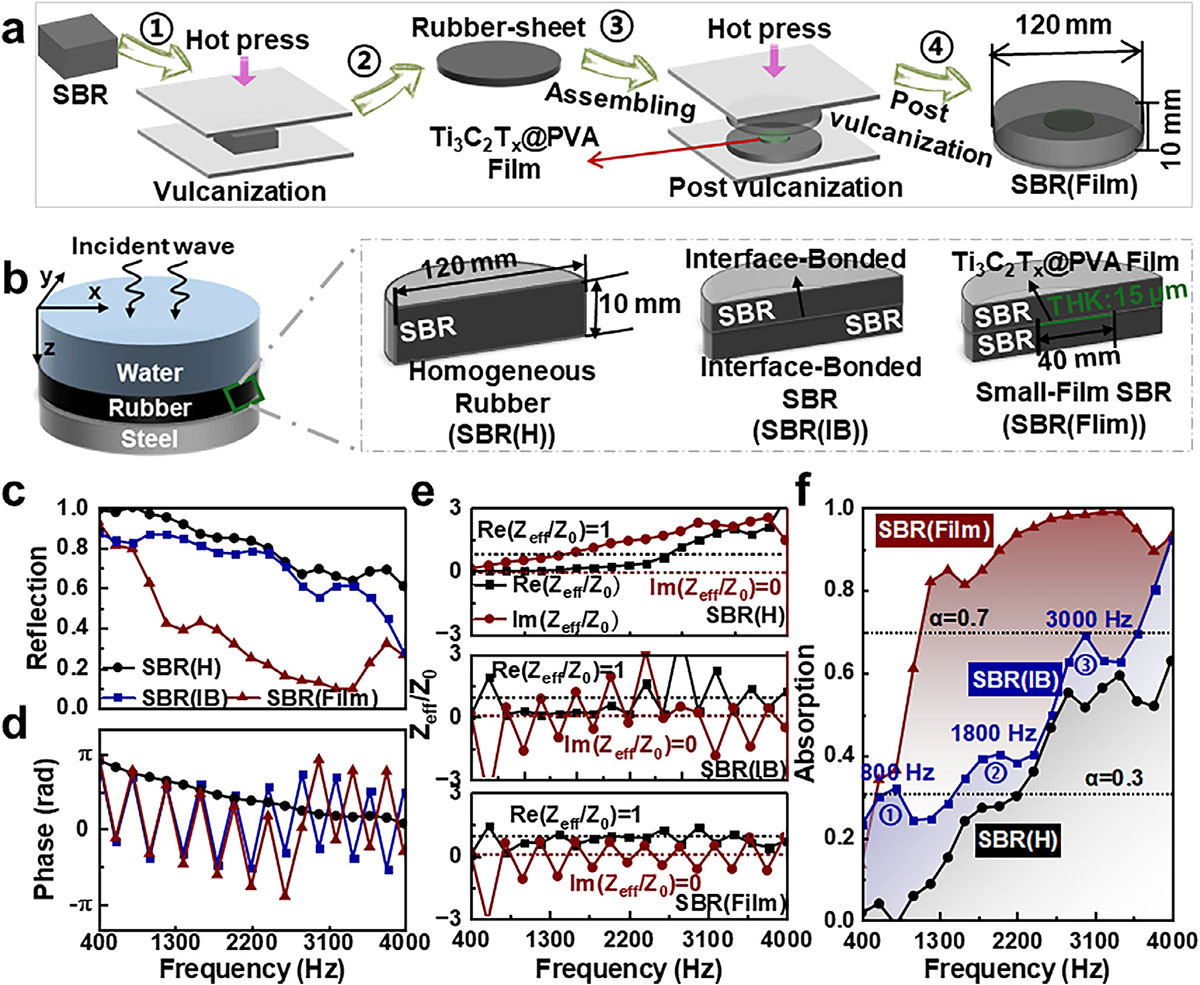 |
| Acoustic response of SBR(H), SBR(IB), and SBR(Film). (a) Fabrication process of the acoustic samples. (b) Schematic diagrams of the test samples and cross-sectional structure of the rubber components. (c) Reflection coefficients. (d) Reflection phases. (e) Normalized acoustic impedance. (f) Sound absorption coefficients. (Image: Reproduced from DOI:10.1002/advs.76139, CC BY) (click on image to enlarge) |
| The film had to do something more precise than reinforce rubber. It needed enough order and stiffness to help sound enter from water, but enough internal mobility to dissipate vibration once the wave was inside. That balance guided the material choice. Ti₃C₂Tₓ MXene offered reactive nanosheet surfaces, while polyvinyl alcohol formed a flexible polymer network that could connect those surfaces into a layered film. |
| Glutaraldehyde supplied the chemical handle. As a crosslinker, it tied the polymer and MXene surface groups into a covalent network. During vacuum-assisted filtration, that mixture organized into a film with two acoustic environments: polymer-separated MXene layers and closely stacked MXene regions. |
| The first helped establish constrained layered phases. The second added dense contact interfaces where nanosheets could slide and dissipate motion under vibration. |
| Laminating the film into styrene-butadiene rubber brought those internal interfaces into the underwater absorber. The covalent network helped set stiffness and impedance, which governs whether sound enters from water or reflects away. Hydrogen bonds formed a second, more dynamic network. Under acoustic loading, these weaker bonds could break and reform, while MXene interfaces added frictional loss. The material absorbed sound by coordinating entry and dissipation. |
| The control samples show the sequence cleanly. Plain rubber behaved mainly as a viscoelastic solid and reflected much of the incident sound. Rubber with vulcanized internal interfaces introduced resonances, but they remained separated into narrow peaks. Adding the MXene-polymer film changed the response qualitatively. The discrete peaks spread into a broad absorption band, showing that the self-assembled film was controlling the acoustic state of the composite. |
| At the optimized crosslinking level, the 10 mm composite reached an average absorption coefficient of 0.90 from 1000 to 4000 Hz. It also retained useful absorption from 400 to 1000 Hz, where thin underwater absorbers face a stronger size penalty. The material approached near-critical damping, a state in which it admits sound from water while dissipating vibration quickly inside the laminate. |
| A single strong absorber would not prove chemical programming. The stronger result came when the researchers changed the glutaraldehyde amount and watched the acoustic response move. Low crosslinking left the layered film loose and unevenly damped across frequency ranges. |
| Intermediate crosslinking produced the best balance of stiffness, hydrogen bonding, and interfacial loss. Higher crosslinking shifted the system away from broadband absorption. |
| sThat shift reached the material’s metamaterial signature. The effective bulk modulus, which describes resistance to compression, approached near-zero or negative values in different frequency bands as the crosslinker concentration changed. |
| In conventional acoustic metamaterials, those anomalous responses come from resonant geometry. Here, changing bond density moved the bands where the anomalous response appeared. The chemistry tuned the metamaterial behavior itself. |
| Physical tuning then added a second design dimension built on the chemically programmed film. Changing the active film thickness from 6 to 29 µm altered low-frequency resonance while keeping the full absorber compact. Adding multiple active films inside the same 10 mm rubber laminate strengthened sub-kHz absorption through coupled resonances. In the strongest low-frequency case, the absorption coefficient at 600 Hz reached 0.70. |
| The layer count did not improve every frequency at once. Stronger sub-kHz absorption came with reduced absorption in some mid-frequency ranges. That trade-off matters because it keeps the work in engineering perspective. |
| The chemistry does not remove the compromises that shape underwater acoustic design. It gives researchers more variables for managing them, including cross-link density, hydrogen bonding, nanosheet order, film thickness, and layer count. |
| The material remains a laboratory demonstration. A marine coating would need large-area fabrication, durable bonding between film and rubber, and testing under pressure cycling, temperature changes, fouling, abrasion, fatigue, and extended underwater exposure. The reported stability checks support the concept, but real operating environments would test whether the programmed bonding network can remain reproducible and intact. |
| The work reframes the absorber as a material whose acoustic response can be set from within. Geometry still defines the outer design, but the critical resonance and damping behavior no longer come only from shaped structures. In this system, they change with the bonding network itself. That is the larger point of the paper: underwater sound absorption can be engineered not only by building shapes, but by programming the chemistry that connects the material together. |
 By
Michael
Berger
– Michael is author of four books by the Royal Society of Chemistry:
Nano-Society: Pushing the Boundaries of Technology (2009),
Nanotechnology: The Future is Tiny (2016),
Nanoengineering: The Skills and Tools Making Technology Invisible (2019), and
Waste not! How Nanotechnologies Can Increase Efficiencies Throughout Society (2025)
Copyright ©
Nanowerk LLC
By
Michael
Berger
– Michael is author of four books by the Royal Society of Chemistry:
Nano-Society: Pushing the Boundaries of Technology (2009),
Nanotechnology: The Future is Tiny (2016),
Nanoengineering: The Skills and Tools Making Technology Invisible (2019), and
Waste not! How Nanotechnologies Can Increase Efficiencies Throughout Society (2025)
Copyright ©
Nanowerk LLC
|
|
ORCID information
|

Become a Spotlight guest author! Join our large and growing group of guest contributors. Have you just published a scientific paper or have other exciting developments to share with the nanotechnology community? Here is how to publish on nanowerk.com. |


