| Jun 16, 2026 |
Spiky nanoparticles clear drug-resistant biofilms with ultrasoundA spiky nanoparticle activated by ultrasound clears drug-resistant bacterial biofilms, mechanically piercing them while releasing two reactive oxygen species, each tuned to reach a different depth. |
| (Nanowerk Spotlight) A drug that wipes out bacteria in a dish can fail outright in a patient, even when the microbes are identical. The difference is that the bacteria in the body have stopped living as single cells. They have built dense communities sealed in a self-produced layer of slime, the kind that forms on catheters, joint implants, and the surface of a chronic wound. Inside it, the cells sit beyond easy reach, and antibiotics that would destroy free-floating cells cannot get through. |
| These communities, called biofilms, lie behind many infections that no longer respond to treatment, and they help explain why drug-resistant bacteria now contribute to close to a million deaths each year. One strategy sidesteps the genetic machinery bacteria use to defeat antibiotics. It floods the infection with reactive oxygen species, unstable molecules that damage bacterial proteins, membranes, and DNA on contact. The approach has shown real promise. It has also stayed blunt. |
| Reactive oxygen species are not interchangeable. The hydroxyl radical is highly reactive but travels almost no distance before it reacts and disappears, which makes it useless against bacteria buried deep in a biofilm. Singlet oxygen is gentler, but persists long enough to drift through dense material and reach those hidden cells. Most treatments ignore the distinction and release every species at once, risking collateral damage while missing their targets. |
| A study in Advanced Science ("Inside‐Outside ROS Therapeutic Strategy Based on Piezoelectric Nano‐Urchin for Drug‐Resistant Bacteria Biofilm Infections") turns that difference into a design principle. |
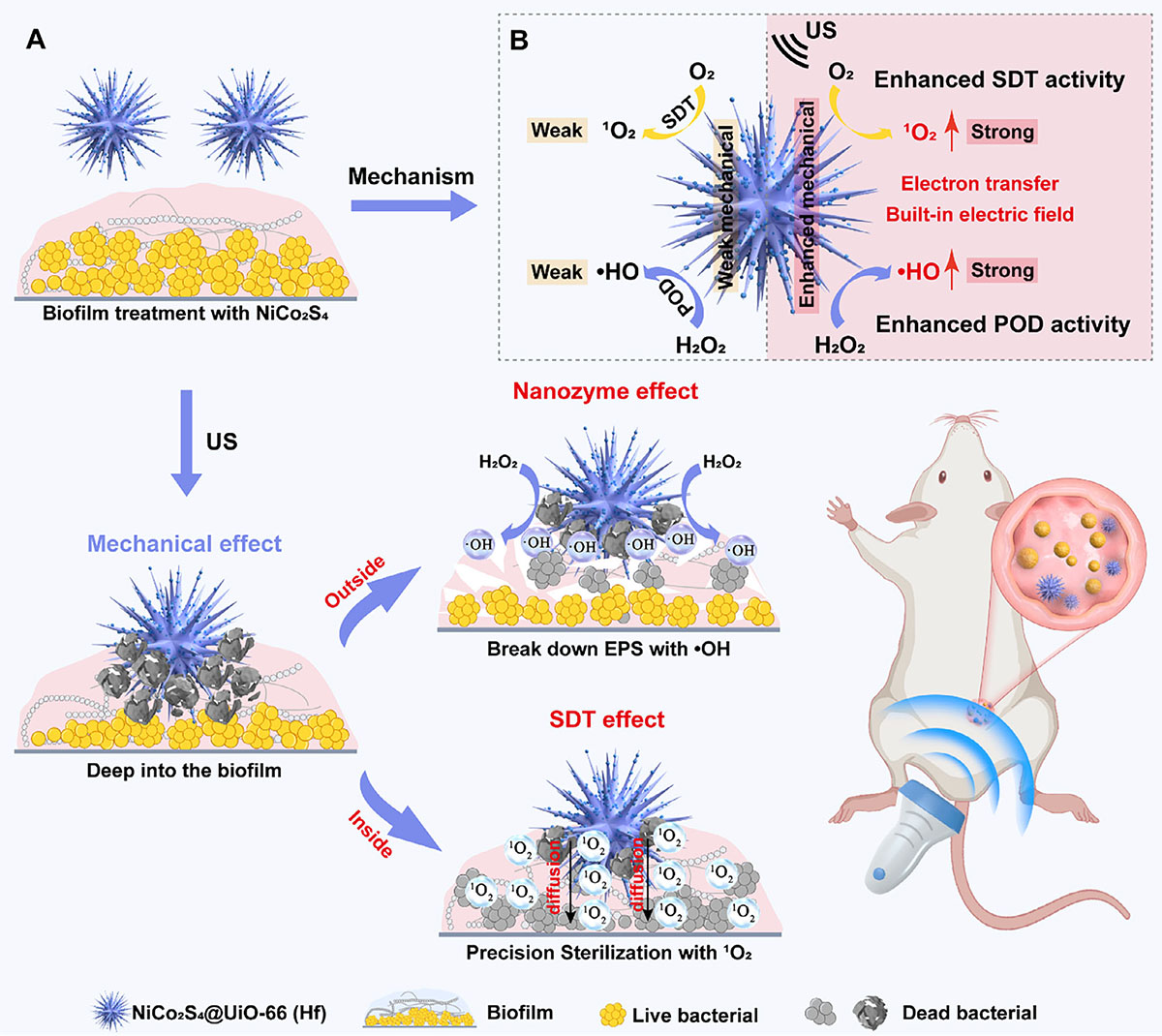 |
| (A) Schematic of spatially hierarchical ROS release by piezoelectric nano-urchin for treatment of biofilm infections in drug-resistant bacteria. (B) Schematic of the piezoelectric nanozyme mechanism of NiCo2S4@UiO-66. (click on image to enlarge) |
| At the center of the study sits a spiky particle the researchers call a nano-urchin. Its core is nickel cobalt sulfide, grown into elongated spikes several micrometers long. Studding those spikes are particles of a metal-organic framework, a porous crystalline solid built from metal atoms joined by organic struts. This particular framework, assembled around the metal hafnium, carries the property that powers the chemistry to come. It is piezoelectric. |
| Ultrasound supplies the trigger. Low-intensity sound waves travel through tissue to the infected site, set the particles in motion, and their rigid spikes puncture the biofilm and the walls of nearby bacteria. The same physical principle drives a separate line of work on antibacterial surfaces that puncture bacteria on contact. The same waves also flex the piezoelectric framework, and the electric charge it releases under that stress powers the chemistry that follows. |
| That chemistry divides in two, which is the central idea. At the outer edge of the biofilm, the nickel cobalt sulfide works as a catalyst that mimics a natural enzyme, converting hydrogen peroxide, which pools at infection sites, into hydroxyl radicals. Because these radicals act only where they form, they concentrate on the surrounding matrix and break it apart without spreading oxidative damage. The particle joins a broader class of reactive-oxygen-generating nanozymes being tested as antibiotic alternatives. |
| Deeper inside, the piezoelectric framework performs the opposite job. Driven by ultrasound, it produces singlet oxygen, the longer-lived species that can diffuse through the dense interior. This molecule reaches the bacteria sheltered at the core of the biofilm and inactivates them by oxidizing their lipids and proteins. The short-range radical breaks down the matrix from outside while the long-range singlet oxygen kills the cells within, each species matched to where it works best. |
| The two parts need each other. The framework on its own generates little reactive oxygen, because the charges it produces recombine before they can drive a reaction. Adding the nickel cobalt sulfide narrows the band gap and keeps those charges apart, roughly doubling the composite's singlet-oxygen output over the framework alone. The radical pathway gains its own lift. Modeling identified cobalt as the site where hydrogen peroxide breaks down and showed that ultrasound lowers the barrier to releasing the radical. |
| Confirming that each species did its assigned job required switching one off at a time. When the team neutralized singlet oxygen, the deep bacteria largely survived and a thicker biofilm remained. When they neutralized the hydroxyl radical, the surface slime stayed intact and the overall kill weakened. Fluorescent markers mapped where each species formed, placing singlet oxygen throughout the biofilm and the radicals at its periphery, as the spatial design intended. |
| Those mechanisms translated into hard antibacterial numbers. The particles did almost nothing without ultrasound and killed more than 99.9% of two resistant strains with it, methicillin-resistant Staphylococcus aureus and a multidrug-resistant Escherichia coli. Biofilms responded in degrees. Ultrasound alone barely registered and the framework could not penetrate, but the sulfide spikes under ultrasound already halved a mature MRSA biofilm and killed most of its bacteria. The full composite cut deeper, and added peroxide reduced it to about 1 µm, near-total clearance. |
| A central claim for any antibiotic alternative is that bacteria should not adapt to it. The researchers tested that directly. Across sixteen rounds of repeated exposure, two common antibiotics quickly selected for resistant populations of the test bacteria. The nano-urchin treatment held its full potency through every round. Its design rests on damage that mutation cannot easily counter, mechanical puncturing and broad oxidative injury rather than a single molecular target. |
| In mice carrying MRSA biofilms in full-thickness skin wounds, the ultrasound-activated particles cut bacterial counts by 99.9% within a week and brought the wounds to near-complete closure over sixteen days. Untreated wounds and most single-component treatments lagged well behind. The biofilms had already formed when treatment began, the hardest stage to clear. |
| Clearing the bacteria did not, on its own, guarantee healing. The treatment also reset the wound. It steered the local immune response from inflammation to repair, switching the resident immune cells toward a healing role. As inflammation subsided and the oxidative stress of infection eased, new blood vessels grew, rebuilding the supply lines that regenerating skin depends on. |
| Safety held up alongside the biology. The ultrasound dose stayed within FDA limits. Human and mouse cells tolerated the particles, blood markers of liver and kidney function held normal, and tissue from the major organs showed no damage. |
| The work makes a single, transferable point. The type of reactive oxygen species, and the place it is released, can be engineered as deliberately as the amount. By combining physical penetration with chemistry tuned to two different ranges, the design addresses both obstacles that make biofilms so durable, the protective matrix and the bacteria hidden behind it. The evidence is preclinical, drawn from cell cultures and mice, and a long way from a clinic. |
 By
Michael
Berger
– Michael is author of four books by the Royal Society of Chemistry:
Nano-Society: Pushing the Boundaries of Technology (2009),
Nanotechnology: The Future is Tiny (2016),
Nanoengineering: The Skills and Tools Making Technology Invisible (2019), and
Waste not! How Nanotechnologies Can Increase Efficiencies Throughout Society (2025)
Copyright ©
Nanowerk LLC
By
Michael
Berger
– Michael is author of four books by the Royal Society of Chemistry:
Nano-Society: Pushing the Boundaries of Technology (2009),
Nanotechnology: The Future is Tiny (2016),
Nanoengineering: The Skills and Tools Making Technology Invisible (2019), and
Waste not! How Nanotechnologies Can Increase Efficiencies Throughout Society (2025)
Copyright ©
Nanowerk LLC
|
|
ORCID information
|

Become a Spotlight guest author! Join our large and growing group of guest contributors. Have you just published a scientific paper or have other exciting developments to share with the nanotechnology community? Here is how to publish on nanowerk.com. |


