| Jul 01, 2026 |
Nanofluidic fibers let wastewater help power its own cleanupCOF nanofluidic fibers turn wastewater ion gradients into power for copper recovery and trace copper ion sensing in one integrated platform. |
| (Nanowerk Spotlight) Wastewater treatment usually treats dissolved ions as a problem to remove. Salt ions complicate separation, heavy-metal ions create health risks, and mixed chemical streams make monitoring harder. Yet those same ions also carry energy, chemical value, and information. Their concentration differences can drive current, their identity can trigger a sensing signal, and their charge can make them recoverable rather than disposable. |
| The difficult part is controlling that ion movement without slowing it down. A recent Nanowerk Spotlight on the ion-transport bottleneck in nanofluidic blue-energy membranes explained why this is difficult: fast ion transport gives current, while charge selectivity gives voltage, and many membranes improve one at the expense of the other. The same problem appears in wastewater treatment, where ion control must survive more complex chemistry and do more than generate power. |
| A paper in Advanced Functional Materials ("Integrated Nanofluidic Covalent Organic Framework Fibers for Sustainable Wastewater Valorization") takes that ion-transport problem into a broader wastewater system. |
| It reports covalent organic framework fibers that use one light-responsive nanofluidic pathway to connect salinity-gradient power generation, copper recovery, and copper ion sensing. The key advance is not a single performance number, but the way one controlled ion pathway links energy harvesting, chemical recovery, and pollutant monitoring. |
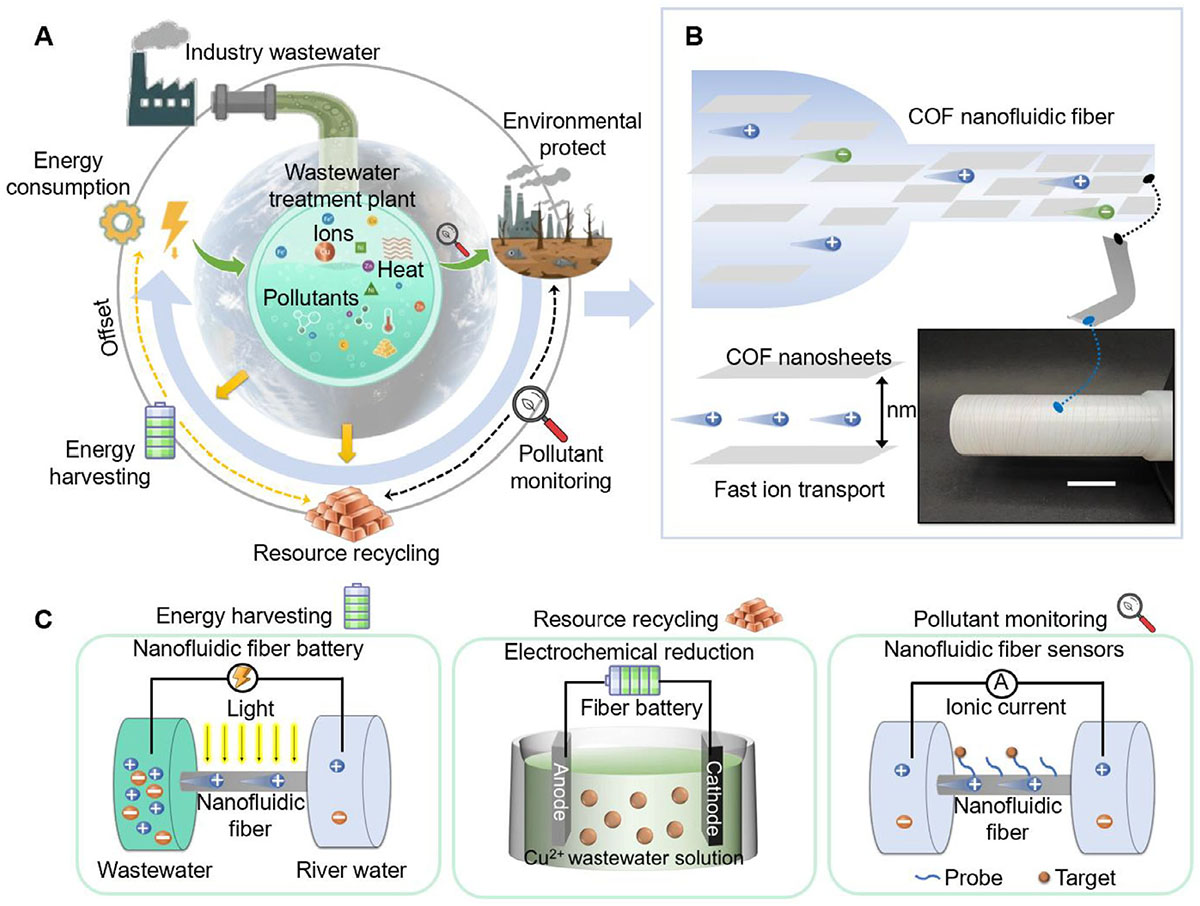 |
| Conceptual framework for the design of nanofluidic COF fiber system for sustainable wastewater management. (A) Conceptual framework illustrating the transition from conventional energy-consuming wastewater treatment to a self-sufficient cycle enabled using COF nanofluidic fibers. The integrated system combines energy harvesting, pollutant monitoring, and resource recycling to offset energy consumption and promote environmental protection. (B) Structural design and ion transport mechanism of COF nanofluidic fibers. The fiber consists of stacked COF nanosheets forming nm-scale channels that enable fast and selective ion transport; inset shows the macro-flexibility and scale of the fabricated COF fiber (scale bar, 1 cm). (C) Operational principles of the integrated functions: capture of solar and osmotic coupled energy, electrochemical reduction for recovery of valuable metal ions (e.g., Cu2+), and real-time pollutant monitoring. (Image: Reproduced with permission from Wiley-VCH Verlag) (click on image to enlarge) |
| Nanofluidic materials work because liquids behave differently inside channels only a few nanometers wide. Charged channel walls attract oppositely charged ions and exclude others, giving the material a way to guide ion flow. Earlier work on COF channels for salinity-gradient power generation showed why ordered covalent organic framework structures fit ion-transport applications. |
| The new study changes both the form and the function. Instead of using a flat membrane, the team built continuous fibers from COF nanosheets. The fibers contain sulfonic acid groups, which give their internal surfaces a stable negative charge. That charge favors the movement of cations, including metal ions, through confined pathways. The fiber geometry also makes large-scale assembly more practical than isolated nanoscale channels. |
| The structure solves part of the selectivity problem by separating transport roles across different pore sizes. Intrinsic COF nanochannels provide chemical and electrostatic control. Larger internal pores formed during spinning give ions less obstructed routes through the material. This hierarchy helps the fiber preserve charge selectivity while reducing resistance, which matters for both power generation and sensing. |
| When the fiber bridged salt solutions with different concentrations, ions moved through the charged channels and produced electrical output. Under a 500-fold NaCl gradient and light illumination, the system reached a maximum output power density of 249.4 W/m². The output remained useful over 7 days of repeated testing, supporting the paper’s claim that the fiber can sustain repeated ion-transport operation under laboratory conditions. |
| Light is the hinge that makes the system more than another salinity-gradient device. The COF absorbs ultraviolet and visible light because its molecular structure contains electron-donating and electron-accepting units connected through a conjugated backbone. Under illumination, the material separates charges and increases negative charge at the fiber surface. The channel walls then attract cations more strongly, raising current and power output. |
| That mechanism links solar input directly to ion transport. Only a small temperature rise appeared under illumination, so heating could not explain the current increase. The stronger interpretation is photoelectric: light changes the surface charge state, and the charged nanochannels translate that change into faster cation movement. The same fiber therefore couples solar response and osmotic energy conversion inside one controlled pathway. |
| The system also worked with less ideal water combinations. Under simulated sunlight, the fibers harvested energy from gradients between simulated river water and artificial seawater, natural seawater, or salt lake brine. A test pairing natural seawater with real electroplating wastewater produced 179.9 ± 8.0 W/m². These results do not establish field performance, but they show that the energy-harvesting effect survives beyond pure laboratory salt solutions. |
| The generated electricity then powered copper recovery. By arranging fiber units in serial and parallel configurations, the device produced enough electrical output to drive electrochemical reduction in a separate cell. In simulated copper wastewater, copper ions converted to metallic copper and deposited on a carbon cloth cathode. Over 24 h, the dissolved copper ion concentration steadily declined. |
| That experiment proves a controlled operating principle, not a complete industrial process. The wastewater model contained a single target metal ion, while real effluents can include mixed metals, organic molecules, acids, suspended solids, and fouling agents. The result still matters because the fiber’s harvested energy performed chemical work. The device did not merely report a voltage. It applied that voltage to resource recovery. |
| The same ion-transport pathway also served as a copper sensor. A surface layer of poly-γ-glutamic acid, a molecule that binds copper ions, changed the fiber’s response to copper. When copper ions attached to this layer, it reduced the fiber’s surface charge and restricted ion movement. The device read that change as a drop in ionic current, enabling label-free detection without fluorescent tags or separate reagents. |
| The sensor detected copper ions down to 5 nM and distinguished them from common ions such as Ca²⁺, Al³⁺, Na⁺, and Mg²⁺. In real electroplating wastewater, the team used simple filtration before measuring with a portable electrochemical workstation. The full detection process took about 13 min. That performance makes the sensing component a practical counterpart to the recovery experiment rather than a separate demonstration. |
| Several questions remain before the concept can approach deployment. The paper does not resolve module-scale flow design, long-term fouling, recovery efficiency in mixed wastewater, or performance under variable sunlight and changing salt gradients. Those tests will determine whether the architecture can withstand real industrial operation. At this stage, the advance is more fundamental: wastewater streams are not only fluids to be cleaned, but ion-rich environments that can help drive parts of their own treatment. |
 By
Michael
Berger
– Michael is author of four books by the Royal Society of Chemistry:
Nano-Society: Pushing the Boundaries of Technology (2009),
Nanotechnology: The Future is Tiny (2016),
Nanoengineering: The Skills and Tools Making Technology Invisible (2019), and
Waste not! How Nanotechnologies Can Increase Efficiencies Throughout Society (2025)
Copyright ©
Nanowerk LLC
By
Michael
Berger
– Michael is author of four books by the Royal Society of Chemistry:
Nano-Society: Pushing the Boundaries of Technology (2009),
Nanotechnology: The Future is Tiny (2016),
Nanoengineering: The Skills and Tools Making Technology Invisible (2019), and
Waste not! How Nanotechnologies Can Increase Efficiencies Throughout Society (2025)
Copyright ©
Nanowerk LLC
|

ORCID information
|

Become a Spotlight guest author! Join our large and growing group of guest contributors. Have you just published a scientific paper or have other exciting developments to share with the nanotechnology community? Here is how to publish on nanowerk.com. |


