| Jun 24, 2026 |
A spider silk smart suture tightens, senses, delivers drugs, and fades as wounds healIn mouse skin wounds, a recombinant spider-silk and liquid-metal thread reduced scar area by over 58 percent while adding light-triggered tightening, drug transport, and self-powered sensing. |
| (Nanowerk Spotlight) A suture sits closer to a wound than any bandage, patch, or sensor on the skin. Yet in most surgeries it does only one job: pull tissue together and wait. |
| That leaves a gap in smart wound care. Newer dressings can track healing, release medicine, watch for infection, or report the wound’s condition to a clinician. But almost all of that happens from the surface. Dressings, patches, and gels sit on top of the skin, while the device placed directly inside the wound remains mostly inert. |
| A suture is not an easy place to add electronics or therapy. It has to hold tissue under load, survive a wet biological environment, pass through tissue without tearing it, and avoid triggering a damaging reaction. A drug coating or a sensor can be added one at a time, but combining treatment, sensing, and mechanical strength in the same load-bearing thread runs into a materials problem: proteins that are safe and strong usually do not conduct electricity, while soft conductors that can sense and respond often lose stability once wet or stretched. |
| Researchers reporting in (Advanced Functional Materials, "Engineered Spider Silk Living e‐Suture") have built a suture that tries to solve that conflict. They spun recombinant spider silk protein together with a gallium-based liquid metal, creating a bioresorbable fiber that can close a wound, tighten under near-infrared light, guide drug transport along its surface, and generate its own electrical signal as the wound moves. |
| The work is still preclinical, but the design is unusually compact. Instead of attaching electronics to a thread, the researchers built the functions into the fiber itself. |
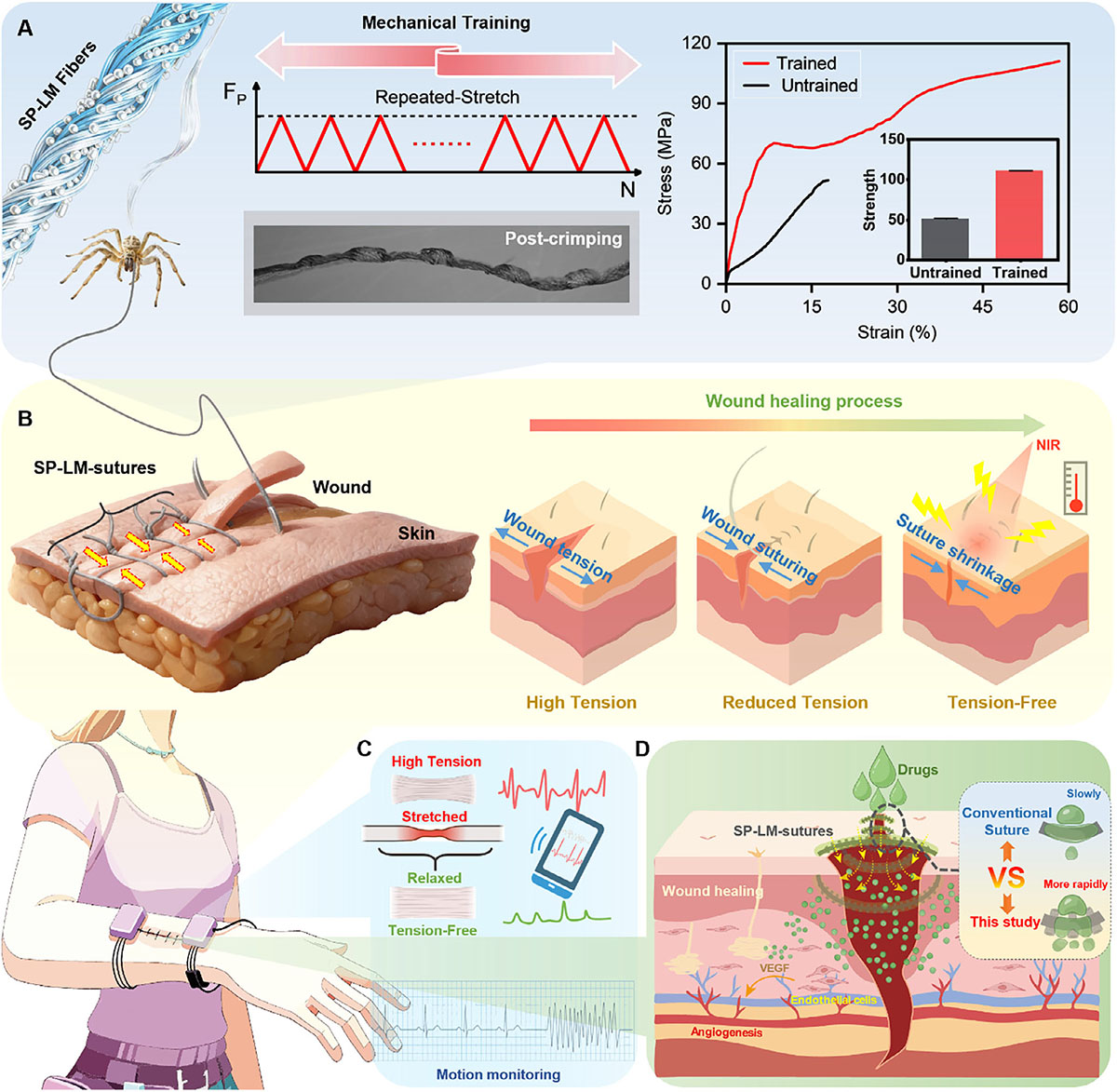 |
| Engineered spider silk living e-sutures enabling multifunctional intelligent wound management. (A) Bionic SP–LM (spidroin–liquid metal) sutures are designed and manufactured by integrating recombinant spidroin with LM, followed by mechanical training (cyclic stretching) and imprint-assisted texturing to endow the fibers with markedly enhanced mechanical robustness (tensile strength >115 MPa). (B) The implanted SP–LM suture enables dynamic wound management (middle): after suturing, the fiber initially releases excessive tissue tension at the wound site; subsequent NIR activation triggers programmable fiber contraction, progressively reducing wound tension and ultimately achieving a near “tension-free” state that accelerates wound healing. (C) The SP–LM suture functions as a strain sensor that converts joint movements into electrical signals for remote and real-time motion monitoring (e.g., smartphone-based readout). (D) The imprinted micro-pillar surface facilitates guided microfluidic drug delivery along the fiber, thereby improving therapeutic efficiency and promoting wound closure compared to conventional sutures. (Image: Reproduced with permission from Wiley-VCH Verlag) (click on image to enlarge) |
| Spider silk gives the suture its structural base. Its protein chains fold into tightly packed crystalline sheets that provide strength, while less ordered regions allow the fiber to stretch and dissipate stress. To strengthen that architecture, the team engineered a recombinant spider silk protein with 24 repeating units, a length that balanced molecular size with how efficiently engineered E. coli could produce it. |
| The harder step was adding metal without wrecking the protein structure. The gallium alloy stays fluid at room temperature but conducts electricity like a metal. In the best-performing formulation, it made up 25 percent of the fiber by weight. At that level, the metal remained dispersed as microscopic droplets inside the protein matrix and left the silk’s crystalline regions largely intact. Higher metal loadings caused aggregation and voids, making the fibers more brittle. |
| The metal does more than conduct. Gallium ions form weak, reversible bonds with chemical groups on the protein. Under strain, these bonds can break before the protein backbone does, absorbing energy that might otherwise open cracks, then reform when the stress relaxes. That gives the fiber a sacrificial bonding network: strong enough to toughen the material, but weak enough to fail safely before the main structure does. |
| A single filament was too thin for surgical use, so the researchers twisted sixteen filaments into a yarn. They then repeatedly stretched and released the yarn, mechanically training it. This aligned the protein chains, packed the internal structure more tightly, and stabilized the metal domains. After training, the dry fiber’s tensile strength exceeded 115 MPa, and its toughness nearly doubled. |
| Once stitched into tissue, the fiber can be activated with near-infrared light. The liquid-metal droplets absorb the light and convert it to heat, warming the fiber and causing it to contract. In the lab, the fiber bent or tightened within about 15 seconds of exposure. In principle, that could let a surgeon tighten the suture after placement, gradually pulling wound edges closer together and reducing the mechanical tension that contributes to thick scar formation. |
| The surface of the thread carries another function. The team pressed the fiber against a mold of microscopic pillars, imprinting ridges and grooves into the surface. Those patterns increase contact area, improving the electrical interface, and create capillary pathways that draw liquid along the thread. In tests, a spiral version of the patterned surface roughly doubled liquid transport compared with a smooth fiber, enough to guide a therapeutic payload toward the wound interface rather than letting it diffuse broadly into surrounding tissue. |
| The same patterned surface improves sensing. As the thread rubs against skin or stretches, it generates a small triboelectric voltage without a battery. Its electrical resistance also changes as it bends. In motion tests, fibers placed across a finger, wrist, or elbow produced distinct signals for different joint movements. Smooth fibers generated weaker signals; imprinted fibers produced more than twice the voltage of native fibers because their ridged surfaces created more contact for charge transfer. |
| Silk fibers without the liquid metal produced no detectable signal under the same deformation conditions, pointing to the metal network as the source of the electrical response. |
| Many earlier bioelectronic sutures have relied on electronics or conductive additions attached to the thread. Here, the sensing is built into the fiber itself. Silk spun without the liquid metal produced no detectable signal under the same deformation conditions, pointing to the metal network as the source. |
| The bioresorption data are promising but not complete. In an enzyme solution meant to mimic a proteolytic biological environment, the fibers fragmented over seven days as the protein backbone broke down and released embedded metal droplets. They did not fully dissolve within that test period, so the result shows the beginning of degradation rather than the entire fate of the material. |
| The animal results came from a mouse full-thickness skin wound model. The researchers compared untreated wounds, wounds closed with ordinary nylon sutures, and wounds treated with several versions of the spider-silk suture: plain, loaded with VEGF, activated with near-infrared light, and combining both VEGF and light-triggered tightening. |
| The plain spider-silk-liquid-metal suture already performed better than nylon, even without added drug or light activation. The authors attribute part of that effect to weak electric fields generated by movement of the conductive thread, although that connection remains correlational rather than proven. |
| The strongest result came from the combined treatment. With both VEGF delivery and light-triggered tightening, wounds were almost closed by day 10, and scar area fell by 58.3 percent compared with nylon sutures. The healed skin showed a more continuous epidermis and denser, better aligned collagen, closer to uninjured tissue than the thinner, more disordered repair seen in controls. |
| The mice moved normally during the study, and the authors report no obvious irritation or rejection. The implanted fiber also continued to report its mechanical state as healing progressed, with the signal weakening as wound tension eased. In a future system, that kind of signal could potentially warn when a wound is under abnormal strain or when a suture is beginning to fail. |
| The appeal of the design is its independence. Other smart sutures often depend on an external power source, attached electronics, or constant patient movement. This fiber supplies its own sensing signal, responds to light, and uses a form factor close to an ordinary surgical thread. Its ingredients and fabrication methods, including engineered bacterial protein production and wet spinning, are also compatible with scalable manufacturing in principle. |
| The limits are just as important. The evidence so far covers simple skin wounds in mice. Chronic wounds such as diabetic ulcers, infected wounds, high-motion wounds, and internal surgical sites remain untested. The study also does not fully separate how much healing improvement comes from the fiber’s mechanics, its electric field, its drug delivery, its light-triggered contraction, or the interaction among all of them. |
| For now, the work is best read not as a finished clinical suture, but as a materials platform: a single thread that can hold tissue, respond to light, move medicine, sense strain, and gradually break down as tissue repairs itself. |
 By
Michael
Berger
– Michael is author of four books by the Royal Society of Chemistry:
Nano-Society: Pushing the Boundaries of Technology (2009),
Nanotechnology: The Future is Tiny (2016),
Nanoengineering: The Skills and Tools Making Technology Invisible (2019), and
Waste not! How Nanotechnologies Can Increase Efficiencies Throughout Society (2025)
Copyright ©
Nanowerk LLC
By
Michael
Berger
– Michael is author of four books by the Royal Society of Chemistry:
Nano-Society: Pushing the Boundaries of Technology (2009),
Nanotechnology: The Future is Tiny (2016),
Nanoengineering: The Skills and Tools Making Technology Invisible (2019), and
Waste not! How Nanotechnologies Can Increase Efficiencies Throughout Society (2025)
Copyright ©
Nanowerk LLC
|

Become a Spotlight guest author! Join our large and growing group of guest contributors. Have you just published a scientific paper or have other exciting developments to share with the nanotechnology community? Here is how to publish on nanowerk.com. |


