| Jun 17, 2026 |
Metasurfaces turn quantum dot films into light-powered heat enginesMetasurfaces make quantum dot films cooler where they emit more efficiently, turning light-controlled temperature gradients into self-powered electrical signals. |
| (Nanowerk Spotlight) Heat engines convert energy flows into useful work by exploiting an imbalance, most classically a temperature difference between a hot source and a cold sink. In solid-state devices, this principle appears in several forms. Thermoelectric generators turn heat gradients into voltage. Thermophotovoltaic devices use thermal radiation to drive semiconductor cells. Photovoltaic solar cells convert sunlight directly into electrical power. |
| Each of these conversions depends on preserving a useful imbalance instead of letting absorbed energy disperse as undirected heat. Semiconductors make that difficult because absorption, emission, charge transport, and heating can occur within the same thin material layer. The process that creates useful carriers can also weaken the temperature difference or carrier-energy imbalance needed to extract work. |
| A paper in Advanced Functional Materials ("Powering Nanocrystal‐Based Heat Engines With Light‐Emitting Metasurfaces That Influence Their Temperature") approaches this problem through the light emitted after absorption has already occurred. |
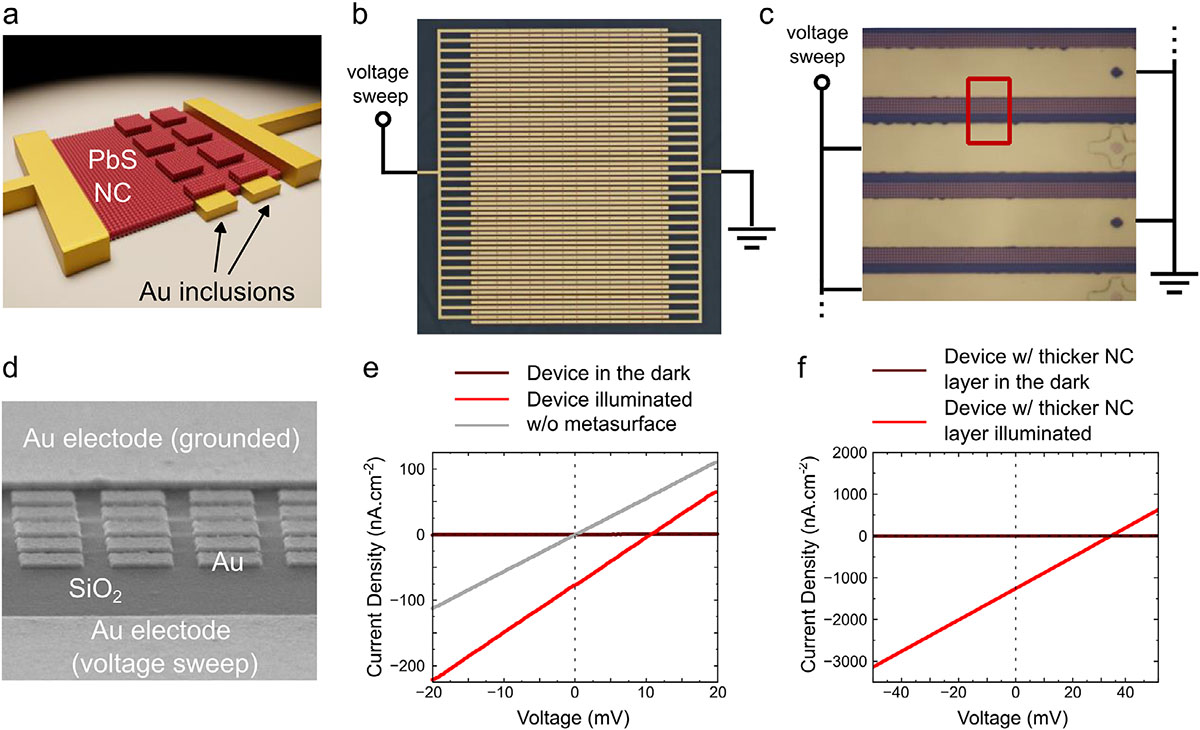 |
| A PbS nanocrystal film covering an asymmetric gold metasurface channel generates electrical power under visible light. The patterned region enhances near-infrared emission, creating a temperature gradient that drives a thermoelectric response. (Image: Reproduced from DOI:10.1002/adfm.76301, CC BY) (click on image to enlarge) |
| The French research team studied colloidal lead sulfide nanocrystals, a form of quantum dot that absorbs visible light and emits near-infrared photons. When placed near patterned gold surfaces, these nanocrystals did not simply become brighter or dimmer. Their carrier temperature changed. |
| That temperature change depends on which optical pathway the pattern modifies. If a gold structure strengthens absorption of the incoming pump light, it can increase heating. If it strengthens emission from the nanocrystals, more absorbed energy can leave as photons rather than heat. The same family of photonic structures can therefore push carrier temperature in opposite directions. |
| After absorbing light, electrons and holes in a semiconductor must release their energy. Some recombine by emitting photons. Others lose energy through non-radiative pathways that warm the material. Dense nanocrystal films suffer from this second route because packing the particles together strongly reduces photoluminescence. Related work on molecular coatings that tune quantum dot emission rates shows how sensitive these emission pathways can be to the local environment. |
| Measuring carrier temperature from emitted light required a careful reference point. In a plain PbS nanocrystal film on glass, stronger continuous illumination shifted the photoluminescence toward shorter wavelengths. The researchers compared the full emission spectrum with the film’s absorption feature using a non-thermal form of Kirchhoff’s law. That comparison turned small spectral shifts into carrier temperatures without relying on a narrow high-energy tail. |
| Patterned gold complicates this optical thermometer because a metasurface can reshape the emitted spectrum even when temperature stays unchanged. It can favor certain wavelengths, polarizations, or emission directions. To avoid confusing optical filtering with heating or cooling, the researchers focused on parts of the emission that the pattern disturbed least. Those spectral regions still carried the temperature information needed for comparison with the glass reference. |
| The most direct heating case came from a gold particle array resonant near the incoming red pump light. The particles concentrated excitation close to the nanocrystals, increasing absorption and Joule heating. Under the same pump power, the film on glass reached 310 K, while the pump-resonant structure reached 318 K. This behavior matches the familiar plasmonic outcome: stronger local excitation produces hotter carriers. |
| A flat gold film showed why metal alone does not provide a simple answer. The film strongly suppressed photoluminescence because excited carriers could transfer energy into non-radiative surface plasmon modes instead of emitting photons. The extracted temperature reached 335 K under the same comparison conditions, although the authors caution that surface effects and small spectral shifts may affect the absolute value. Across pump powers, the metal also spread heat efficiently and damped temperature variations. |
| The reversal came when the gold resonance matched the nanocrystals’ emitted near-infrared light rather than the incoming pump. In a nanorod array tuned to the photoluminescence band, the nanocrystal layer emitted more strongly but retained less heat. Under comparable pumping, the analyzed region reached 305 K, below the 310 K measured on glass. Both values stay above room temperature, so the effect is less heating relative to the glass reference rather than active refrigeration. More efficient emission corresponded to a lower carrier temperature. |
| No external cooling process was required. The patterned optical environment changed how absorbed energy left the nanocrystal film. Time-resolved photoluminescence showed little change in carrier lifetime, so the brighter signal did not mainly arise from faster decay of individual emitters. The evidence instead points to a shift in recombination balance, with more energy leaving as photons and less becoming Joule heat. |
| The researchers then strengthened the emission-resonant effect with square gold inclusions. This pattern enhanced photoluminescence near the nanocrystal emission band more strongly, but it also distorted much of the spectrum, making temperature extraction less direct. The least disturbed spectral region still indicated relative cooling of about 10 K. That difference was large enough to test whether emission-controlled cooling could produce electrical power. |
| To convert local cooling into a current, the researchers patterned only part of the channel between two gold electrodes. Square gold inclusions covered most of the channel, while one section remained unpatterned. A PbS nanocrystal film covered both regions. Under visible white light, nanocrystals across the channel absorbed photons, but the patterned region gained the enhanced near-infrared emission pathway and stayed cooler than its neighbor. |
| This geometry created a temperature gradient inside a uniformly illuminated film. The cooler patterned region and warmer unpatterned region formed a thermoelectric junction along the channel, so charge transport generated voltage from the internal thermal imbalance. Nanowerk’s earlier coverage of a flexible thermoelectric nanogenerator on paper explains the same conversion principle in another materials platform. |
| The best device produced a short-circuit current density of −1236 nA/cm² and an open-circuit voltage of 33 mV under 100 mW/cm² illumination. The current-voltage curves remained linear, which fits thermoelectric operation rather than diode-like photovoltaic operation. The output remains modest, but the experiment shows that a temperature gradient created through emission control can drive a self-powered nanocrystal device. |
| Removing the metasurface erased the self-powered signal. So did shrinking the nanocrystals until their emission no longer overlapped the gold resonance — and restoring that overlap brought the response back. The effect therefore hinges on the resonance acting on the light the nanocrystals emit, not the light they absorb. |
| The devices remain proof-of-concept systems. Thin nanocrystal films limit absorption, carrier mobility constrains output, and the patterned gold structures would need scalable fabrication for large-area use. Better absorbers, higher-mobility films, and stronger photoluminescence enhancement could improve performance. |
| The work reaches past these particular devices. The temperature-reading method could help researchers gauge other light-emitting semiconductors in complex photonic environments, and the principle behind it is broader still: optical design can serve as thermal design. A metasurface does more than filter spectra or brighten emission. By steering absorbed energy between photon emission and heat-producing loss, it sets where carriers warm, where they cool, and whether a semiconductor can turn that imbalance into electrical power. |
 By
Michael
Berger
– Michael is author of four books by the Royal Society of Chemistry:
Nano-Society: Pushing the Boundaries of Technology (2009),
Nanotechnology: The Future is Tiny (2016),
Nanoengineering: The Skills and Tools Making Technology Invisible (2019), and
Waste not! How Nanotechnologies Can Increase Efficiencies Throughout Society (2025)
Copyright ©
Nanowerk LLC
By
Michael
Berger
– Michael is author of four books by the Royal Society of Chemistry:
Nano-Society: Pushing the Boundaries of Technology (2009),
Nanotechnology: The Future is Tiny (2016),
Nanoengineering: The Skills and Tools Making Technology Invisible (2019), and
Waste not! How Nanotechnologies Can Increase Efficiencies Throughout Society (2025)
Copyright ©
Nanowerk LLC
|

Become a Spotlight guest author! Join our large and growing group of guest contributors. Have you just published a scientific paper or have other exciting developments to share with the nanotechnology community? Here is how to publish on nanowerk.com. |


