| Jun 29, 2026 |
Nanofluidic clay membranes tackle the ion transport bottleneck in blue energyModified clay membranes improve ion flow and charge selectivity, advancing osmotic power harvesting from seawater and river water. |
| (Nanowerk Spotlight) When seawater meets river water, dissolved salt ions spread from the saltier side into the fresher side because there is an imbalance in concentration. That imbalance acts like stored pressure. As ions move toward a more even distribution, the pressure drops. A membrane can turn part of that drop into electricity by letting positive and negative charges move at different rates. |
| The hard part is building a membrane that controls ion movement without choking it. Slow ion transport gives weak current. Poor charge selectivity gives weak voltage. Unstable channels fail as water keeps flowing. Many osmotic power membranes improve one of these traits at the expense of another, which leaves the device with impressive laboratory numbers but limited usable output. |
| A paper in Advanced Energy Materials ("High‐Flux 2D Clay Nanofluidics for Substantial Osmotic Energy Harvesting") reports a clay membrane designed to move ions quickly without giving up the charge selectivity needed to produce voltage. |
| The membrane uses modified montmorillonite nanosheets, a naturally layered clay, to create short ion pathways through a stacked two-dimensional structure. Using natural seawater and river water, it reached 20.8 W m⁻² and maintained stable output for more than 18 days. |
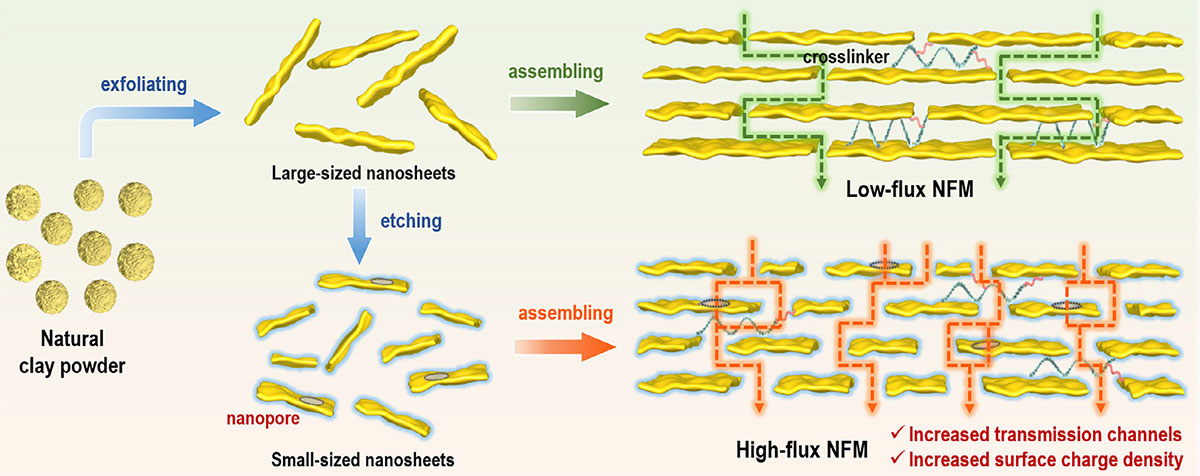 |
| Design of high-flux nanofluidic membrane (HF-NFM) and the comparisons with pristine low-flux nanofluidic membrane (LF-NFM). (a) Schematic construction strategy of HF-NFM and LF-NFM. (Image: Reproduced with permission from Wiley-VCH Verlag) (click on image to enlarge) |
| The work builds on reverse electrodialysis, which harvests electricity from salinity gradients using ion-selective membranes. Nanofluidic membranes, which contain channels only nanometers wide, can improve this process because charged channel walls influence ion motion, a problem Nanowerk previously covered in its Spotlight on nanofluidic osmotic energy generators. |
| Montmorillonite offers a useful starting point because it is abundant, inexpensive, naturally layered, and negatively charged. Those features make it attractive for cation-selective membranes, which favor positively charged ions. The weakness is geometry. When large clay sheets stack into a membrane, ions can face long, winding routes between layers before crossing the material. That supports selectivity but limits flux, the rate at which ions move through. |
| The study changed the geometry by treating the clay nanosheets with acid. This made the sheets smaller and introduced nanoscale defects. In the stacked membrane, those changes created more vertical routes across the material, reducing the need for ions to travel sideways through extended interlayer paths. The same treatment exposed more negatively charged sites, so faster transport did not simply come at the cost of weaker cation selectivity. |
| That coupling between structure and charge is the core of the design. More direct pathways lower resistance and raise current. Additional negative surface charge helps maintain the ion imbalance that produces voltage. Instead of treating permeability and selectivity as separate membrane properties, the researchers modified the clay so both came from the same structural change. |
| The faster channel network also had to remain usable in water. Smaller, defect-rich clay sheets could have made the membrane weaker or more prone to swelling. The researchers countered that risk by adding polyvinyl alcohol and glutaraldehyde, which formed a crosslinked network through the layered stack. The network held the inorganic sheets together while leaving the new ion pathways open. |
| The controlled salt-gradient tests showed how much the modified structure changed performance. With 0.5 m NaCl on one side and 0.01 m NaCl on the other, the high-flux membrane reached 17.5 W m⁻². That was about twice the output of the low-flux clay control. The improvement came from lower transport resistance while preserving useful charge selectivity. |
| The more realistic test used natural water. Seawater contains sodium, magnesium, calcium, potassium, and other ions that can complicate selective transport. Paired with Liangshui River water, the membrane still produced strong output across several seawater samples. The highest power density came from East China Sea water, where the membrane reached 20.8 W m⁻². |
| Peak power alone says little about durability, so the authors also tested sustained operation. A static salt gradient fades as ions move, which reduces the driving force for current. The researchers used a circulating setup that refreshed seawater and river water on opposite sides of the membrane. Under those conditions, current stayed stable for 439 h, and the membrane retained its structure after testing. |
| The paper also addresses a scaling problem that often weakens nanofluidic osmotic power devices. Small membrane openings can produce high power density while delivering little total current. Making the opening larger should increase output, but larger active areas can disturb the local salt gradient near the membrane. Ions accumulate or deplete near the surface, and the current-driving imbalance weakens. |
| Instead of enlarging one opening, the researchers used a concentration cell with parallel membrane perforations. This layout spread ion transport across multiple active sites. As the permeation area increased from 0.8 mm² to 4.8 mm², power density stayed approximately constant while total current rose with area. The result does not prove commercial-scale osmotic power, but it shows that the cell geometry can preserve membrane performance during integration. |
| The final demonstration connected the membrane cells to an energy-storage module. A 30-unit concentration-cell pack produced 3.9 V and charged a 220 mF capacitor to 3.5 V. The stored energy powered small electronic demonstrations, including a calculator, an alarm clock, electrochromic displays, and a fan motor. These tests show integration at the laboratory scale, not near-term grid readiness. |
| Other membrane strategies pursue the same goal by reducing resistance inside nanoscale ion channels. Nanowerk recently reported on slippery ions and blue energy, where lipid-coated nanopores reduced ion friction during osmotic energy conversion. The clay membrane takes a different route: shorter pathways for faster transport, stronger surface charge for selectivity, and crosslinking for durability. |
| Real estuaries will impose harsher conditions than the tests in this paper. Organic matter, suspended particles, microbes, and changing water chemistry can foul membranes or alter charge transport. Net power will also depend on pumping losses, pretreatment, stack design, maintenance, and long-term membrane lifetime. The useful lesson is that osmotic energy devices need membrane chemistry and cell geometry designed together, so gains in ion transport survive the move from material testing to device operation. |
 By
Michael
Berger
– Michael is author of four books by the Royal Society of Chemistry:
Nano-Society: Pushing the Boundaries of Technology (2009),
Nanotechnology: The Future is Tiny (2016),
Nanoengineering: The Skills and Tools Making Technology Invisible (2019), and
Waste not! How Nanotechnologies Can Increase Efficiencies Throughout Society (2025)
Copyright ©
Nanowerk LLC
By
Michael
Berger
– Michael is author of four books by the Royal Society of Chemistry:
Nano-Society: Pushing the Boundaries of Technology (2009),
Nanotechnology: The Future is Tiny (2016),
Nanoengineering: The Skills and Tools Making Technology Invisible (2019), and
Waste not! How Nanotechnologies Can Increase Efficiencies Throughout Society (2025)
Copyright ©
Nanowerk LLC
|

ORCID information
|

Become a Spotlight guest author! Join our large and growing group of guest contributors. Have you just published a scientific paper or have other exciting developments to share with the nanotechnology community? Here is how to publish on nanowerk.com. |


