| Jun 15, 2026 |
Nanozyme liners reduce inflammatory wear debris from joint implantsNanozyme-modified polyethylene liners reduced wear debris and made remaining particles less inflammatory, lowering oxidative stress and bone loss in implant models. |
| (Nanowerk Spotlight) A joint implant does not fail only because its parts wear down. It can fail because the body reacts to the microscopic debris that wear produces. Movement across the bearing surface releases polymer particles into the surrounding tissue. Immune cells can treat those particles as persistent irritants, driving inflammation that activates bone-resorbing cells near the implant. Over time, the bone that anchors the device erodes. |
| This makes liner design a materials problem with biological consequences. A stronger liner can shed fewer particles, but no bearing surface can avoid wear under years of load. Once debris forms, the challenge shifts from mechanics to biology. The most durable material is not necessarily the safest one if the particles it releases still inflame the surrounding tissue. |
| A new study in Nature Communications ("Nanozyme-engineered liners for proactive prevention of wear particle-induced osteolysis"), led by Professor Hui Wei from Nanjing University, reports a polyethylene liner designed to reduce wear and make the remaining debris less inflammatory. The work focuses on wear particle-induced osteolysis, a major cause of aseptic loosening after joint replacement. Its central idea is direct: a liner should reduce particle formation, but it should also limit the damage caused by particles that still form. |
| The researchers used ultra-high molecular weight polyethylene, a tough polymer widely used in artificial joint bearings, as the base material. They modified it by growing cerium oxide nanoparticles inside the polymer during processing. The resulting ceria nanozyme-polyethylene composite, called CZPE, could also be molded and machined into implant-like liner shapes. |
| The key addition is cerium oxide, a nanozyme that can repeatedly neutralize reactive oxygen species. Nanowerk recently covered related work on nanozymes for bone regeneration, where enzyme-like nanomaterials were used to influence cell metabolism rather than serve as passive additives. |
| That chemistry only matters if the modified polymer can still do the mechanical job of a liner. The optimized material, called CZPE-5, preserved the basic properties required for ultra-high molecular weight polyethylene while improving durability. It showed higher tensile strength and better impact resistance than unmodified polyethylene. In wear testing, it reduced wear loss by about 32 %. The tests also showed less debris formation over repeated wear cycles. |
| The more important result emerged after the particles formed. Ordinary polyethylene debris does not simply sit in tissue. Macrophages, the immune cells that engulf foreign material, encounter those particles and can enter a state of chronic activation. The process raises levels of reactive oxygen species and inflammatory cytokines, which then push the local environment toward bone resorption. CZPE particles changed that response. They still provoked immune activity, but with lower inflammatory intensity. |
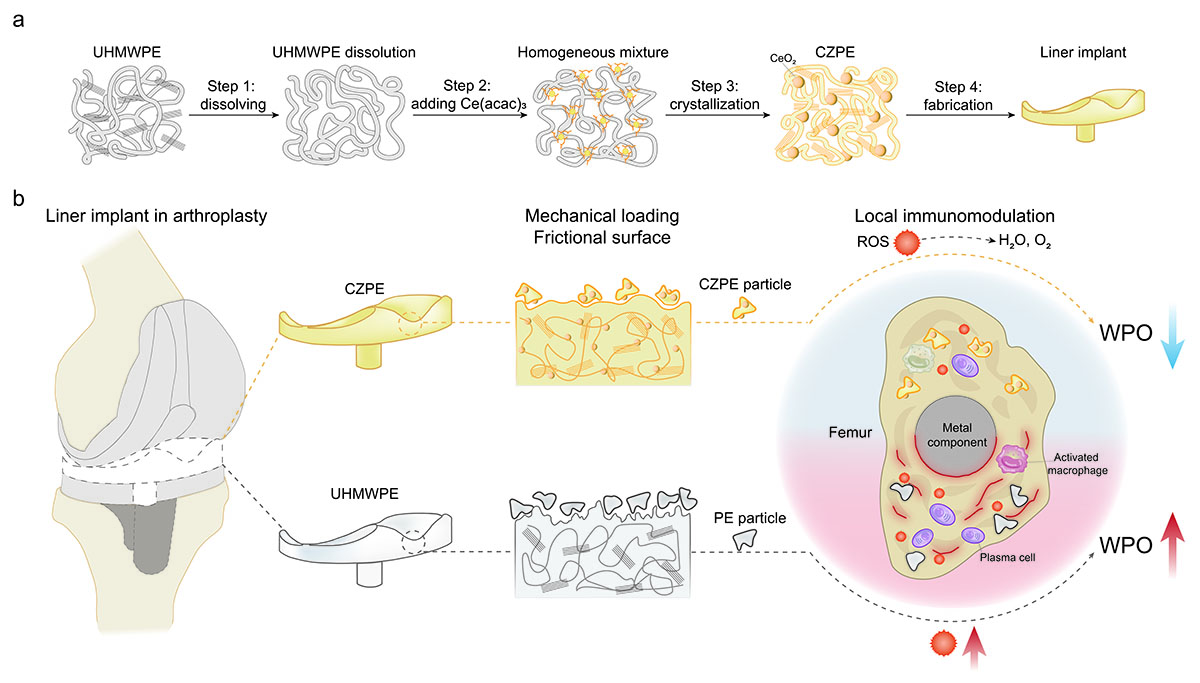 |
| Illustration of the “proactive preventive” strategy employing CZPE as a model system. (Image: Reproduced from DOI:10.1038/s41467-026-74063-3, CC BY) (click on image to enlarge) |
| In cell experiments, macrophages exposed to CZPE particles produced less oxidative stress than macrophages exposed to polyethylene particles. They also showed lower expression of inflammatory signals including IL-6, IL-1β, and TNF-α. The distinction is important. The material did not make wear debris biologically invisible. Instead, it reduced the inflammatory program that links debris exposure to tissue damage. |
| That reduced macrophage response also changed the behavior of bone-resorbing cells. When the researchers used particle-stimulated macrophage media to drive osteoclast formation, polyethylene particles produced a strong osteoclast response. Osteoclasts are the cells that break down bone. CZPE particles still increased osteoclast formation relative to unstimulated controls, but far less than polyethylene particles did. The debris retained a biological footprint, but it no longer pushed the system as strongly toward bone loss. |
| Mouse experiments showed that the reduced inflammatory response translated into less bone loss in living tissue. In a mouse skull model of particle-induced osteolysis, CZPE particles caused less bone loss than polyethylene particles. Bone volume and mineral density were better preserved, osteoclast activity declined, and inflammatory staining fell. These results did not show complete protection. They showed that CZPE reduced the severity of particle-driven bone loss. |
| To test the material in a more implant-like environment, the researchers placed titanium alloy nails in mouse femurs and exposed the surrounding bone to the different particles. After 7 weeks of particle exposure, the polyethylene group lost trabecular bone around the implant. Osteoclast activity increased, and inflammatory signals rose in the marrow cavity. The CZPE group preserved more bone structure and showed a reduced foreign body reaction. |
| Implant loosening involves more than macrophage activation. Fibroblasts, osteoclasts, bone-forming cells, and other immune cells reshape the marrow environment around the implant. CZPE reduced several parts of that response, including oxidative stress, inflammatory signaling, osteoclast-driven erosion, and fibrous capsule formation. The result was not a silent immune response. It was a less destructive one. |
| The marrow response also involved plasma cells, the antibody-producing immune cells that can influence bone inflammation. Ordinary polyethylene particles increased their infiltration in the marrow cavity, while CZPE particles reduced it. This result suggested that the material altered a wider immune pathway rather than only suppressing macrophage activation. It also connected wear debris to a marrow immune pathway beyond the macrophage-centered mechanism usually emphasized in wear particle-induced osteolysis. |
| The researchers tested the relevance of that pathway by changing plasma cell levels directly. When they increased plasma cell infiltration using U266B1 cells, bone resorption worsened. When they reduced plasma cells with bortezomib, bone loss improved, with the strongest benefit in the polyethylene group. The drug experiment served as a mechanistic test, not as a proposed implant therapy. Plasma cells were not the sole driver of osteolysis, but they contributed to the bone damage triggered by wear particles. |
| In this design, proactive prevention means treating wear debris as part of the implant’s function. CZPE reduces particle generation, but it also changes the inflammatory behavior of the debris that still forms. The result is a material whose wear products provoke less oxidative stress, less inflammatory signaling, less plasma cell infiltration, and less osteoclast-mediated bone resorption. |
| The work remains preclinical. Mouse models cannot reproduce the full mechanical history of a human hip or knee replacement, and 7 weeks in an animal study cannot substitute for years of cyclic loading in a patient. The study also used male mice, leaving sex-specific immune and bone responses unresolved. Clinical translation would require larger-animal studies, long-term wear simulations, and safety data under realistic implant conditions. |
| The study points to a stricter standard for joint implant materials. Reducing wear is not enough if the remaining debris still drives inflammation and bone loss. CZPE is not a clinical solution yet, but it tests a different design rule: future implant liners may need to be judged not only by how slowly they wear, but by how much harm their unavoidable wear products cause once they enter living tissue. |
 By
Michael
Berger
– Michael is author of four books by the Royal Society of Chemistry:
Nano-Society: Pushing the Boundaries of Technology (2009),
Nanotechnology: The Future is Tiny (2016),
Nanoengineering: The Skills and Tools Making Technology Invisible (2019), and
Waste not! How Nanotechnologies Can Increase Efficiencies Throughout Society (2025)
Copyright ©
Nanowerk LLC
By
Michael
Berger
– Michael is author of four books by the Royal Society of Chemistry:
Nano-Society: Pushing the Boundaries of Technology (2009),
Nanotechnology: The Future is Tiny (2016),
Nanoengineering: The Skills and Tools Making Technology Invisible (2019), and
Waste not! How Nanotechnologies Can Increase Efficiencies Throughout Society (2025)
Copyright ©
Nanowerk LLC
|

Become a Spotlight guest author! Join our large and growing group of guest contributors. Have you just published a scientific paper or have other exciting developments to share with the nanotechnology community? Here is how to publish on nanowerk.com. |


